
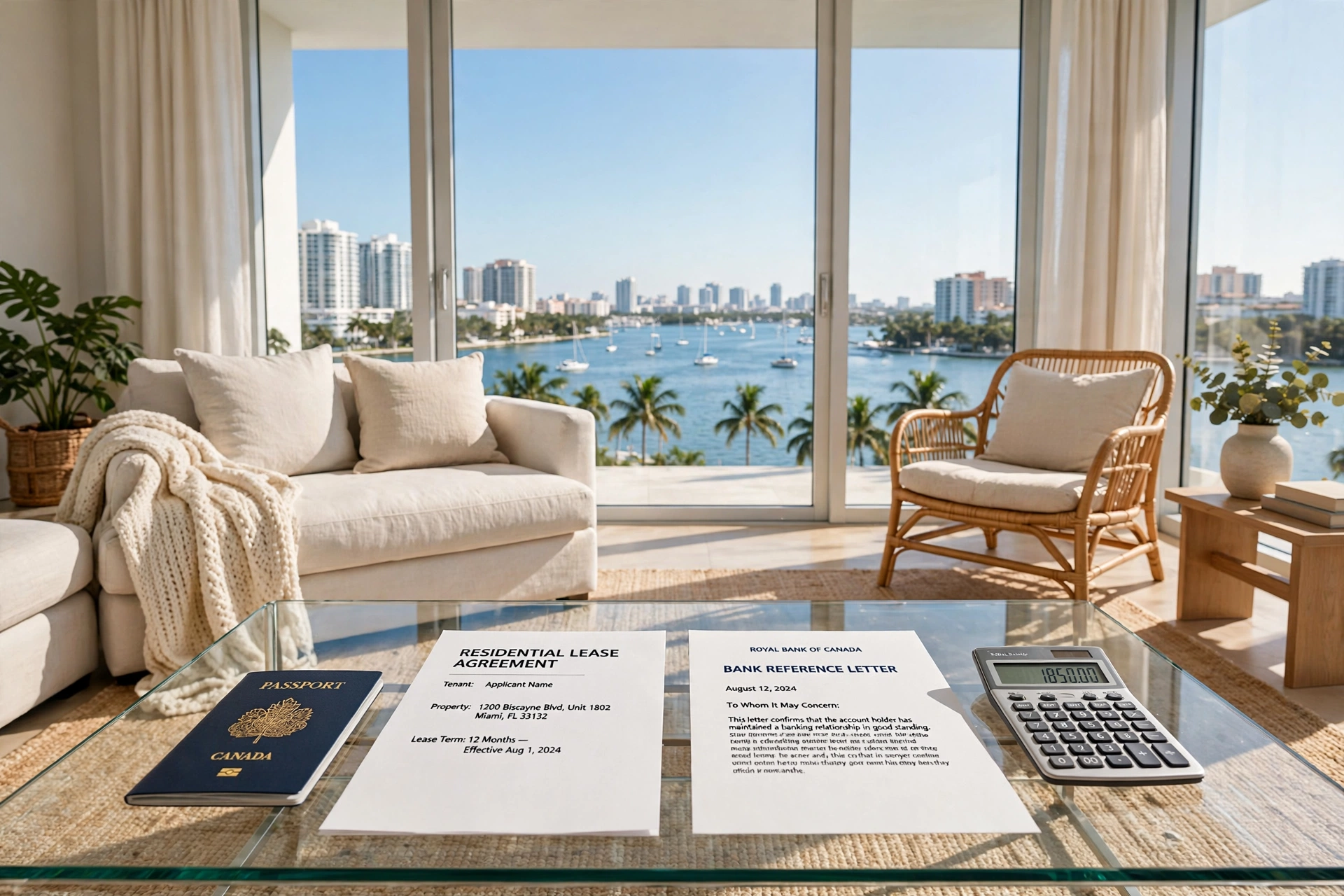
Short answer: if you are moving to Miami from Canada, you can rent a furnished condo without ever boarding a plane first — but you will be approved twice, by the landlord and then by the condo association, and you may pay two different security deposits. On a furnished condo advertised at US$3,000 a month, plan on US$6,540 to get the keys — first month with the 13% transient tax (US$3,390), a one-month landlord deposit (US$3,000) and the association approval fee capped at US$150 — and on US$9,540 (about C$13,407.52 at the October 20, 2026 rate of 1.4054) if the association also takes its own deposit of up to one month. You do not need a Social Security number or U.S. credit: you need the Canadian paperwork package below, sent complete, in English, from abroad. The literal question — renting a furnished condo in Miami from Canada: deposits and paperwork from abroad — is really a question about that package.
Updated: October 22, 2026.
¿Prefieres leer en español? Lee esta guía en español
Moving to Miami from Canada: the two approvals nobody warns you about
A Canadian who rents a house deals with one landlord. A Canadian who rents a Miami condo deals with two gatekeepers, in sequence.
Gate 1 — the landlord. The owner (or their manager) checks that you are who you say you are and that you can pay. There is no Florida law requiring a Social Security number to rent in the private market, and no U.S. credit file exists for most Canadians — so this gate runs on documents, not on a bureau score.
Gate 2 — the condo association. Most Miami condo buildings must also approve the tenant before move-in, under the building’s own governing documents. This is a second application, a second background check and a second fee — and it usually cannot start until the lease with the landlord is already signed. It is the bottleneck of every remote rental, and the reason a complete packet matters more than a fast one.
While you compare buildings, remember that the neighbourhood decides the building stock you will be applying to — the corridors where Canadians actually cluster are mapped in our guide to the best neighborhoods in Miami for a winter stay.

Cost of living in Miami from Canada: the deposits, line by line
Florida collects move-in money in a lump, in U.S. dollars, before you sleep one night. Here is the full stack on the US$3,000 furnished example:
| Move-in item | USD | CAD at 1.4054 | The rule behind it |
|---|---|---|---|
| First month, with 13% transient tax | US$3,390 | C$4,764.31 | Leases of 6 months or less are taxed like a hotel stay (Florida Statute 212.03); only a bona fide written lease for continuous residence longer than 6 months is exempt |
| Landlord security deposit | US$3,000 | C$4,216.20 | One month is typical for seasonal furnished rentals; section 83.49 sets no state cap on the amount |
| Association approval fee | US$150 | C$210.81 | Capped at US$150 per applicant under section 718.112, as adjusted by the DBPR; spouses and dependent children count as one applicant |
| Total to get the keys — without an association deposit | US$6,540 | C$9,191.32 | |
| Association security deposit, if the building requires one | +US$3,000 | +C$4,216.20 | The association may hold its own deposit to protect the common areas, capped at one month of rent (section 718.112) |
| Total to get the keys — with an association deposit | US$9,540 | C$13,407.52 |
Over a four-month season, rent with tax alone is US$13,560 — C$19,057.22. I rebuilt the same US$3,000 rent in Canadian dollars, line by line, in what a US$3,000 Miami rent really costs a Canadian per month; this page is about the paperwork and the deposits that get you approved to pay it. And because both deposits come back only if the paper trail is clean, read how security deposits work in Miami before you wire anything: the landlord must tell you in writing, within 30 days, where your deposit is held, return it within 15 days after the tenancy ends if there is no claim, or send a certified notice of claim within 30 days — and you then have 15 days to object.
The paperwork package that replaces a Social Security number
U.S. screening companies cannot pull a Canadian credit file, and Florida landlords know it. What gets a Canadian approved from abroad is a substitute package, sent once, complete:
1. Passport. Your primary identity document for both applications — the name on every other document must match it exactly.
2. Your own Canadian credit report. Download it yourself from Equifax Canada or TransUnion Canada and include it. A U.S. bureau report on a Canadian with no U.S. file comes back empty, which reads as risk; your Canadian file, with years of clean history, reads as proof.
3. A bank reference letter. One page from your Canadian bank, in English: how long you have banked there, that the accounts are in good standing, and the balance range. This single letter does more for a foreign applicant than any other document.
4. Three months of bank statements. They verify the letter, show the season’s money is real, and match the wire that will arrive later.
5. Proof of income. An employment letter, pension statements or investment income — whatever pays the rent. Retired snowbirds are normal in this market; pension income counts.
6. A previous landlord reference. A name, a phone number and one line confirming you left a prior rental in good standing.
7. Certified translations, if anything is in French. Quebec documents are common in South Florida, and buildings accept them — translated into English by a certified translator. Translated, never altered: see the warning below.
What most people don’t know
Since October 1, 2026, faking a rental document in Florida is a felony. A new law (HB 1293, creating section 817.537) makes it a third-degree felony — up to five years in prison and a US$5,000 fine — to take possession of a rental using a false identity statement, a forged document (the statute names bank statements and pay stubs) or impersonation, and the landlord can end that lease on seven days’ notice with no chance to cure. It passed both chambers unanimously. For honest Canadians the lesson is the opposite of fear: never let anyone “fix,” reformat or retype your Canadian documents to look more American. A genuine French bank statement with a certified translation is a strong document. An edited one is now a crime scene.
Your move-in wire will be reported — and that is normal. The US$9,540 move-in total is about C$13,407.52, which crosses Canada’s C$10,000 threshold: your bank must report an international electronic transfer of C$10,000 or more to FINTRAC, automatically, including transfers split across a 24-hour window. You file nothing yourself. Do not split the wire into smaller pieces to stay under the threshold — that is structuring, and it converts a routine report into a real problem. Send it whole, keep the wire confirmation, and keep the first page of the signed lease with it: together they answer the “purpose and source of funds” question before anyone asks.
Being Canadian is not a lawful reason to reject you. The federal Fair Housing Act prohibits discrimination based on national origin, and HUD guidance is clear that landlords may verify identity and ability to pay only with criteria applied consistently to every applicant. A building can ask you for more proof of funds because you have no U.S. credit file. It cannot hold you to a different standard because of where that file was built. If a rejection names your nationality rather than your numbers, that is a HUD complaint, not a dead end. The full seasonal picture — days, taxes and insurance — is in the Canadian snowbird guide to a Miami winter.
The remote timeline that actually works
45 to 60 days before arrival: assemble the package above — passport scan, Canadian credit report, bank letter, statements, income proof, landlord reference, translations. One PDF, in that order, named with your passport name.
30 or more days before arrival: submit the landlord application and, the moment the lease is signed, the association application. The association clock is the one that decides your move-in date; a lease that starts before the association approves you is a hotel bill waiting to happen.
Before any wire: verify the wiring instructions by calling a phone number you already trust — never only the number in the email that sent the instructions. Changed wire instructions are the most expensive rental scam aimed at foreign tenants.
Arrival day: walk the furnished unit with dated photos against the furniture inventory and sign it. That inventory, not your memory, is what releases both deposits in the spring.
Frequently asked questions
Can a Canadian rent a condo in Miami without a Social Security number?
Yes. Nothing in Florida law requires an SSN to rent in the private market. Landlords verify identity with your passport and ability to pay with a substitute package — your own Canadian credit report, a bank reference letter, bank statements and proof of income. What a landlord may not do is reject you because of your national origin; the Fair Housing Act prohibits that.
How many security deposits does a Canadian pay for a Miami condo?
Potentially two. The landlord’s deposit — typically one month of rent, with no state cap under section 83.49 — and, if the building’s documents allow it, the condo association’s own deposit to protect the common areas, capped at one month of rent under section 718.112. On a US$3,000 rental that is US$3,000 plus US$3,000, on top of the first month and the US$150 association approval fee.
How do I pay the deposits from Canada?
By international wire, in U.S. dollars, after verifying the instructions by phone. Expect your bank to report a transfer of C$10,000 or more to FINTRAC automatically — that is routine and requires nothing from you — and never split the amount into smaller transfers to avoid the threshold. Keep the wire confirmation together with your signed lease.
How early should I start the paperwork from Canada?
Start 45 to 60 days before your arrival date, and have both applications in at least 30 days out. The association approval is the slow gate: it usually starts only after the lease is signed, and your move-in cannot happen before it clears.
Yara Coker — SETTLE, relocation services in Miami.
Want help with your move to Miami?
Send me the building you are looking at and your arrival date. I will tell you whether that building runs a second approval, whether it takes an association deposit on top of the landlord’s, and exactly which Canadian documents to put in the packet — before you wire a dollar. More winter playbooks live in our Miami relocation guides hub.
Sources
Florida Statutes, section 83.49: security deposit custody, written notice of where the deposit is held within 30 days, return within 15 days after the tenancy ends if no claim is made, certified notice of intent to impose a claim within 30 days, tenant’s 15 days to object — and no state cap on the deposit amount. Florida Statutes, section 718.112(2): condominium association transfer and approval fee capped at US$150 per applicant (spouses and dependent children count as one applicant), as adjusted by the Department of Business and Professional Regulation, and an association security deposit of up to one month’s rent to protect the common elements, as summarized by Florida Realtors. Florida Statutes, section 212.03: 6% transient rentals tax on leases of six months or less, with an exemption only for a bona fide written agreement for continuous residence longer than six months; Miami-Dade stack of 13% in most of the county (state 6% + discretionary surtax 1% + county tourist taxes 6%), per the Florida Department of Revenue form DR-15TDT and county tourist tax structure. Fraudulent entry of a residential dwelling unit, section 817.537, created by CS/HB 1293 (Chapter 2026-143, Laws of Florida), effective October 1, 2026: third-degree felony for taking possession of a rental through a materially false identity statement, forged or fictitious documents (including bank statements and pay stubs) or impersonation; lease termination on seven days’ notice without cure under amended section 83.56; vote House 110-0, Senate 34-0 (Florida Senate bill summary, 2026). Private-market renting without regard to immigration status, with federal restrictions applying only to federally subsidized housing (42 U.S.C. 1436a): LegalClarity guidance checked October 22, 2026. Fair Housing Act prohibition of national-origin discrimination and HUD guidance that identity and ability-to-pay screening must be applied consistently to all applicants: HUD Office of Fair Housing and Equal Opportunity. Screening of international tenants without an SSN using credit references, bank statements, landlord references and passport or visa: Avail (Avail landlord education, screening international tenants). Electronic funds transfer reporting: Canadian financial institutions must report international electronic funds transfers of C$10,000 or more (including multiple transfers within a 24-hour window) to FINTRAC under the Proceeds of Crime (Money Laundering) and Terrorist Financing Act; the individual files nothing (FINTRAC guidance on reporting electronic funds transfers; Canada Revenue Agency, Electronic Funds Transfer Reporting). Exchange rate: Bank of Canada reference and market reporting for October 20, 2026, USD/CAD 1.4054 (Reuters, October 21, 2026: loonie at 1.4050, strongest intraday level since September 22 at 1.4030 on October 20; next Bank of Canada decision October 28, 2026). All CAD conversions and the move-in cash model are SETTLE computations from the verified figures above, October 22, 2026.
Versión en español: Vivir en Miami: rentar un condo amoblado en Miami desde Canadá — depósitos y papeleo desde el exterior
