
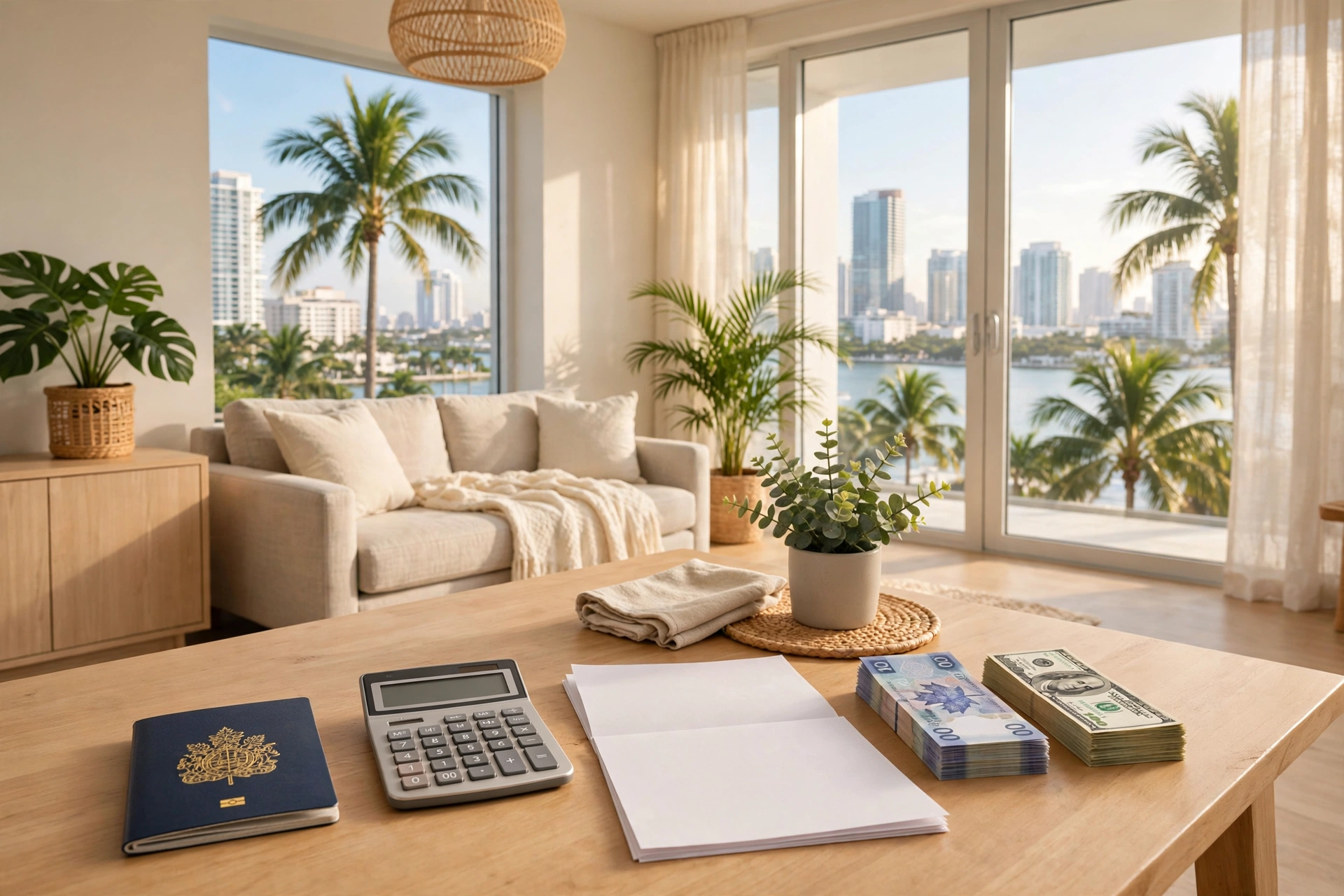
Short answer: if you are moving to Miami from Canada, a rental advertised at US$3,000 a month does not cost C$3,000, and it does not cost the C$4,229.10 your banking app shows either. At the Bank of Canada reference rate for October 19, 2026 — US$1 = C$1.4097 — US$3,000 converts to C$4,229.10. But a snowbird lease of six months or less in most of Miami-Dade carries 13% in transient taxes on top of the rent, which lifts the rent to US$3,390, or C$4,778.88. Pay it the way most Canadians pay — by converting at a bank or on a standard Canadian credit card, which typically adds 2.5% — and the real monthly cost is C$4,898.36. Over a four-month season that is C$19,593.42 in rent alone, and getting the keys takes about US$6,540 (C$9,219.44) in cash up front. The literal question — Canadians renting in Miami in CAD terms: what US$3,000 really costs you per month — has one honest answer: budget C$4,900 a month, not the number in the listing.
Updated: October 20, 2026.
¿Prefieres leer en español? Lee esta guía en español
Moving to Miami: the US$3,000 rent, rebuilt line by line in Canadian dollars
Every Canadian I relocate does the same first calculation: they multiply the rent by the rate on their phone and stop there. That number is the mid-market rate — the price banks charge each other, published once a day by the Bank of Canada. You never actually get it. And in Florida, rent is not the whole rent: a lease of six months or less is a transient rental under Florida law, taxed like a hotel stay, unless you sign a bona fide written agreement for continuous residence longer than six months (Florida Statute 212.03). Here is the full stack on a US$3,000 listing, at the October 19, 2026 reference rate:
| Line | In USD | In CAD at 1.4097 | In CAD if you convert at +2.5% |
|---|---|---|---|
| Advertised monthly rent | US$3,000 | C$4,229.10 | C$4,334.83 |
| Transient taxes, 13% (state 6% + Miami-Dade surtax 1% + county tourist taxes 6%) | +US$390 | +C$549.78 | +C$563.53 |
| Real monthly rent | US$3,390 | C$4,778.88 | C$4,898.36 |
| Four-month season, rent only | US$13,560 | C$19,115.53 | C$19,593.42 |
Two of those lines surprise almost everyone. The first is the tax: the 13% is made of Florida’s 6% transient rental tax, Miami-Dade’s 1% discretionary surtax, and the county’s 6% in tourist taxes (3% Convention Development, 2% Tourist Development, 1% Professional Sports). In Miami Beach the stack runs to roughly 14% with the city resort tax. The second surprise is the conversion line: the Financial Consumer Agency of Canada documents that most Canadian cards add a 2.5% foreign-currency conversion charge on top of the exchange rate, and Canadian banks build a similar margin into their retail rates. On this rent, that quiet 2.5% is C$105.73 a month on the base rent alone — C$422.91 across a four-month season — paid for nothing but the act of converting.
Cost of living in Miami in CAD: what the first cheque actually looks like
The monthly figure is only half the planning problem. The other half is move-in cash, because Florida collects it in a lump, in US dollars, before you sleep one night:
| Move-in item | USD | CAD at 1.4097 |
|---|---|---|
| First month, with 13% transient tax | US$3,390 | C$4,778.88 |
| Landlord security deposit (one month is typical; Florida law, section 83.49, sets no state cap on the amount) | US$3,000 | C$4,229.10 |
| Condo association approval fee (capped at US$150 per applicant by section 718.112 as adjusted by the DBPR; spouses and dependent children count as one applicant) | US$150 | C$211.45 |
| Total to get the keys | US$6,540 | C$9,219.44 |
| If the landlord also collects last month up front | US$9,540 | C$13,448.54 |
One more deposit hides in condo buildings: the association itself may require its own security deposit of up to one month’s rent, held in escrow, on top of the landlord’s. That is why how security deposits work in Miami matters more to a Canadian than to a local — at 1.4097, every extra US$1,000 of deposit is C$1,409.70 of cash parked, interest-free, for the season. None of this is a reason not to come. It is a reason to arrive with the season’s cash already converted and sitting in a US-dollar account, instead of discovering the stack from a leasing office. My full seasonal framework is in the Canadian snowbird guide to a Miami winter.
What most people don’t know
Your rent moves C$30 a month for every cent the loonie moves. On US$3,000 of rent, a one-cent change in USD/CAD is C$30 a month, C$120 a season — C$135.60 a season once tax is included. A ten-cent swing, well inside the loonie’s normal range, is C$339 a month on the taxed rent. That sensitivity is why converting the whole season on one morning is a gamble, and why the Bank of Canada’s next rate decision, on October 28, 2026, matters to snowbirds who have not converted yet: the Bank has held its policy rate at 2.25% since October 2025, Canada’s September inflation came in at 3.1%, and the loonie just touched its strongest level since September 23 (1.4095 on October 19, per Reuters) partly on bets the Bank could raise. Convert in tranches — rent money first, spending money later — and a rate move becomes a small win or a small loss, never a season-changing one.
Signing past six months deletes the tax line entirely. The 13% exists because the lease is six months or less. A bona fide written lease for continuous residence longer than six months is exempt under 212.03 — on a US$3,000 unit that is US$390 a month, US$2,340 over six months, that simply disappears. It does not make a longer lease cheaper in total (six untaxed months at US$3,000 are US$18,000 against US$13,560 for four taxed months), but if your winter was already drifting toward five or six months, the per-month math flips in favour of signing the longer term and it is worth pricing both ways before you sign. Where you sign matters just as much: the buildings that actually take seasonal Canadian leases are concentrated in a few corridors — see the condo buildings Canadians rent in Sunny Isles and Aventura, with winter costs.
Never let anyone convert for you. If a landlord’s payment portal or a card terminal offers to charge you “in Canadian dollars,” that convenience is dynamic currency conversion, and the rate is set by the processor, not the market — routinely worse than your bank’s 2.5%. Always choose US dollars at the terminal, pay rent from a US-dollar account you funded in Canada, and keep a no-foreign-transaction-fee card for daily spending. In my earlier breakdown of what the CAD-to-USD rate does to a full Canadian winter, the conversion channel was worth more than most rent negotiations. On this season’s numbers it still is: the gap between the reference rate and a 2.5% conversion across four taxed months is C$477.89.
Frequently asked questions
How much is US$3,000 rent in Canadian dollars in October 2026?
At the Bank of Canada reference rate for October 19, 2026 (1.4097), US$3,000 is C$4,229.10 before tax and conversion costs. With Miami-Dade’s 13% transient tax on a lease of six months or less, the rent is US$3,390 — C$4,778.88 at the reference rate, and about C$4,898.36 if your bank or card converts at the typical 2.5% charge.
Do Canadians pay tax on a four-month Miami rental?
Yes. Florida taxes transient rentals — leases of six months or less — at 6% state tax, plus Miami-Dade’s 1% surtax and 6% county tourist taxes, for 13% total in most of the county (about 14% in Miami Beach). The only escape in the statute is a bona fide written lease for continuous residence longer than six months.
What is the cheapest way to pay Miami rent from Canada?
Convert in Canada into a US-dollar account, in tranches rather than all at once, and pay the landlord in US dollars from that account. Avoid paying by standard Canadian credit card (typically a 2.5% conversion charge per the FCAC), avoid airport and hotel conversion counters, and always decline “pay in CAD” offers at US terminals.
How much cash do I need up front for a US$3,000 Miami rental?
Plan on about US$6,540 (C$9,219.44): first month with tax (US$3,390), a one-month landlord security deposit (US$3,000), and the condo association approval fee capped at US$150. If the landlord also collects last month, the figure is US$9,540 (C$13,448.54), and a condo association may add its own deposit of up to one more month.
Yara Coker — SETTLE, relocation services in Miami.
Want help with your move to Miami?
Send me the listing you are looking at and the neighbourhood — I will rebuild its real monthly and move-in cost in Canadian dollars at today’s rate, check whether the building takes a seasonal lease and what it charges on top of rent, and tell you honestly which of the best neighbourhoods in Miami fits your winter. No pressure, just the numbers in your currency.
Sources
Bank of Canada, Daily Digest, accessed October 20, 2026: daily exchange rates for October 19, 2026 (USD/CAD 1.4097, CAD/USD 0.7094; October 16: 1.4154) and target for the overnight rate of 2.25%. Reuters, October 19, 2026: Canadian dollar at 1.4095 (70.95 US cents), strongest intraday level since September 23, on Bank of Canada rate-hike expectations; Canada September CPI 3.1% (Statistics Canada). Bank of Canada policy rate 2.25% held since the October 29, 2025 decision, next scheduled decision October 28, 2026 (Bank of Canada schedule). Financial Consumer Agency of Canada: foreign-currency conversion charge of 2.5% on most Canadian credit cards, as documented in FCAC guidance and issuer disclosures (TD, RBC, CIBC, BMO, Scotiabank). Florida Statutes, section 212.03 (Online Sunshine): 6% transient rentals tax and the exemption for a bona fide written agreement for continuous residence longer than 6 months. Florida Department of Revenue, Local Option Transient Rental Tax Rates (form DR-15TDT): Miami-Dade local transient rate 6%, collected by the county. Miami-Dade County tourist tax structure: Convention Development Tax 3%, Tourist Development Room Tax 2%, Professional Sports Facilities Franchise Tax 1%, plus the county’s 1% discretionary sales surtax, for a 13% combined transient stack in most of Miami-Dade (about 14% in Miami Beach with its resort tax). Florida Statutes, section 83.49: security deposit custody and notice rules, with no state cap on the deposit amount. Florida Statutes, section 718.112(2), as adjusted by the Department of Business and Professional Regulation: condominium transfer and approval fee capped at US$150 per applicant, and an association security deposit of up to one month’s rent. All CAD conversions, the C$30-per-cent sensitivity, the four-month season totals and the move-in cash model are SETTLE computations from the verified figures above, October 20, 2026.
Versión en español: Vivir en Miami: canadienses rentando en dólares canadienses — lo que US$3,000 cuesta al mes en realidad
