
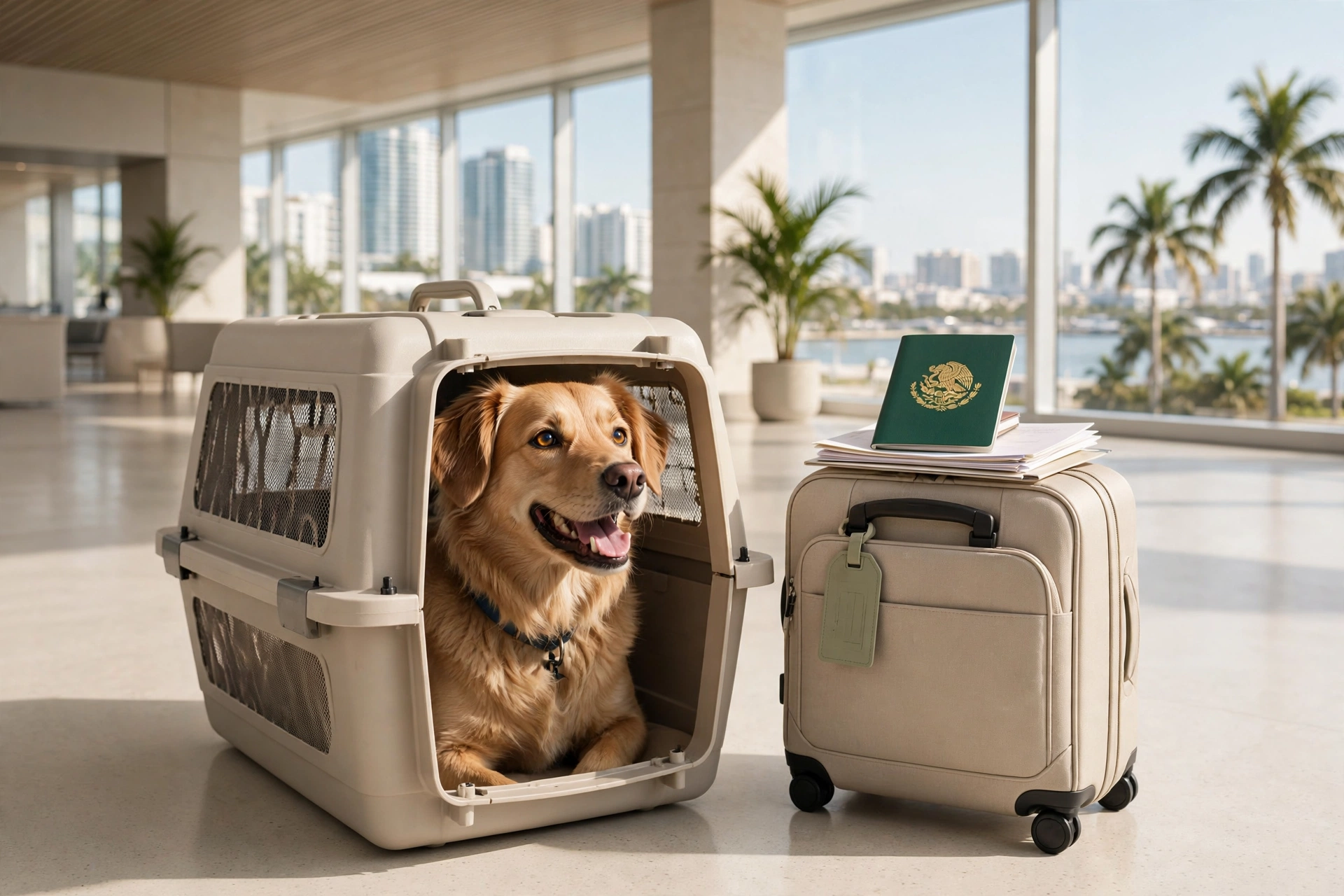
Short answer: bringing your dog from Mexico to Miami under the CDC rules in 2026 is the easiest dog-import route into the United States — Mexico is not on the CDC high-risk rabies list, so there is no serology test, no CDC facility reservation and no quarantine. Federally, your dog needs three things: the free CDC Dog Import Form receipt, an ISO microchip a universal scanner can read, and to be at least 6 months old and visibly healthy on arrival. Mexico adds one twist most people miss: a screwworm (GBG) health certificate signed by a SENASICA-approved veterinarian, issued within 5 days before the flight. Government fees: US$0. Your real cost is the vet certificate plus the airline pet fee — US$150 in cabin on American, US$162–168 on Aeromexico. If you are moving to Miami from Mexico, the dog’s calendar is a 5-day window, not a 90-day process.
Updated: October 14, 2026.
¿Prefieres leer en español? Lee esta guía en español
Why Mexico gets the short CDC route — and Colombia does not
The CDC runs two dog-import routes, and which one you are on depends only on where your dog has physically been during the 6 months before entry. Mexico sits on the easy side of that line: it is not on the CDC list of high-risk countries for dog rabies — it was the first country the World Health Organization certified as free of dog-transmitted rabies — so a dog that has only been in Mexico (or other low-risk countries) enters under the low-risk pathway. Compare that with a dog coming from a high-risk country, which needs an endorsed rabies certification, a reservation at a CDC-registered animal care facility and possibly a 28-day quarantine. I explain that heavier route in our guide to bringing pets to the US: the real process. The warning hidden inside this good news: the route is decided by the dog’s last 6 months, not by its passport. If your dog spent two weeks in a high-risk country — a family trip to Colombia, for example — the high-risk pathway applies instead, and MIA happens to be one of the airports with a CDC-registered facility. Check the 6-month history before you book anything.
| Requirement | From Mexico (low-risk) | From a high-risk country |
|---|---|---|
| CDC Dog Import Form | Yes — free, online | Yes — free, online |
| Minimum age / microchip / healthy on arrival | 6 months / ISO chip / yes | 6 months / ISO chip / yes |
| Rabies certificate for CDC | Not required | Required, government-endorsed |
| Rabies serology (titer) test | Not required | Required in most cases |
| CDC-registered facility reservation | Not required | Required |
| Port of entry | Any airport, seaport or land crossing | Only airports with a registered facility |
| Screwworm certificate (USDA APHIS) | Required — inspection within 5 days | Depends on the country |
The two federal layers, in the order you actually do them
Layer 1 — the CDC Dog Import Form (free, do it days before). You complete it online, confirm your email, and a receipt is emailed back. One form per dog. For the low-risk route this receipt is the only CDC document required, it costs nothing, and it stays valid for 6 months and for multiple entries as long as your departure country does not change and the dog does not visit a high-risk country in between. The CDC says it can be filled out on the day of travel — I tell my clients to file it a few days ahead anyway, because you must show the receipt to the airline before boarding and to CBP on arrival, and a check-in counter is the worst place to discover an email problem. Note that the form system was updated on February 5, 2026: receipts issued in the older format are still accepted if the information is accurate and unexpired.
Layer 2 — the screwworm certificate (the 5-day window). This is a USDA APHIS rule, separate from the CDC, and it exists because of the New World screwworm (gusano barrenador del ganado) outbreak response in the Mexico–US corridor. Your dog needs a health certificate signed by a veterinarian trained and approved by SENASICA — CBP describes it as an official government veterinarian of the region of origin — stating that the dog was inspected for screwworm within 5 days before shipment to the United States and found free of it (or was held in quarantine and treated until free, before the certificate was issued). CBP says it enforces this strictly, including for travelers crossing with dogs at the US–Mexico border, and encourages carrying recent veterinary records. Practical consequence: this certificate cannot be done a month ahead. It is the last document you get, and your flight date has to be set before you schedule the inspection — if the flight moves more than 5 days, you do the inspection again.
The airline is the real gatekeeper: cabin quotas, weights and fees
Here is the gap nobody warns Mexican families about: the CDC does not ask for a rabies certificate on this route, but your airline will. For international pet travel the airlines require a health certificate and a current rabies vaccination record regardless of what the CDC asks, and they add their own weight limits and per-flight quotas. The routes my clients actually fly:
| Airline | Cabin rule | Cabin fee (one way) | Larger dogs |
|---|---|---|---|
| American Airlines | Small dog in a carrier that fits under the seat; cabin pets allowed between the US and Mexico | US$150 per kennel | Checked pets only for active-duty military and State Department travelers on orders; everyone else uses cargo (PetEmbark), priced by route and weight |
| Aeromexico | Pet plus carrier up to 20 lbs (9 kg), one pet per passenger, flights under 6 hours — the Mexico City–Miami nonstop fits | US$162 low season / US$168 high season | As checked baggage up to 99 lbs (45 kg) combined, US$252 / US$258 — but snub-nosed breeds are not accepted in the hold at all |
| Volaris | Pet plus container up to 10 kg; only 2 cabin pets per flight, one per passenger | Confirm at booking — it is an add-on service | In the hold up to 45 kg combined; only 4 hold pets per flight |
Two planning rules fall out of that table. First, book the pet slot when you book your own seat — with quotas of two cabin pets per flight, the dog’s space sells out long before the cabin does. Second, size decides everything: a dog that fits in cabin flies for about US$150–168; a large dog in summer faces the cargo heat embargo (airlines stop accepting hold pets when temperatures pass roughly 85°F on the route, and Miami sits above that from about May through September). For a big dog arriving in summer, my honest advice is to travel in a cooler month, or use the land route: low-risk dogs may enter at any land border crossing with the same CDC receipt and the same screwworm certificate, then continue from Texas. It is slower, and for a 30-kilo dog in August it is often the only humane option. And if your move itself is still being planned, sequence the dog inside the whole relocation — I lay out the order of operations in our guide to moving from Mexico to Miami: what to bring, what to sell, what it costs and how long it takes.
After landing in Miami: the rabies record becomes mandatory again
The CDC let you in without showing a rabies certificate. Florida does not let you live here without one. Under Florida Statute 828.30, every dog, cat and ferret 4 months or older must be vaccinated against rabies by a licensed veterinarian, with a booster 12 months after the initial vaccination and then on the manufacturer’s schedule. Miami-Dade County also requires a dog license (tag) for dogs over 4 months, issued against proof of current rabies vaccination, with renewal tied to the vaccine’s 1- or 3-year term. So bring the original vaccination record and your Mexican vet’s history with you — your first Miami vet visit, the county license and your landlord will all ask for them. That last one matters more than people expect: pet policies in Miami rentals routinely require vaccination records, charge non-refundable pet deposits and monthly pet rent of US$25–100, and enforce breed and weight limits that can quietly exclude the dog you just flew in. Confirm the building accepts your dog, in writing, before you sign — not after you land.
What most people don’t know
1. The 5-day screwworm certificate is the document that actually decides your flight date. The CDC form is free, instant and valid for 6 months — it never blocks anyone. The APHIS certificate expires 5 days after the inspection. Families who do the vet paperwork a month early, the way you would for a high-risk country, land in Miami with an expired certificate. Work backwards: flight first, inspection inside the final 5 days.
2. Frequent Mexico–US travelers get a quiet perk. Because the low-risk receipt is valid for 6 months and multiple entries while the departure country stays the same, a dog that splits time between Mexico and Miami does not need a new CDC form for every trip. The screwworm certificate, however, is per shipment — a fresh 5-day inspection each time the dog travels from Mexico.
3. Your airline’s minimum age is not the CDC’s. Volaris accepts pets from 4 months and Aeromexico from 8 weeks for travel in general — but no dog under 6 months may enter the United States, full stop. A puppy that an airline happily boards in Mexico City still does not get in at MIA. The entry rule beats the airline rule every time.
4. A holiday can quietly change your dog’s route. The low-risk pathway looks at the last 6 months, not at nationality. One trip with the dog to a high-risk country inside that window moves you to the facility-and-serology route. If the dog traveled recently, tell me (and your vet) before assuming the simple process applies.
5. Snub-nosed dogs have exactly one realistic option: the cabin. Aeromexico bars brachycephalic breeds from the hold, and other carriers restrict them in cargo for breathing risk. If your French bulldog is too big for the cabin carrier, the land route is the plan — not a cargo booking you hope slips through.
My SETTLE timeline for a Mexico-to-Miami dog
3–4 weeks out: confirm the microchip reads on a universal scanner, gather the rabies record and vet history, and check the dog’s 6-month travel history against the CDC high-risk list. At booking: reserve the pet slot on the same call or click as your own ticket — cabin quotas are two pets per flight on some carriers. A few days out: file the CDC Dog Import Form and save the receipt on your phone and on paper. Inside the final 5 days: the SENASICA-approved vet inspection and screwworm certificate. First week in Miami: a local vet visit, the rabies vaccination brought current under Florida law, and the Miami-Dade license. If you are arriving on a work route as well, line the dog’s flight up with the visa calendar — the sequencing logic is the same one I use in our Miami relocation guides hub, where the TN and Mexico-move guides live alongside this one.
Frequently asked questions
Does my dog need a rabies certificate to enter the US from Mexico?
Not for the CDC: on the low-risk route the CDC Dog Import Form receipt is the only CDC document required, with the dog at least 6 months old, microchipped and healthy on arrival. Bring the rabies record anyway — your airline requires it for international pet travel, and Florida law (Statute 828.30) plus the Miami-Dade dog license require current rabies vaccination once you live here.
What is the screwworm certificate and who can issue it in Mexico?
It is a USDA APHIS requirement for dogs coming from Mexico: a health certificate signed by a veterinarian trained and approved by SENASICA (an official government veterinarian) stating the dog was inspected for New World screwworm within 5 days before shipment to the US and found free of it, or was quarantined and treated until free before export. Ask your vet early who the SENASICA-approved signer is in your city, because not every clinic can issue it.
Can I bring a puppy from Mexico to Miami?
Only if the puppy will be at least 6 months old on arrival. The CDC minimum has no exceptions, and it overrides lower airline minimums (8 weeks or 4 months). If your puppy is younger, the move waits — or the puppy stays with family in Mexico until it turns 6 months and flies then, with its own CDC form and certificate.
How much does it cost in total to fly a dog from Mexico to Miami?
Government fees are US$0: the CDC form is free and there is no facility or serology charge on this route. Your real one-way spend is the SENASICA-approved vet exam and certificate (priced by the clinic in Mexico — get the quote when you book the inspection) plus the airline fee: US$150 in cabin on American or US$162–168 on Aeromexico, more for hold or cargo transport of a large dog. Budget the carrier itself on top, and remember the Miami side adds a vet visit and the county license in the first week.
This article is general information about relocation planning, not veterinary or legal advice. Import rules change — confirm current requirements with the CDC, USDA APHIS and your airline before booking any flight.
Yara Coker — SETTLE, relocation services in Miami.
Want help with your move to Miami?
Moving to Miami with your dog? Tell me where in Mexico you are leaving from, your dog’s size and age, and your target flight date — I will sequence the CDC form, the 5-day certificate and the pet-friendly housing so the dog’s paperwork and your lease line up.
Sources
Low-risk pathway (only the CDC Dog Import Form required for dogs only in rabies-free/low-risk countries in the prior 6 months; high-risk countries are the ones listed, any other country counts as rabies-free/low-risk), the universal conditions (6 months old, microchip detectable by universal scanner, healthy on arrival, any port of entry), and the form mechanics (free, one per dog, receipt valid 6 months and multiple entries while the departure country is unchanged, show to the airline and to CBP; system updated February 5, 2026, older receipts still accepted if accurate): CDC, Entry Requirements for Dogs from Dog-Rabies Free or Low-Risk Countries; CDC Dog Import Form and Instructions; CDC dog importation FAQs (cdc.gov). Screwworm certificate for dogs from Mexico (inspection within 5 days before shipment, certificate signed by a veterinarian trained and approved by SENASICA; dog free of screwworm or quarantined and treated until free): USDA APHIS, Import Alert: New World Screwworm Restrictions for Live Animals Originating from or Transiting Mexico (aphis.usda.gov); enforcement and the same 5-day certificate plus CDC conditions for dogs from Mexico: CBP, reminder for travelers with dogs crossing the US–Mexico border (cbp.gov); the bilateral 5-day GBG inspection certificate in the Mexico–US corridor from August 3, 2026: SENASICA / Secretaría de Agricultura (gob.mx). Airline rules: American Airlines pet policy (US$150 carry-on pet fee; cabin pets allowed between the US and Mexico; checked pets restricted to military and State Department travelers on orders) — aa.com pet pages as checked October 2026; Aeromexico pet service (cabin pet plus carrier up to 9 kg, one per passenger, flights under 6 hours; international cabin fee US$162 low / US$168 high season; hold up to 45 kg at US$252 / US$258; snub-nosed breeds not accepted as checked baggage) — Aeromexico pet rates as published and summarised October 2026; Volaris pet terms (cabin up to 10 kg combined, max 2 cabin pets per flight; hold up to 45 kg, max 4 per flight; no pets under 4 months) — Volaris pet terms and conditions (cms.volaris.com). Florida rabies vaccination for dogs, cats and ferrets 4 months or older, booster at 12 months then per manufacturer: Florida Statute 828.30 (flsenate.gov). Miami-Dade dog license (tag) for dogs over 4 months against proof of current rabies vaccination, renewal tied to the vaccination term: Miami-Dade County Animal Services. Heat embargo threshold (roughly 85°F) and cargo restrictions: major US airline live-animal programs, as verified for this series on October 12, 2026. Figures checked October 14, 2026.
Versión en español: Vivir en Miami: Traer tu perro de México en 2026 — un formulario gratis, un certificado de 5 días, cero cuarentena
