
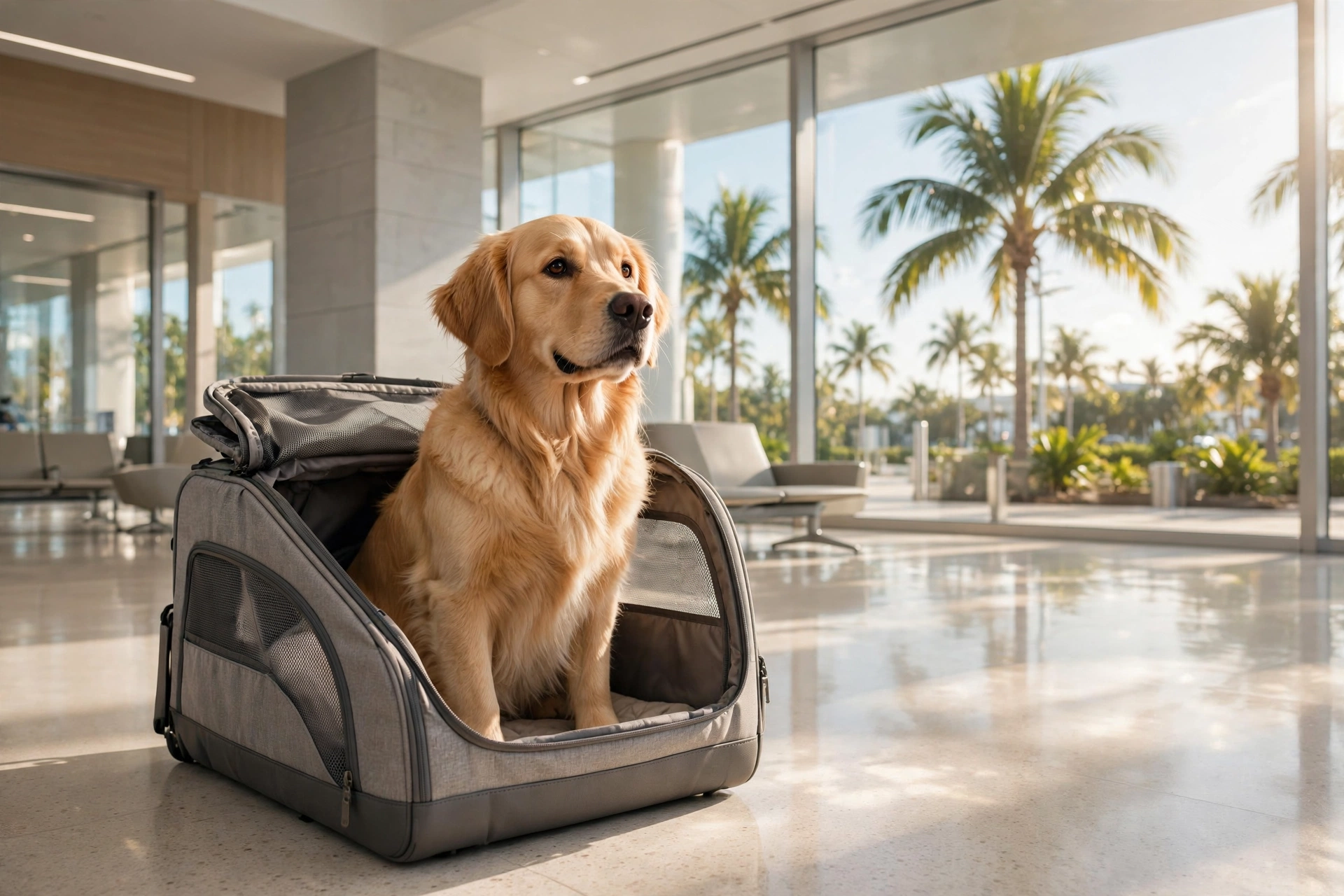
Short answer: moving to Miami with your pet in 2026 is a federal paperwork process, not an airline reservation: every dog entering the US needs the free CDC Dog Import Form, a minimum age of 6 months, an ISO microchip implanted before the rabies shot that counts for entry, and to look healthy on arrival. From a low-risk country (Canada, Mexico, most of Europe) that is the whole federal process — no rabies proof required. From a high-risk country (100+ on the CDC list updated April 15, 2026, including Colombia, Brazil, Cuba, the Dominican Republic, Peru and Ecuador) add a CDC-approved rabies serology test plus a reservation at a CDC-registered animal care facility on arrival. Budget from about US$250 (microchip plus airline cabin fee) to US$1,500+ for a high-risk-country dog with serology and facility costs.
Updated: October 12, 2026.
¿Prefieres leer en español? Lee esta guía en español
The CDC dog rule: 4 requirements for every dog entering the US
Since August 1, 2024, the CDC applies the same rule to every dog entering the United States, whether you are moving to Miami from Madrid, Toronto or Bogotá:
- CDC Dog Import Form: free, filed online, one per dog. The receipt is valid for 6 months and asks for a photo of the dog and the microchip number. No form, no boarding.
- Minimum age 6 months. This kills the plan of flying in with a brand-new puppy — there is no exception at the federal level.
- ISO microchip detectable with a universal scanner, implanted before the rabies vaccination used for entry. The order is not a suggestion: a shot given before the chip does not count.
- The dog must appear healthy on arrival — sick or visibly ill animals can be denied entry.
From high-risk countries: the serology test and the CDC-registered facility
If your dog is coming from one of the 100+ high-rabies-risk countries on the CDC list (updated April 15, 2026) — Colombia, Brazil, Cuba, the Dominican Republic, Peru, Ecuador among them — the process gets a second, expensive layer. A dog vaccinated abroad needs a valid rabies vaccination certificate plus a rabies antibody titer (serology) test, with the blood sample taken at least 30 days after the first rabies vaccine and at least 28 days before entering the US, at a CDC-approved laboratory. Then you need a reservation at a CDC-registered animal care facility at the port of arrival: the dog is examined, revaccinated, and can be held in quarantine for 28 days if there is no valid titer — every dollar of it at the importer’s expense.
There is a special case that surprises US residents most: a dog vaccinated in the US that then spent time in a high-risk country cannot re-enter on the old paperwork. It needs a “Certification of U.S.-Issued Rabies Vaccination” filed by a USDA-accredited veterinarian before the dog left the US — it is never issued retroactively. Skip that step and the dog is treated as foreign-vaccinated on return.
Cats, and the one Florida law that applies to everyone
The CDC has no federal import requirements for cats — the Dog Import Form is dogs only. Airlines and states can still impose their own: most airlines require a recent health certificate for any pet in cabin or cargo. And once you live in Miami, one state law applies to every household: Florida Statute 828.30 requires rabies vaccination for all dogs and cats over 4 months of age. Your vet in Miami will ask for it at the first visit — bring your vaccination records translated if they are not in English.
The real cost of bringing your pet to the US in 2026
Moving to Miami is already a budget exercise, so here are the verified ranges:
| Item | Typical cost (US$) |
|---|---|
| CDC Dog Import Form | Free |
| ISO microchip (vet implant) | US$45–75 |
| Vet health certificate for the airline | US$45–300 |
| Rabies serology (titer) test — high-risk countries only | US$150–400 |
| In-cabin pet fee, per segment | US$95–150 (Southwest US$95, Alaska US$100, American/Delta/United US$150) |
| Cargo fee — domestic / international | US$150–500+ / US$200–1,000+ |
| CDC-registered facility exam and possible 28-day quarantine | Four figures possible, all on the importer |
The cheapest realistic case — a chipped, vaccinated dog from Canada flying in cabin — runs under US$300 total. The most expensive — a large dog from a high-risk country needing serology, cargo, and facility time — can pass US$2,000 before you even think about the security deposit rules that shape your first rental in Miami, where pet deposits and monthly pet rent are a separate negotiation.
Moving to Miami: the heat embargo and the brachycephalic ban
This is the Miami-specific trap. Airlines apply heat embargoes on pet cargo: they will not fly animals in the hold when temperatures exceed roughly 85°F at any point on the route — and Miami sits above that from about May through September. For summer arrivals, cargo is effectively off the table, so the dog either flies in cabin (if under the airline’s size limit, usually under 15–20 lbs including the carrier) or the trip waits for cooler months. Separately, most airlines ban brachycephalic (short-nosed) breeds from cargo entirely — pugs, French and English bulldogs among dogs, Persians among cats — year-round, because of the breathing risk in the hold.
And when the plane lands, a second reality check waits: pet policies in Miami rentals are strict and pricey — breed and weight restrictions, non-refundable pet deposits, and monthly “pet rent” of US$25–100 per animal are standard in the buildings most newcomers rent in first. Line up a pet-friendly building before you fly, not after.
Cost of living in Miami: what the pet actually adds to the budget
Frame the pet inside the bigger picture: a small dog from a low-risk country adds roughly US$250–400 to your move, a one-time cost you can absorb. A dog from a high-risk country can add US$1,000–2,000 — comparable to a month of the cost of living in Miami delta between a studio and a one-bedroom. Then the ongoing part: pet rent, higher renter’s insurance, and vet prices in Miami that run 10–20% above the US average. Our Miami relocation guides hub covers the rest of the first-month math.
What most people don’t know
1. The microchip-before-vaccine sequence is the #1 silent rejection. CDC requires the chip to be implanted before the rabies shot that counts for entry. Get the shot first and the chip later — the most natural order for most owners — and the vaccination officially does not exist for the import. Re-chip, re-vaccinate, and restart the 30/28-day clocks.
2. The CDC-registered facility reservation must exist before the flight. You cannot book it at the airport. No reservation, and the airline is entitled to refuse boarding the dog on a route that requires facility processing — some owners discover this at the departure gate.
3. The 6-month minimum has no workarounds. Breeders abroad sometimes promise an 8-week puppy can fly as “emotional support” or in cabin. The CDC rule measures age at arrival: under 6 months, the dog does not enter. Period.
4. “Healthy on arrival” is a real inspection, not a formality. CBP and airline staff can deny entry to a dog showing signs of illness — and a stressed, dehydrated dog after a long cargo flight with a Miami heat delay can look exactly like that. Build buffer days and keep water and vet records in the cabin bag.
Frequently asked questions
Can I bring a puppy younger than 6 months to the US?
No. The CDC requires every imported dog to be at least 6 months old on arrival — no exceptions, no waivers, regardless of breed or country.
Do cats need the CDC Dog Import Form?
No — it is dogs only. The CDC has no federal import requirements for cats, but airlines commonly require a health certificate and Florida requires rabies vaccination for cats over 4 months.
I am moving from Colombia. How far ahead should I start?
At least 90 days before the flight: microchip plus first rabies vaccine, wait 30 days, draw blood for the serology test, wait 28 more days before entry — and book the CDC-registered facility in parallel, because availability is the bottleneck nobody prices into the timeline.
Can my dog fly in the cabin to Miami?
If the dog plus carrier fits under the seat and stays within the airline’s weight limit (typically 15–20 lbs total). Larger dogs fly as cargo — which is where Miami’s summer heat embargo becomes the deciding factor.
This article is general information about relocation planning, not veterinary or legal advice. Import rules change — confirm current requirements with the CDC and a USDA-accredited veterinarian before booking any flight.
Yara Coker — SETTLE, relocation services in Miami.
Want help with your move to Miami?
Tell us where you are moving from and when — we will map the pet timeline backwards from your flight date, so the microchip, serology and facility reservation all land in the right order.
Sources
CDC dog import rule (effective August 1, 2024): CDC, “Bringing a Dog into the United States” and CDC Dog Import Form (cdc.gov) — 6-month minimum age, ISO microchip before vaccination, health on arrival. High-risk rabies countries list (updated April 15, 2026): CDC list of high-risk countries for dog rabies. Serology timing and CDC-registered animal care facilities: CDC guidance for dogs from high-risk countries; Certification of U.S.-Issued Rabies Vaccination: CDC/USDA guidance (issued by USDA-accredited vets before departure, not retroactively). Florida Statute 828.30: rabies vaccination required for dogs and cats over 4 months. In-cabin pet fees: Alaska Airlines (US$100), Southwest (US$95), American/Delta/United (US$150) — 2026 published fees. Cargo ranges and brachycephalic restrictions: major US airline pet policies. Heat embargo thresholds (~85°F): airline live-animal programs.
Versión en español: Vivir en Miami con tu mascota en 2026: el proceso real que casi nadie conoce
