
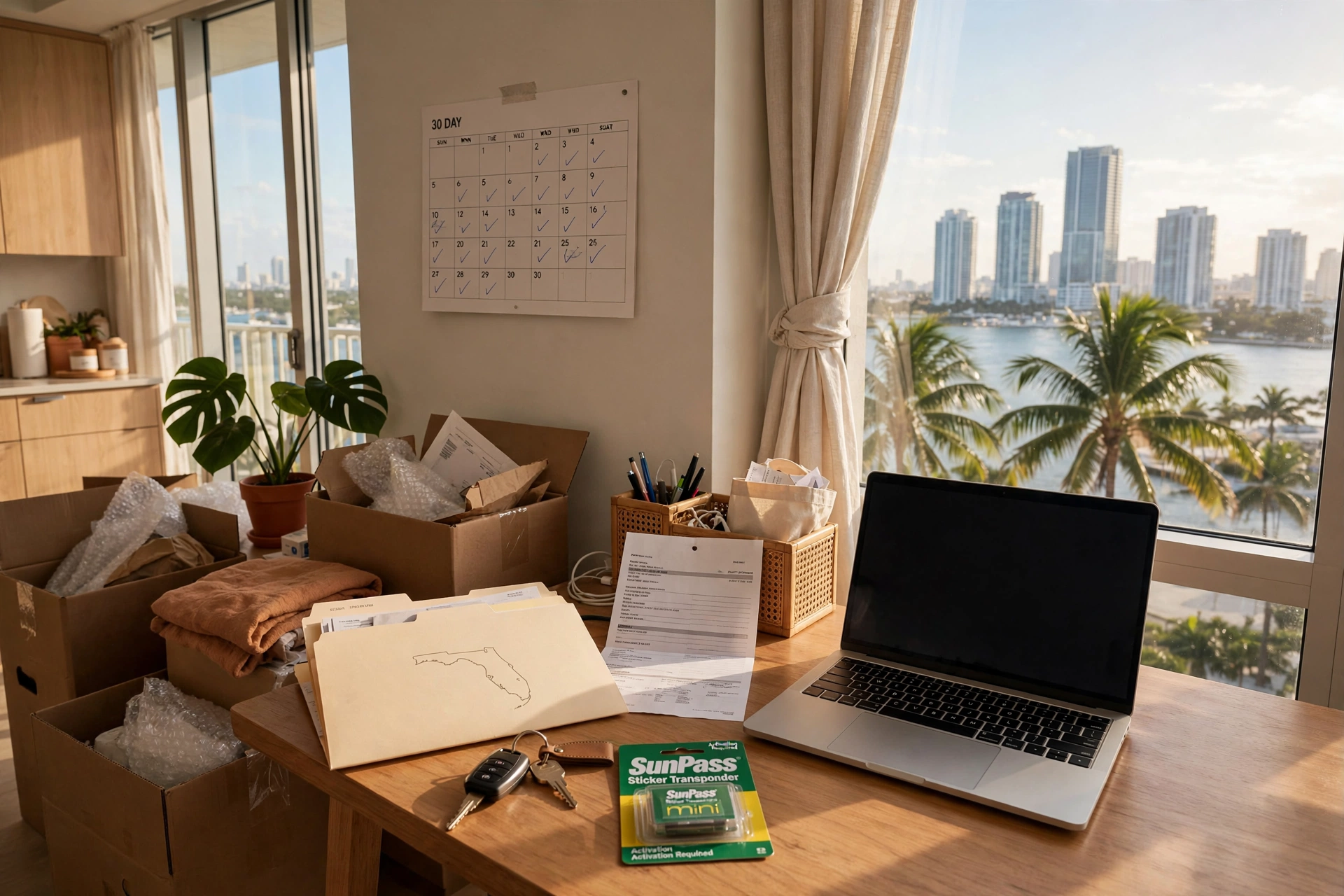
Short answer: your first 30 days in Miami run on two legal clocks, not on moving-day energy. If you are moving to Miami with a car, Florida gives you 10 days from establishing residency to insure, title and register it here — and 30 days to hold a Florida driver license (US$48 plus a US$6.25 tax collector fee). Add the setup costs nobody budgets — a US$225 initial registration fee, a US$25 FPL service charge, a US$4.99 SunPass Mini — and a driver with a car spends about US$422 in paperwork and utility setup before insurance. Families face a third clock: Miami-Dade schools need two proofs of address, a health exam (form DH-3040) done within the last year and a Florida immunization certificate (DH-680) before a child can start. This checklist sequences all of it week by week, in the order the deadlines actually fall — because the cost of living in Miami is not just rent; it is what the first month charges you for doing things late or twice.
Updated: October 13, 2026.
¿Prefieres leer en español? Lee esta guía en español
Moving to Miami: the first 30 days in one table
Florida law decides the order. Residency does not start when the moving truck arrives — under the Florida Department of Highway Safety and Motor Vehicles (FLHSMV), you establish it the day you start a job here, enroll your children in a Florida public school, register to vote, file for homestead, or complete six consecutive months living in the state. Every deadline below counts from that day:
| Deadline | Task | Real cost (2026) |
|---|---|---|
| Day 1–3 | Start electric service (FPL) in your name | US$25 service charge; deposit = about 2 months of expected usage (US$25 minimum), waivable with excellent credit |
| Day 1 | USPS change of address at usps.com/move | US$1.25 online identity-verification fee; free in person at a Post Office |
| Within 10 days | Florida insurance, then title and register your car | Title transfer US$75.25 + initial registration fee US$225 + plate US$28, plus the insurance premium |
| Week 1 | SunPass transponder on the windshield | Mini US$4.99 (PRO US$14.95) + US$10 opening balance; saves an average of 25% vs. TOLL-BY-PLATE |
| As soon as the lease is signed | Enroll kids in Miami-Dade public schools | Free — but blocked without 2 proofs of address, DH-3040 exam (within 1 year) and DH-680 immunizations |
| Within 30 days | Florida driver license at the tax collector | Class E US$48 + US$6.25 service fee (state ID card: US$25 + US$6.25) |
| Any time — do it with the license | Register to vote in Florida | Free; the deadline that matters is 29 days before any election |
| Calendar it in month 1 (owners) | Homestead exemption | Free to file — but only if you own and occupy by January 1 and file by March 1 |
Total the government-and-utility column for a driver with a car: US$54.25 license + US$75.25 title + US$225 initial registration + US$28 plate + US$25 FPL + US$14.99 SunPass-with-balance = about US$422, before insurance, and before any sales tax due on a vehicle you bought out of state. That is the number to hold in reserve on top of your deposit and first month’s rent — and if you have not yet signed, read exactly what that deposit can and cannot cover in our guide to security deposits in Miami and how they really work before the money moves.
Week 1 (days 1–7): make the house work
Electricity first, because it is also paperwork. Start FPL service before or on move-in day: US$25 service charge, and a deposit set at roughly two months of expected usage for that address unless your credit waives it. Keep the deposit receipt — Miami-Dade schools accept an electric deposit receipt or bill as one of your two proofs of address, so week 1’s utility email is week 2’s school document. Mail: file the USPS change of address yourself at usps.com/move for US$1.25; any site charging US$40 for the same form is a third party, not the Postal Service. Tolls: Miami’s expressways are all-electronic; without a transponder you pay TOLL-BY-PLATE rates and the invoices chase your old state’s plate and address. A SunPass Mini costs US$4.99 and pays the lowest rate — SunPass puts the average saving at 25%. Internet and water vary by building: in most Brickell and downtown condos water is in the HOA and internet is a bulk building contract, which is one reason the best neighborhoods in Miami for a fast landing are not always the cheapest on rent alone.
Weeks 2–3 (days 8–21): the car, the license and the kids
The 10-day car clock is the one newcomers miss. You must carry insurance from a Florida-licensed agent before the tax collector will title and register the car, and the whole sequence — insurance, title transfer, Florida plate — is due within 10 days of establishing residency, not within 10 days of whenever you get around to it. Budget the US$225 initial registration fee: it is charged the first time a vehicle is registered in Florida in your name, and it surprises almost everyone. The license visit does triple duty: at the same tax collector appointment you get the Class E license (vision test; a valid out-of-state license normally waives the written and road tests), you can register to vote, and the license itself becomes your primary proof of Florida address for everything after. Bring your current license, proof of Social Security number, and two documents showing the new address — the signed lease and that FPL bill from week 1 are the standard pair. Schools: register as soon as the lease is signed rather than after the furniture lands; Miami-Dade requires two proofs of address, the child’s birth certificate or passport, a DH-3040 health examination performed within one year before enrollment, and the DH-680 Florida immunization record — a pediatrician visit in week 2 beats a child sitting at home in week 4.
Week 4 (days 22–30): close the loop
By day 30 you should hold the Florida license, the Florida plate, school enrollment (or a dated plan for it), voter registration, and a SunPass account with auto-replenishment on. Week 4 is for the unglamorous finish: photograph every document into one folder, update the address with your bank, your employer and your insurer, set calendar reminders for the two dates that are not 30-day deadlines but punish forgetfulness all the same — the March 1 homestead filing deadline if you bought, and the 29-days-before-the-election voter book-closing if an election is coming. If your first 30 days are really a winter trial run before a full move, the sequence differs — seasonal residents keep a different set of clocks, as our Canadian snowbird guide to a winter in Miami lays out. And when you are ready to plan month two — neighborhoods, renewals, buying vs. renting on — the full library lives in our Miami relocation guides hub.
What most people don’t know
1. The 10-day clock can start before you feel moved in. Starting the Miami job, enrolling the kids or registering to vote each establishes residency on its own and starts the car and license clocks. People who “officially move” a month after they start working here are, on paper, already late.
2. The FPL deposit is not gone money — but it is slow money. FPL returns the deposit after 23 months of service with the last 12 consecutive months in good payment standing (or when you close the account), and it earns 2% interest after six months. Treat it as a forced savings account, not a fee — and never miss a payment in year two if you want it back on schedule.
3. Your lease plus your electric bill are your school keys. Miami-Dade accepts exactly the pair a renter already has — an executed lease and an electric deposit receipt or bill — as the two proofs of address. The families who stall enrollment are usually missing the health forms (DH-3040 and DH-680), not the address proof. Book the pediatrician before the movers.
4. Buying in December vs. January changes a full tax year. Homestead requires owning and occupying the home on January 1 and filing by March 1. Close on December 30 and you can file for that year; close on January 3 and the exemption — worth roughly US$50,000 off the assessed value — starts a year later. Nobody at the closing table volunteers this.
5. TOLL-BY-PLATE bills go to the car you no longer register there. Until the Florida plate is on, Miami tolls bill the out-of-state plate, and the invoices mail to the old address your USPS forwarding may have already ended. The US$4.99 SunPass Mini in week 1 is the cheapest insurance in this entire checklist.
Frequently asked questions
What do I actually have to do in my first 30 days in Miami?
Legally: insure, title and register any car within 10 days of establishing residency, and hold a Florida driver license within 30 days. Practically: start FPL service, file the USPS change of address (US$1.25 online, free in person), put a SunPass on the windshield (US$4.99 Mini), enroll school-age kids (2 proofs of address, DH-3040 exam within the last year, DH-680 immunizations), and register to vote at the license appointment.
How much does the first month of paperwork cost?
For a driver with a car, about US$422 before insurance: license US$54.25 with the tax collector fee, title transfer US$75.25, initial registration US$225, plate US$28, FPL service charge US$25, and a SunPass Mini with its US$10 opening balance. Without a car, the same month costs under US$60 — a state ID is US$25 plus US$6.25. The FPL deposit (about two months of expected usage) sits on top as refundable credit, not a fee.
Can I keep driving on my out-of-state license?
Only inside the window. Once you establish Florida residency — starting a job, enrolling kids in public school, registering to vote, filing homestead, or six consecutive months here — FLHSMV requires the Florida license within 30 days. A valid out-of-state license normally waives the written and road tests; you still take a vision test and surrender the old license.
Do renters need to worry about the homestead deadline?
Not until they buy — homestead is owners-only. But renters who plan to buy within the year should learn the trap now: own and occupy by January 1, file by March 1, or the exemption starts a full year later. This article is general information, not legal advice; confirm deadlines against your exact move date with the tax collector and the Miami-Dade Property Appraiser.
Yara Coker — SETTLE, relocation services in Miami.
Want help with your move to Miami?
Send us your landing date, whether a car and kids are part of the move, and the neighborhood you chose — we will turn this checklist into your dated, week-by-week plan with the appointments in the right order, so no 10-day clock ever starts without you knowing.
Sources
Florida Department of Highway Safety and Motor Vehicles (FLHSMV), “New Resident — Welcome to Florida”: residency triggers, the 30-day driver license rule and the 10-day insurance/title/registration rule; Class E license US$48.00, ID card US$25.00, tax collector service fee US$6.25. FLHSMV fees schedule: title transfer/duplicate US$75.25, initial registration fee US$225, original plate US$28. FLHSMV motor vehicle registrations page: out-of-state vehicles must be registered within 10 days of employment, school enrollment or establishing residency. Florida Power and Light (FPL), new-customer overview: US$25 service charge; deposit based on the expected average cost of two months of service, US$25 minimum, possibly waived for excellent credit; 2% interest after six months; return after 23 months of service with the last 12 consecutive months in good standing. SunPass official FAQ (sunpass.com): PRO transponder US$14.95 plus tax, Mini US$4.99 plus tax; SunPass customers pay the lowest toll rate, saving an average of 25% over TOLL-BY-PLATE. USPS change of address: US$1.25 online identity-verification fee; free in person at a Post Office. Miami-Dade County Public Schools, new student registration guide and handbook: two proofs of address (executed lease, electric deposit receipt or bill, homestead card, FM-7444), birth certificate or passport, DH-3040 health examination within one year prior to enrollment, DH-680 Florida Certificate of Immunization. Florida Division of Elections: voter registration deadline (“book closing”) 29 days before each election. Florida Statute section 196.131 and Miami-Dade Property Appraiser: homestead application on or before March 1, with ownership and permanent residence established by January 1.
Versión en español: Vivir en Miami — Tus primeros 30 días: la lista que sí sirve
