
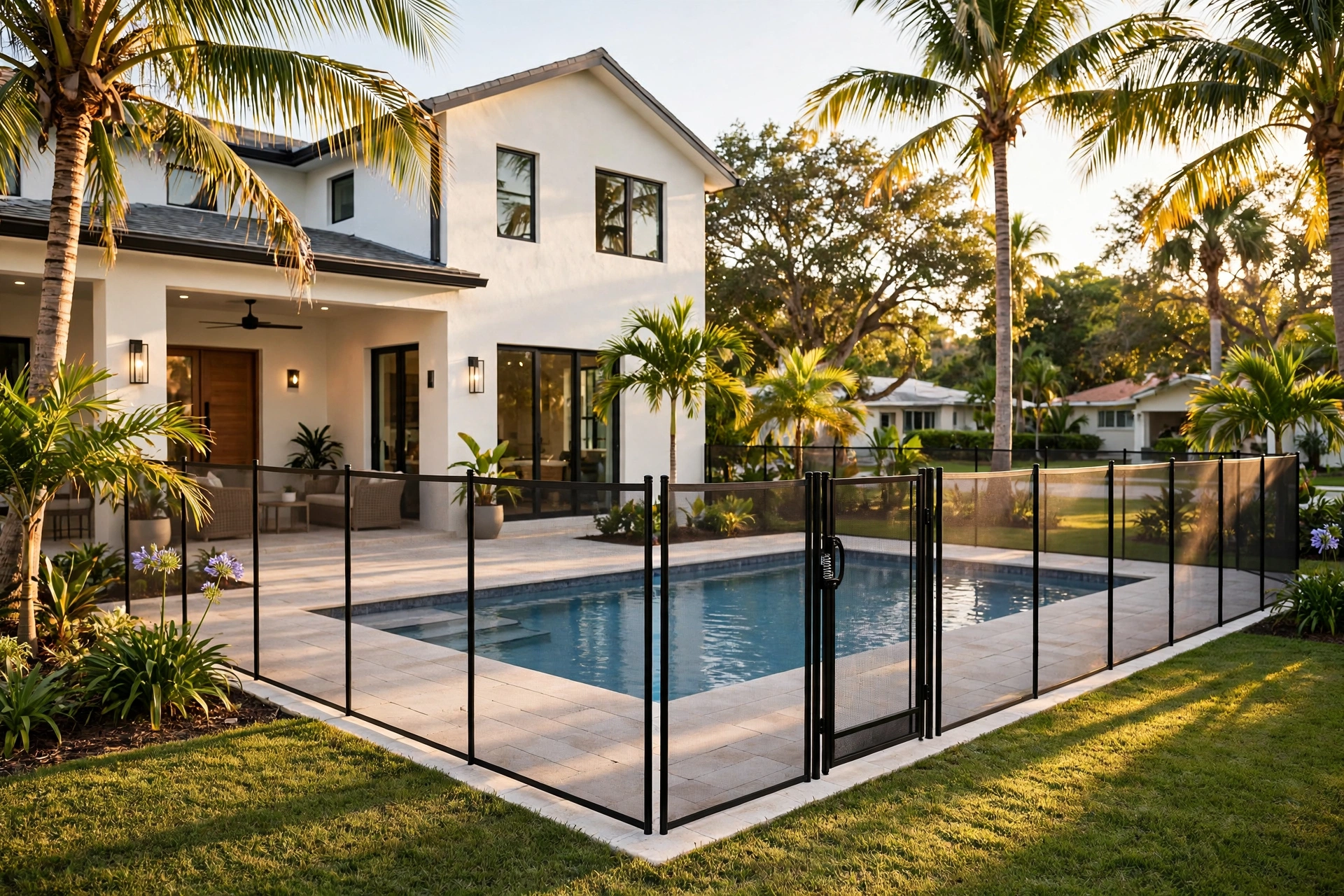
Short answer: if you are moving to Miami and renting a house with a pool, budget the pool as a second contract, not as a free amenity. At the October 2026 median of US$3,750 a month for a 3-bedroom (Zumper), a pool you maintain yourself adds roughly US$222 to US$322 a month — US$150 to US$250 for weekly professional service plus about US$72 for the pump’s electricity — and Florida law lets the lease put that cost on you with a single written clause.
On safety, the rule that surprises almost every relocating family is this: Florida requires a new pool to have only one safety feature, and a door alarm counts. A rental house can be legally compliant and still have no fence between your toddler and the water.
Your cost of living in Miami in a pool house is decided by two documents most tenants never read closely: the pool clause of the lease, and the barrier that is actually standing in the backyard on move-in day.
Updated: October 21, 2026.
¿Prefieres leer en español? Lee esta guía en español
Moving to Miami and renting a house with a pool: what the rent does not include
Start with the rent itself. Zumper’s Miami research, updated October 21, 2026, puts the median 3-bedroom at US$3,750 a month and the average house — as opposed to an apartment — at US$3,300, across 6,297 listed rentals.
Houses with pools sit inside that house market, in the family neighborhoods of the best neighborhoods in Miami search: Kendall, Cutler Bay, Palmetto Bay, Coral Gables, Coconut Grove. The listing price, however, almost never says who pays to keep the water clean, safe and circulating.
In a Florida single-family rental, that answer is not set by custom. It is set by the lease you sign — in writing.
| Pool cost | What it covers | Verified 2026 figure | Who usually pays |
|---|---|---|---|
| Weekly professional service | Skimming, brushing, vacuuming, chemical testing and balancing, basket and filter checks | US$150–250/month, chemicals included (Miami market) | Whoever the pool clause names — read it before signing |
| Pump electricity | Running the circulation pump about 8 hours a day | ~US$72.48/month (2,000W pump at Florida’s 15.10¢/kWh) | The tenant, through the electric bill, in almost every house lease |
| Green-to-clean recovery | Shock treatment and algae removal after service lapses | ~US$250–500 per recovery | Whoever let it lapse, where the lease so provides |
| Major equipment repairs | Pump, filter, heater replacement | No standard figure — priced per failure | Typically the landlord, unless you agreed otherwise in writing |
| Removable mesh safety fence | Professionally installed barrier with a self-closing gate, if the house lacks one | ~US$2,000–3,500 one time | Negotiated before signing — never assumed |
Add the running costs to the rent and the honest monthly figure for a tenant-maintained pool house at the 3-bedroom median is US$3,972 to US$4,072 a month — call it about US$4,000 before water top-ups and the rest of the electric bill.
The pool alone consumes US$2,670 to US$3,870 a year. That is roughly one extra month of 1-bedroom rent, every year, for water.

The pool clause: the one paragraph that moves US$3,000 a year
Florida Statute 83.51 sets the landlord’s maintenance duties — and for a single-family home or duplex, the law expressly allows those duties to be altered or modified in writing.
That single rule is why two families in identical pool houses on the same street can pay US$250 a month apart. One lease says the landlord provides weekly professional service. The other says the tenant maintains the pool in clean, clear and safe condition at the tenant’s expense.
Before you sign, the clause — or a written addendum — should answer five questions, in words, not promises.
Who provides weekly service? If it is you, the service contract is yours to arrange before move-in: in Miami’s summer heat and storm season, a pool skipped for a few weeks can turn green, and the recovery runs about US$250 to US$500.
Who pays for major equipment? Standard Florida lease practice keeps pump, filter and heater repairs with the landlord unless otherwise agreed in writing. If your lease moves those to you, price that risk openly or strike it.
What are your daily duties? Keeping the water level high enough for the pump, clearing debris between visits, never disabling equipment or alarms, and reporting problems immediately are typical — and reasonable. Vague duties are not: “maintain the pool” without a list becomes an argument at deposit time.
When does the service company come? A named service day and gate access in the lease prevents the missed-visit spiral that ends in a green pool neither side paid to fix.
What happens at move-out? Florida sets no state cap on security deposits, so a stained, green or damaged pool is fought over real money. Before any deposit moves, read our guide to how much Miami landlords can charge as a security deposit and when Florida law forces them to return it — and photograph the pool, the equipment pad and the barrier on move-in day, with dates.
What most people don’t know
“Legally compliant” can mean a door alarm and nothing else. Under Florida Statute 515.27, a residential pool passes its final inspection with at least ONE safety feature: a barrier meeting the barrier standard, an approved safety pool cover, exit alarms of at least 85 decibels on every door and window with direct access to the pool, or self-closing, self-latching doors with the release at least 54 inches above the floor. Failing to equip a new pool is a second-degree misdemeanor — but one working alarm satisfies the list. When you tour a rental house, do not ask “is the pool legal?” Ask “which feature does this house actually have, and is there a physical barrier?” For a family with a child under six, only the barrier answers the real question.
The barrier standard is exact — and checkable in five minutes. Florida Statute 515.29 requires a barrier at least 4 feet high on the outside, with no gaps or components a young child could crawl under, squeeze through or climb over. Gates must open outward, away from the pool, close by themselves and latch by themselves, with the release on the pool side, out of a young child’s reach. The barrier may not sit where furniture or equipment can be used to climb it. Walk the fence line yourself: push every gate and watch it latch, look for gaps at the bottom, and move anything climbable away from the fence.
Drowning is the leading cause of unintentional death for Florida children ages 1 to 4. That is the Florida Department of Health’s framing, in the state with the most residential pools in the nation — about 1.59 million. Layers are the accepted answer: a real barrier, working alarms, a designated water watcher, and swim lessons. Formal lessons can reduce a child’s drowning risk by up to 88 percent, and Florida’s Swimming Lesson Voucher Program gives free lesson vouchers to families earning up to 200 percent of the federal poverty level with a child aged four or younger.
“Pool service included” never means the pool is free. Even when the landlord’s service is bundled into the rent, the pump runs on your electric meter: about US$72 a month, roughly US$870 a year, for a standard 2,000-watt pump on an 8-hour schedule. Ask what type of pump the house has — a variable-speed pump uses a fraction of that energy — and whether a heater is installed, because heating is a separate, much larger cost that should be named in the lease if you plan to use it.

The safety audit to run before you sign, not after you move in
Bring this list to the showing. Every item is observable in one visit, and every gap is cheaper to fix as a lease condition than as a tenant project.
Barrier first. Is there a fence or enclosure that isolates the pool from the house and the yard — not just a fence around the property line? Does it meet the 4-foot, no-gap, self-latching standard above?
House access second. Which doors open directly onto the pool deck? Do they have working alarms or self-closing, self-latching hardware at 54 inches or higher? Test them; batteries die.
The fix, priced. If the barrier is missing, a professionally installed removable mesh fence typically runs US$2,000 to US$3,500 — about what 8 to 14 months of pool service costs. A tenant cannot drill deck sleeves or alter the enclosure without the landlord’s written permission, so the negotiation is simple and belongs in the lease: the landlord installs it, you share the cost in writing, or you choose a different house.
Water and equipment last. Is the water clear and the equipment running quietly? Green water or a loud pump at the showing is the current owner’s maintenance standard telling you what yours will inherit. Note the condition in writing, with photos, the same way you would screen school zones before signing — the method in our guide to the best public school zones in Miami-Dade to rent in before you buy applies here too: verify the exact thing, at the exact address, before the lease.
Families comparing a Miami winter base sometimes look at pool houses for a season instead of a year. The lease-length traps are different there — our snowbird guide to renting in Miami for winter 2026–2027 explains how seasonal terms change deposits, taxes and what a landlord will accept.
Frequently asked questions
How much does it really cost to rent a house with a pool in Miami?
At the October 2026 median, a 3-bedroom rents for US$3,750 a month (Zumper). If the lease makes you responsible for the pool, add US$150 to US$250 a month for weekly professional service and about US$72 a month for pump electricity — a true total of roughly US$3,972 to US$4,072 a month, before water top-ups. If the landlord includes service, you still pay the electricity, about US$870 a year.
Can a Florida landlord legally make the tenant pay for pool maintenance?
Yes, if it is agreed in writing. Under Florida Statute 83.51, a landlord’s maintenance obligations for a single-family home or duplex may be altered or modified in writing, and pool clauses in Florida house leases routinely assign weekly service to the tenant. That is why the pool clause must be read — and negotiated — before signing, and why major equipment repairs should be expressly kept with the landlord.
Does a Miami rental house with a pool have to have a fence?
Not necessarily a fence specifically. Florida Statute 515.27 requires a pool to have at least one safety feature — a compliant barrier, an approved safety cover, exit alarms on doors and windows with direct access, or self-closing, self-latching doors — and a house can satisfy the rule with alarms alone. For a family with young children, SETTLE’s standard is stricter than the legal minimum: a physical barrier meeting Statute 515.29 (at least 4 feet high, self-closing and self-latching gates), verified in person before signing.
Who pays if the pool turns green or the pump breaks during our lease?
It follows the clause. A pool that turns green after missed service is typically charged to whoever was responsible for that service — recovery runs about US$250 to US$500 — while pump, filter and heater failures are typically the landlord’s, unless you agreed otherwise in writing. Report problems in writing immediately either way: a running record protects your deposit, because Florida law sets no cap on what a landlord can hold as a deposit.
This article is general information about relocation planning, not legal advice. Rents, service prices and lease terms change; confirm the pool clause, the barrier and current prices in writing before signing.
Yara Coker — SETTLE, relocation services in Miami.
Want help with your move to Miami?
Send me the listing — I will read the pool clause with you, run the safety audit against the Florida barrier standard, and price the house’s true monthly cost before you sign. More guides like this one live in our Miami relocation guides hub.
Sources
Pool barrier requirements (at least 4 feet high on the outside; no gaps a young child could crawl under, squeeze through or climb over; gates opening outward, self-closing and self-latching with the release on the pool side out of a young child’s reach): Florida Statutes §515.29. Safety-feature options for passing final inspection (at least one of: compliant barrier, approved safety cover, exit alarms of at least 85 dBA at 10 feet on doors and windows with direct access, or self-closing and self-latching doors with release at least 54 inches above the floor) and the second-degree misdemeanor for failing to equip a new pool, curable within 45 days with a drowning-prevention program: Florida Statutes §515.27. “Young child” defined as under 6 years of age: §515 definitions. Drowning as the leading cause of unintentional death for Florida children ages 1 to 4, and layers of protection: Florida Department of Health drowning-prevention programs, checked October 21, 2026. Florida’s roughly 1.59 million residential pools and highest-in-the-nation child drowning count, and the Swimming Lesson Voucher Program (SB 544, 2024; families up to 200% of the federal poverty level with a child aged 4 or younger): Florida TaxWatch summary of state data, checked October 21, 2026; formal swim lessons reducing drowning risk by up to 88 percent: AAP/CDC figures cited in national drowning-prevention summaries. Landlord maintenance duties for a single-family home or duplex being subject to alteration or modification in writing: Florida Statutes §83.51 and the Florida landlord-tenant summary of Chapter 83, Part II; pool-clause practice (who provides service, daily duties, major equipment repairs typically with the landlord unless otherwise agreed, chargeback for a neglected pool where the lease provides): Florida landlord lease guidance (Ackley Florida). Miami rents (median overall US$3,000; 3-bedroom US$3,750; average house US$3,300; 6,297 listings): Zumper Miami rent research, updated October 21, 2026. Weekly professional pool service in Miami (US$150–250/month, chemicals included, standard residential pool; full service from US$145/month locally): FloPool Miami pool-maintenance cost guide, 2026, and Alligator Pools Miami-Dade pricing, checked October 21, 2026. Green-to-clean recovery (~US$250–500): MM Pool and Spa Services, Miami-Dade. Pump electricity (2,000W pump, 8 hours/day, Florida rate 15.10¢/kWh from EIA Electric Power Monthly = US$2.42/day, US$72.48/month, US$869.76/year): Jackery state cost table built on EIA data, checked October 21, 2026. Removable mesh pool fence professionally installed (typical US$2,000–3,500; DIY kits US$800–1,700; pool alarms US$50–250): All-Safe pool safety pricing, checked October 21, 2026. Security deposits governed by §83.49 with no state cap: linked SETTLE guide. The US$222–322 monthly running cost, the US$3,972–4,072 true monthly total and the US$2,670–3,870 yearly figures are SETTLE calculations from the service, electricity and rent figures above.
Versión en español: Vivir en Miami: rentar una casa con piscina — costos para la familia y reglas de seguridad
