
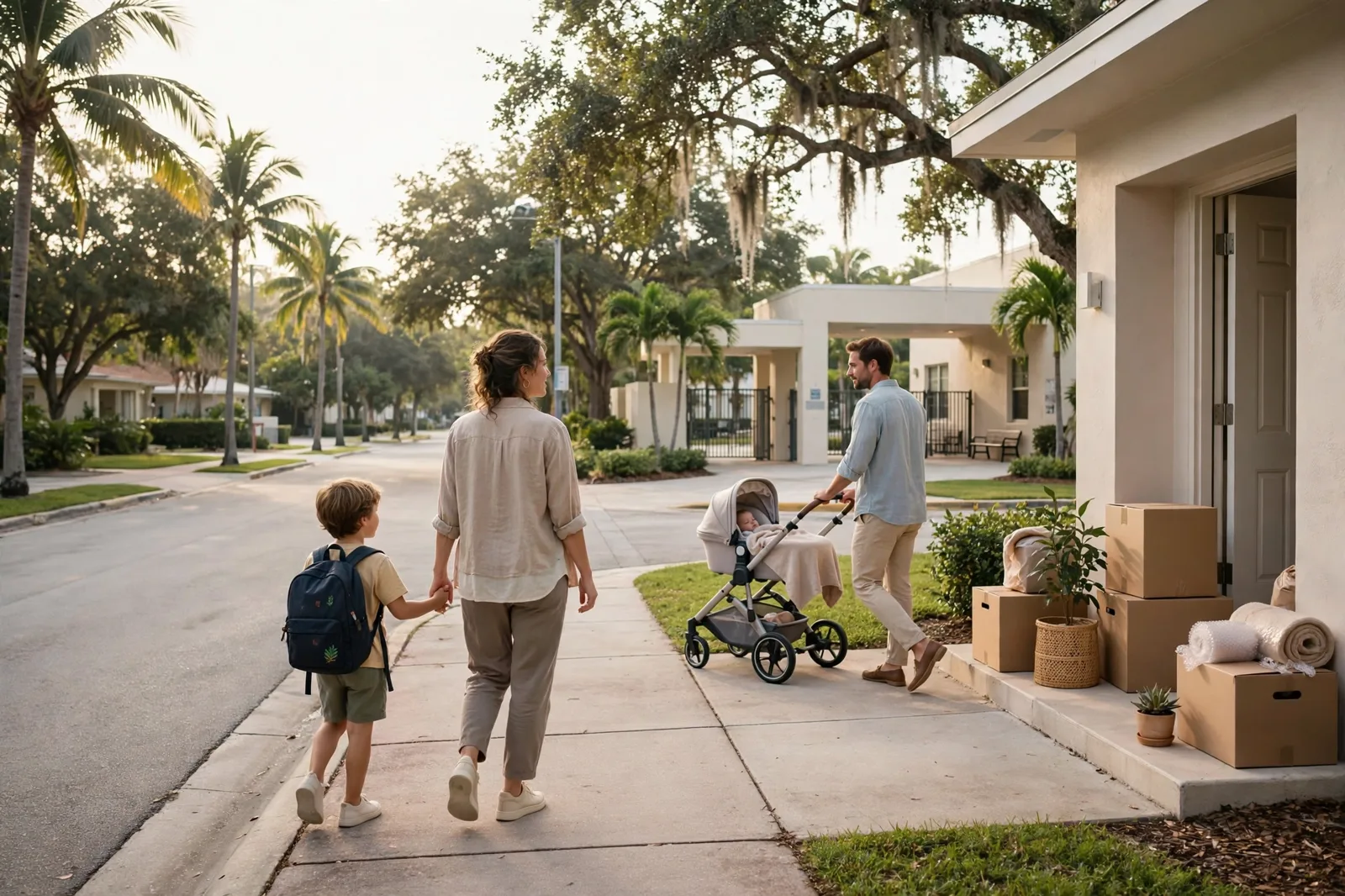
Short answer: if you are moving to Miami with a special-needs child, your old IEP does not die at the Florida border — and it does not simply transfer, either. Under federal rule 34 CFR 300.323(f) and Florida Rule 6A-6.0334, Miami-Dade must give your child a free appropriate public education with services comparable to the ones in the out-of-state IEP from the first day of school, in consultation with you, until the district finishes any evaluation it decides is necessary and writes a new Florida IEP. You are landing in a big system: Miami-Dade County Public Schools counted 42,767 students with a disability as their primary exceptionality in 2024-25, led by specific learning disabilities (14,846) and autism (9,428). Three clocks decide your first semester: the district has 30 days to seek your consent or refuse in writing after your written evaluation request, 60 calendar days (excluding school breaks and summer) to complete an evaluation after you consent, and — if you choose the private route — 30 days to complete the funding matrix behind Florida’s Unique Abilities scholarship, worth about US$10,100 to US$36,534 a year in Miami-Dade. Under 3, the entry point is different again: Early Steps evaluates for free. That sequence — paper first, address second — is how the cost of living in Miami stays under control for a family like yours.
Updated: October 17, 2026.
¿Prefieres leer en español? Lee esta guía en español
Moving to Miami with a special-needs child: the 5 doors, by age and route
Most “best neighborhoods in Miami” advice assumes the school zone is the decision. For your family the decision is which of five doors you enter first — and each door has its own timeline, its own price and its own paperwork. Here they are, with the verified numbers:
| Your situation | The door | What it costs | The clock that governs it |
|---|---|---|---|
| Birth to 36 months, delay suspected or diagnosed | Early Steps — Florida’s early intervention program (Dept. of Health, IDEA Part C) | Eligibility evaluation at no cost, no income requirement; services through an Individualized Family Service Plan, in your child’s natural environment | Refer before 35 months — the program ends at 36 months and hands off to the school system |
| 34 months to age 5, not in public school or Head Start | FDLRS Child Find + Miami-Dade ESE | Free developmental screening; no insurance needed | Screening leads to evaluation under the same 30/60-day rules below |
| Ages 3 to 21, public school | Miami-Dade ESE + an IEP | Free — FAPE is a legal entitlement, including specialized transportation and related services written into the IEP | Comparable services from day one; 30 days for consent/refusal after your written request; 60 calendar days for the evaluation after consent |
| Private school or home education route | FES-UA scholarship (Family Empowerment Scholarship for Students with Unique Abilities) | An education savings account averaging ~US$10,000: in Miami-Dade, US$10,100–US$10,864 at matrix levels 251–253, US$22,755 at level 254 and US$36,534 at level 255 (2026-27) | District must complete the IEP and matrix within 30 days of your request — but you cannot hold the ESA while enrolled full-time in public school |
| Developmental disability, long-term home and community supports | APD iBudget Medicaid waiver | State-funded supports at home — but it is a pre-enrollment list, not an entitlement: 15,442 people were on it on July 7, 2026 | Measured in years. Another state’s waiver does not transfer — apply before you move |
Read the table the way I read it with families: the public-school door is the only one that is both free and legally guaranteed on a deadline. Everything else is either a scholarship you direct yourself, a free screening that leads back to that door, or a waitlist you should join before your moving truck is even booked.
What most people don’t know
1. “Comparable” is the law — “identical” and “adopted” are not. When a child transfers between Florida districts, the new district may adopt the old IEP outright. From another state, it cannot: Florida Rule 6A-6.0334 requires comparable services in consultation with you while the district decides whether a new evaluation is needed and develops a Florida IEP. In practice that means the document that protects your child in the first weeks is the complete paper copy you carry — current IEP, latest evaluations, service logs — because district-to-district record requests move slower than your child does. Hand-deliver it at enrollment; do not wait for the fax that federal law calls “prompt” and real life calls otherwise.
2. All three clocks start with one dated, written request — and the system may not stall you in interventions. Florida Rule 6A-6.0331 gives the district 30 days from your written request to obtain your consent or hand you a written refusal, then 60 calendar days after consent to finish the evaluation — a clock that pauses for school holidays, breaks and summer, and can only stretch 30 more days by your written agreement, signed before day 45. The same rule states that general-education intervention tiers (MTSS/RTI) may not be used to delay an appropriate evaluation. And if you are heading for the FES-UA scholarship instead, Statute 1002.394(7)(b) gives you a separate right: request the IEP meeting and matrix, and the district must complete both within 30 days and report the matrix level within 10 more. Put every request in writing, dated, on day one in Miami. Verbal requests start no clocks.
3. The matrix is money — US$25,670 of it. The FES-UA award is not one number. In Miami-Dade for 2026-27 it runs from US$10,100–US$10,864 for a child at matrix levels 251–253 to US$36,534 at level 255 — a US$25,670 gap set entirely by the services described in the IEP’s matrix of services, not by a separate test. A child who arrives with only a diagnosis and no matrix gets funded at the base level. So the order of operations matters: get the Florida IEP written with every service your child actually receives before anyone completes the matrix, and remember the trade — the scholarship is an account you control for private tuition, therapies, specialists, tutoring and technology, but accepting it means leaving full-time public enrollment, where those same services are the district’s legal duty at no cost to you.
4. Florida’s autism insurance mandate has a ceiling and three holes. The Steven A. Geller Autism Coverage Act (Statute 627.6686) requires group health plans to cover screening and treatment of autism and Down syndrome — speech, occupational and physical therapy and applied behavior analysis by certified or licensed providers. But the coverage is capped at US$36,000 a year and US$200,000 over a lifetime, and the statute’s definition excludes individual-market plans, individually underwritten plans and small-employer plans. If your Miami move comes with a new job, the type of health plan matters as much as the school: an intensive ABA program budgeted against a US$3,000-a-month coverage ceiling is a different family budget than one budgeted against “insurance covers it.” Check the plan type before you sign the offer letter, and price the rest of the therapy stack the way we priced care in our guide to childcare costs in Miami in 2026, daycare vs. nanny — line by line, not by brochure.
5. The one thing that truly does not transfer is the Medicaid waiver. School rights travel under federal law; home-and-community waiver funding does not. Florida’s iBudget waiver, run by the Agency for Persons with Disabilities, had 15,442 people in pre-enrollment on July 7, 2026 — and 5,996 of them had been waiting more than ten years as of April 1, 2026. If your child receives waiver services in your current state, those services end when you leave and the Florida application starts from zero. Apply to APD’s Southern Region before the move, keep your current state’s services until the last legal day, and budget the gap honestly instead of discovering it in month two.
Where to live: the neighborhood logic inverts
For most families I tell them the elementary zone decides the address. For yours, I say the opposite — and it is the single most valuable sentence in this guide: do not sign a long lease for a famous school zone before the IEP team has placed your child. Specialized placements in Miami-Dade are assigned by the IEP team, not bought with rent: the district’s own centers include Neva King Cooper Educational Center in Homestead, which serves students ages 3 to 22 with significant intellectual disabilities, and its emotional/behavioral centers Robert Renick in Miami Gardens and Ruth Owens Kruse in the Kendall area. A placement can land across the county from the neighborhood you fell in love with.
The practical play is a flexible first year near the service cluster, not the prestige cluster. Nicklaus Children’s Hospital’s main campus — developmental-behavioral pediatrics and specialized assessments — sits in the Coral Way / Shenandoah area, and UM-NSU CARD, the state-funded Center for Autism and Related Disabilities, gives registered families free case management, parent training and school consultation across Miami-Dade, Broward and Monroe; it supports more than 17,000 South Florida families. Living in South Miami, West Miami, Coral Gables or Kendall keeps both within a short drive. At October 2026 averages, a 2-bedroom in Kendall (US$2,469) runs US$1,659 a month — US$19,908 a year — under Coral Gables (US$4,128), which is therapy money, not a sacrifice. When you do sign, Florida places no state cap on residential security deposits (Statute 83.49), so read our guide to security deposits in Miami: how much landlords can ask and how the money must be held before the move-in cash leaves your account, and if grandparents are planning a long winter nearby to help with the transition, have them price the season with our Canadian snowbird guide to a Miami winter. Once the placement is confirmed and stable, then — and only then — does the two-stage strategy from our guide to the best Miami suburbs for families with young kids in 2026 apply to your permanent address.
FAQ
Does my child’s IEP transfer to Florida?
Its services do, its document does not. Miami-Dade must provide services comparable to the out-of-state IEP, in consultation with you, from enrollment until it completes any evaluation it deems necessary and issues a Florida IEP (34 CFR 300.323(f); Florida Rule 6A-6.0334). Bring complete paper copies — IEP, evaluations, progress reports — and hand them over at registration.
How long does a new evaluation take in Florida?
After your written request, the district has 30 days to get your consent or refuse in writing. After consent, it has 60 calendar days to complete the evaluation, not counting school holidays, breaks or summer, extendable by up to 30 days only with your written agreement before day 45 (Rule 6A-6.0331). For the FES-UA matrix specifically, the district must complete the IEP and matrix within 30 days of your request (Statute 1002.394).
Can my child keep the FES-UA scholarship and stay in public school?
No — the scholarship’s education savings account replaces full-time public enrollment; you direct it to private tuition, therapies, specialists, tutoring or home education instead. In Miami-Dade the 2026-27 award runs from US$10,100–US$10,864 at the base matrix levels to US$22,755 (level 254) and US$36,534 (level 255), averaging about US$10,000. Staying public keeps the same services as a free legal entitlement under the IEP — which route wins depends on your child’s matrix level and the private option you are actually comparing.
My child is under 3, or has no diagnosis yet. Where do we start?
Under 36 months, call Early Steps: the eligibility evaluation is free, with no income test, and services run through a family service plan in your home or childcare setting. Between 34 months and age 5 and not in public school, FDLRS Child Find offers a free developmental screening with no insurance required. For autism and related disabilities at any age, register with UM-NSU CARD — its family support, training and consultation are free — while the school clocks run.
Note: this guide is general information about relocation and education planning, not legal, medical or special-education advocacy advice. Scholarship amounts follow the Florida Education Finance Program table for 2026-27 and change yearly; confirm your child’s matrix level, placement and timelines with Miami-Dade County Public Schools for your exact case before you sign a lease or decline a service.
Yara Coker — SETTLE, relocation services in Miami.
Want help with your move to Miami?
Tell me your child’s age, diagnosis or IEP status and your target move date — I will sequence the written requests so the Florida clocks start on day one, shortlist flexible first-year rentals near the therapy and hospital cluster instead of the wrong school zone, and line the housing budget up against the scholarship and insurance math above. More guides like this one live in our Miami relocation guides hub.
Sources
Transfer of an out-of-state IEP with comparable services until evaluation and a new IEP: 34 CFR 300.323(f)–(g), U.S. Department of Education, IDEA regulations; Florida Administrative Code Rule 6A-6.0334(3). Thirty days to obtain consent or refuse in writing after a parent’s request, prohibition on using intervention tiers to delay evaluation, and evaluation within 60 calendar days after consent excluding holidays, breaks and summer, with a written extension of up to 30 days agreed before day 45: Florida Administrative Code Rule 6A-6.0331(1)(f) and (3)(c), (3)(g)–(h). Students with a disability as primary exceptionality (42,767, SETTLE’s sum of the disability categories), specific learning disability 14,846 and autism 9,428, district totals of 335,474 students in 503 centers: Miami-Dade County Public Schools, Statistical Highlights 2024-25. FES-UA eligibility from age 3, education savings account uses, average award of about US$10,000 and quarterly deposits: Florida Department of Education, Family Empowerment Scholarship — Unique Abilities, and Step Up For Students scholarship pages, checked October 17, 2026. Miami-Dade FES-UA amounts for 2026-27 (matrix 251–253: US$10,864 / US$10,258 / US$10,100 by grade band; 254: US$22,755; 255: US$36,534): Florida Education Finance Program, Fiscal Year 2026-2027 (Senate SPB 2500, February 13, 2026), Family Empowerment Scholarships award table, Dade district row. District duty to complete the IEP and matrix within 30 days of a parent’s request and report the level within 10 calendar days: Florida Statutes 1002.394(7)(b). Early Steps for birth to 36 months with evaluations at no cost and no income requirement: Florida Department of Health, Early Steps program. Free developmental screening for children 34 months to age 5 not enrolled in public school, no insurance needed: Florida Diagnostic and Learning Resources System (FDLRS), Child Find. Autism coverage mandate limited to group plans, capped at US$36,000 per year and US$200,000 lifetime, excluding individual-market and small-employer plans: Florida Statutes 627.6686. iBudget waiver pre-enrollment of 15,442 people on July 7, 2026 and 5,996 waiting over ten years on April 1, 2026: Florida Agency for Persons with Disabilities quarterly reporting. Neva King Cooper Educational Center serving ages 3–22 with significant intellectual disabilities in Homestead: the center’s official site. Robert Renick (Miami Gardens) and Ruth Owens Kruse (Miami) as the district’s emotional/behavioral educational centers: Miami-Dade County Public Schools, ESE programs list. UM-NSU CARD free services, registration and more than 17,000 families served in Miami-Dade, Broward and Monroe: University of Miami, UAutism / CARD pages. Developmental-behavioral pediatrics and specialized assessments at 3100 SW 62nd Avenue: Nicklaus Children’s Hospital. Rents (Kendall 2-bedroom US$2,469; Coral Gables US$4,128, October 2026 listing averages): ApartmentList. Security deposits with no state cap: Florida Statutes 83.49. Gaps and yearly savings are SETTLE calculations from the figures above, as labeled in the text.
Versión en español: Vivir en Miami: mudarse con un hijo con necesidades especiales — recursos escolares en Miami
