
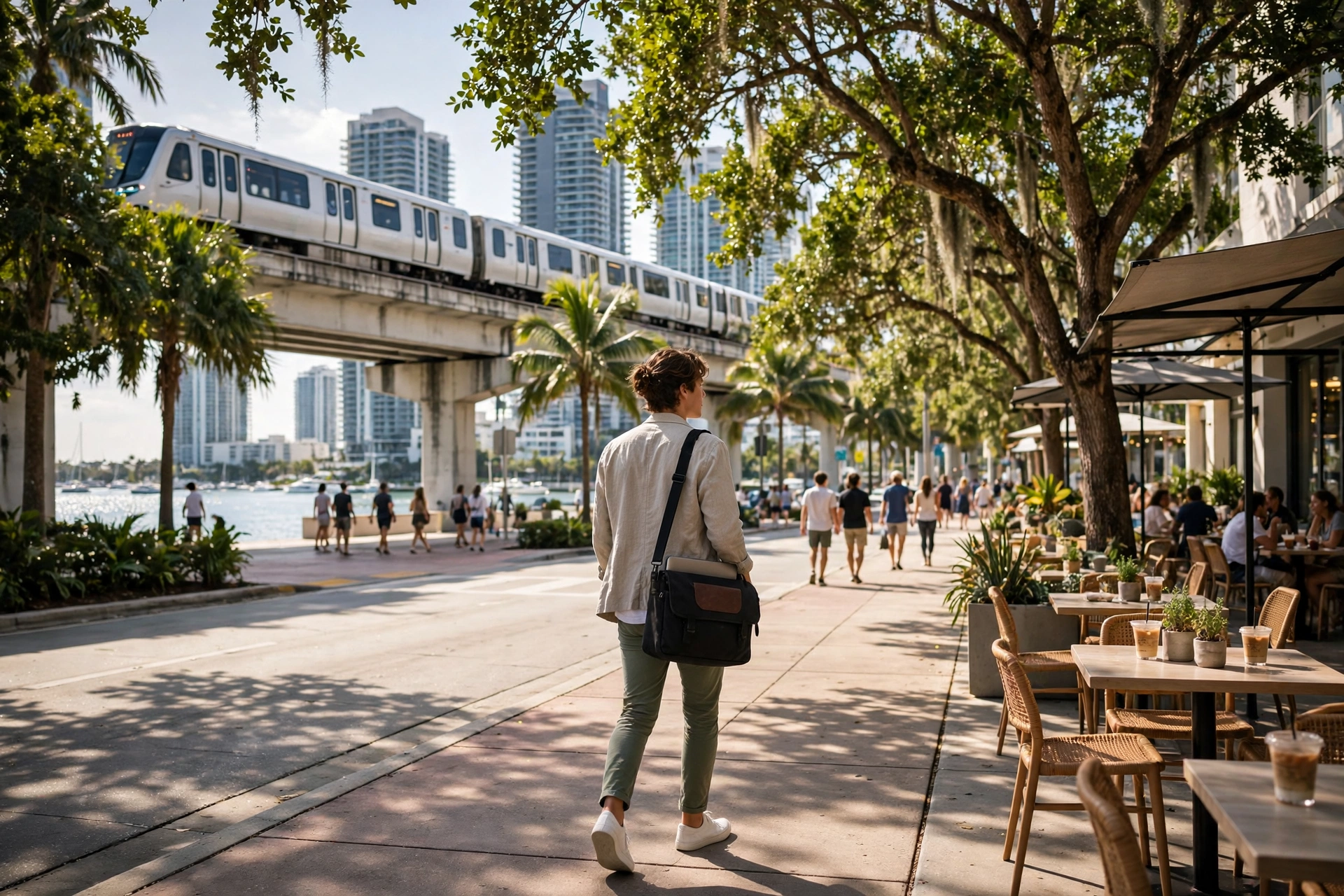
Short answer: If you are moving to Miami and asking about Miami neighborhoods with real walkability for remote workers without a car, the honest list is short. On Walk Score’s own table, Downtown (including Brickell) scores 91 for walking and 94 for transit, Wynwood-Edgewater scores 87, and Little Havana scores 87 — and after that the scores fall fast.
Inside those pockets, car-free life runs on free and cheap rails: the Metromover is free, the City of Miami trolley is free, and an unlimited monthly transit pass costs $112.50. Against that, AAA puts the average cost of owning a car in 2026 at $1,071.92 a month. The catch is that in Miami, walkability belongs to an address, not a neighborhood name — the rest of this guide is the test I use.
Updated: October 22, 2026.
¿Prefieres leer en español? Lee esta guía en español
Moving to Miami without a car: the neighborhoods that actually score
These are Walk Score’s published neighborhood figures — Walk, Transit and Bike, in that order. Read the transit column as carefully as the walk column: for a remote worker, transit is what replaces the car on the days walking does not work.
| Neighborhood | Walk / Transit / Bike | My verdict for remote workers |
|---|---|---|
| Downtown and Brickell | 91 / 94 / 75 | The default answer. The free Metromover loops at your door, Metrorail and Metrobus hub at Government Center, groceries and coworking inside the grid. This is the only zone where car-free is effortless. |
| Wynwood-Edgewater and Midtown | 87 / 64 / 78 | The best Bike Score in the set and a real daily-life grid in Midtown. But there is no rail station — the bus and the free Wynwood trolley do the heavy lifting, so your block matters more here. |
| Little Havana | 87 / 62 / 65 | Genuinely walkable along Coral Way and Calle Ocho, usually at lower rents than Brickell, and the free trolley runs through it. Less polished, more real — and the score is earned, not marketed. |
| Coconut Grove — village core only | 74 / 50 / 79 (Northeast Grove) | The village center around CocoWalk works beautifully on foot. The same neighborhood’s southwest side scores 60 / 42 / 61. In the Grove, you are buying a few specific streets, not a neighborhood. |
| Coral Gables — downtown core only | Address scores up to 92 near Miracle Mile | The most address-sensitive market on this list: an address at 550 Biltmore Way scores 92, while the Walk Score average around Miracle Mile is 60. Inside the core, superb; outside it, a car suburb with beautiful trees. |
| South Beach, Miami Beach | Up to 94 in its best pockets | A separate city with its own free trolley (four loops) and true walk-to-everything streets — but no rail link to the mainland, so airport and Brickell trips mean a bus or a rideshare across the causeway. |
Everywhere else in Miami-Dade, assume you need a car until an address-level check proves otherwise. That is not a criticism of those neighborhoods — it is simply what the numbers say, and it should shape your cost of living in Miami math before you sign anything.

The car-free budget: $112.50 against $1,071.92
The transit stack a car-free remote worker actually uses, at Miami-Dade Transit’s official fares:
| Piece | Cost | What it covers |
|---|---|---|
| Metromover | Free | Downtown, Brickell and the Arts and Entertainment district loops |
| City of Miami trolley | Free | Brickell, Coconut Grove, Coral Way, Little Havana, Wynwood and Biscayne routes, mostly 6:30 a.m. to 11:00 p.m. |
| Metrorail and Metrobus | $2.25 a ride | 23 rail stations including the airport line; transfers between bus and rail are free with an EASY Card |
| 1-month pass | $112.50 | Unlimited Metrorail and Metrobus — the car-free worker’s default |
| Owning an average new car (AAA, 2026) | $1,071.92 a month | $12,863 a year all-in: depreciation, insurance, finance, fuel, maintenance, fees |
My planning model for clients: the $112.50 pass, plus a $150 to $250 monthly allowance for the occasional rideshare, grocery delivery and the one trip transit does badly. That lands at roughly $263 to $363 a month — some $700 to $800 below the average car, every month. That gap is what pays the walkable-neighborhood rent premium, and it is also why the move-in cash matters: read how security deposits in Miami really work before you budget the signing, and if your Miami base is seasonal rather than permanent, the Canadian snowbird guide to a Miami winter runs the same car-free math for part-time residents.
What most people don’t know
1. A Walk Score belongs to an address, not to a neighborhood. Coral Gables proves it: 92 at one downtown address, a 60 average around the same Miracle Mile. Coconut Grove proves it again: 74 in the northeast, 60 in the southwest. Never rent “in a walkable neighborhood” — rent at a walkable address, and check the exact building before you fall in love with the area.
2. The free systems do not go to the beach. The Metromover is free and wonderful — inside Downtown and Brickell. The City of Miami trolley is free — and the city itself notes it does not go to Miami Beach. Miami Beach runs its own separate free trolley. And Metrorail reaches neither Miami Beach nor Wynwood. Car-free works when your daily life sits inside one system; it frays when every day crosses between them. My deeper breakdown of the network is in the SETTLE guide to Miami public transport and living without a car.
3. Walkable in January is not walkable in August. On NOAA’s 1991–2020 normals, Miami’s average high is about 76–77°F in January and 90–91°F in August, and June is the wettest month at roughly 9.5 to 10 inches of rain. A 15-minute walk to the grocery store is a pleasure in February and a strategy problem in September. The remote-work version of this trap: your “office” is home, so the walk that matters is not a commute — it is the midday errand, in the heat, between calls.
4. Your real commute is a 10-minute radius. With no office to reach, what decides car-free life is whether groceries, a pharmacy, a gym, good coffee and a coworking seat sit within about half a mile. Downtown and Midtown pass that test on almost every block. In the Grove and the Gables, only the core blocks pass it. Test any address at 2 p.m. on a weekday and again after rain — not at noon on a January Saturday, which is when every neighborhood in Miami looks walkable.
5. Dropping the car changes your lease checklist, not just your budget. Skip the parking space if the lease lets you — but ask, in writing, whether a parking fee is bundled into the rent whether you use it or not, and what the building charges guests. And keep the full map in view: all of these neighborhoods, plus the ones that failed the test, are indexed in our Miami relocation guides hub.

The half-mile test I run before I recommend an address
Map the five stops — grocery, pharmacy, gym, coffee or coworking, and a transit stop. All five inside a 10-minute walk, or the address is not car-free, whatever the listing says.
Ride the free layer first — if the address sits on a Metromover or trolley route, your bad-weather plan already exists. If the only transit is a bus stop, check its frequency, not just its existence.
Do the August test in your head — shade, covered walkways and short blocks matter more than the score. A treeless 12-minute walk in September sun fails people that a shaded 12-minute walk does not.
Price the whole life, not the rent — a cheaper rent that forces a car costs $1,071.92 a month more than it saves. Run the address against the pass-and-allowance model above before you decide it is “too expensive” to live centrally.
Frequently asked questions
Can a remote worker really live in Miami without a car?
Yes — in the pockets above, and roughly nowhere else without friction. Downtown and Brickell make it effortless (Walk Score 91, Transit Score 94, free Metromover). Midtown, Little Havana, the Grove village core, the Coral Gables downtown core and South Beach make it workable with the half-mile test. The budget also favors it: $112.50 a month for unlimited transit against AAA’s $1,071.92 monthly average cost of owning a car in 2026.
What is the most walkable neighborhood in Miami for remote work?
Downtown, including Brickell, on the numbers: Walk 91, Transit 94 — the highest transit score in the city, because the Metromover, Metrorail, Metrobus and the Brightline station all stack in the same few blocks. Wynwood-Edgewater (87) is the lifestyle alternative, with the city’s best Bike Score (78), but it has no rail station.
Does Miami transit reach the airport and the beach?
The airport, yes: Metrorail’s Orange Line runs to the Miami Intermodal Center, with the free MIA Mover into the terminals — $2.25 from Downtown. The beach, not by rail: Miami Beach is a separate city served by buses and its own free trolley loops, and neither the Metromover nor the City of Miami trolley crosses to it.
Is Coral Gables walkable without a car?
Only its downtown core. Addresses near Miracle Mile score as high as 92 and sit a short walk from the Douglas Road Metrorail station and the free Coral Gables trolley — but the Walk Score average around the Mile is 60, and residential Coral Gables beyond the core is built for cars. In the Gables, the exact address is the whole decision.
This article is general information about neighborhoods and public transport in Miami and Miami Beach, not legal or financial advice. Walk Score figures and transit fares change — confirm the score of a specific address and current fares before you sign a lease.
Yara Coker — SETTLE, relocation services in Miami.
Want help with your move to Miami?
Tell me where you work from, what your days actually look like and the neighborhoods you are considering — I will run the half-mile test on real addresses, price the car-free budget against the car version, and shortlist the blocks that pass.
Sources
Walk Score, Miami city page (walkscore.com/FL/Miami), consulted October 22, 2026: neighborhood table — Downtown Walk 91, Transit 94, Bike 75; Wynwood-Edgewater 87 / 64 / 78; Little Havana 87 / 62 / 65; Overtown 80 / 82 / 73; Coral Way 77 / 53 / 69; Northeast Coconut Grove 74 / 50 / 79; Southwest Coconut Grove 60 / 42 / 61; Miami described as “Very Walkable.” Address-level Walk Score figures: 550 Biltmore Way, Coral Gables, Walk Score 92, two blocks from Miracle Mile and a five-minute walk to Douglas Road Metrorail (LoopNet listing data, Walk Score); average Walk Score 60, Transit 33, Bike 54 for the area around 330 Miracle Mile (Walk Score via Realty.com); South Beach pockets (Ocean Drive, South of Fifth) at Walk Score 94 (Walk Score data compiled by CondoBlackBook). Miami-Dade Transit, official fares page (miamidade.gov), consulted October 22, 2026: Metrobus $2.25, Metrorail $2.25, Metromover free, 1-Day Pass $5.65, 7-Day Pass $29.25, 1-Month Pass $112.50, bus-to-rail and rail-to-bus transfers free with EASY Card or EASY Ticket, bus-to-bus transfers free within three hours. City of Miami Trolley, official information page (miamigov.com): free service; Biscayne, Brickell, Coconut Grove, Coral Way, Little Havana and Wynwood routes mostly 6:30 a.m.–11:00 p.m. Monday to Saturday with reduced Sunday hours on core routes; the City of Miami trolley does not go to Miami Beach, which operates its own free trolley system. AAA, Your Driving Costs 2026 (newsroom.aaa.com, September 15, 2026): average cost to own and operate a new vehicle $12,863 per year, or $1,071.92 per month, including depreciation of $4,422 per year, insurance of $2,098 per year, finance charges of $1,184 per year and license, registration and taxes of $802 per year. The $150–$250 monthly rideshare and delivery allowance and the resulting $263–$363 car-free monthly total are a SETTLE planning model, October 22, 2026, not a published fare. NOAA / National Weather Service 1991–2020 climate normals for Miami: average daily maximum about 76–77°F in January and 90–91°F in August; June the wettest month at about 9.5–10 inches of precipitation, within a May-to-October wet season of frequent afternoon thunderstorms.
Versión en español: Vivir en Miami: barrios de Miami realmente caminables para trabajadores remotos sin carro
