
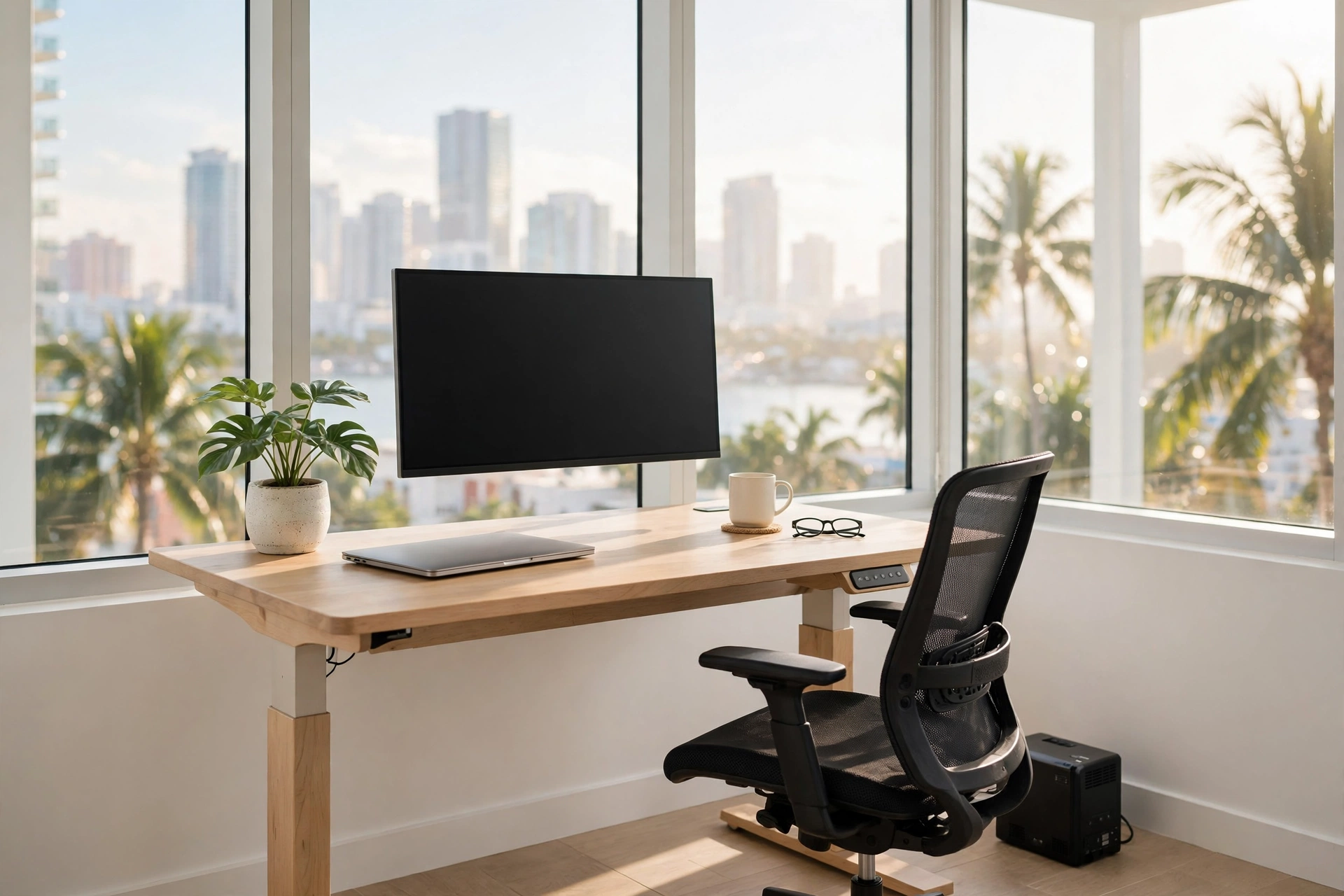
Short answer: if you are moving to Miami and will work from home, budget US$791 to US$1,176 one time for the office itself — US$791 for an essential setup (desk US$110, proper chair US$300, 27-inch monitor US$209, peripherals US$120, plus Miami-Dade’s 7% sales tax) or US$1,176 for the recommended version with a sit-stand desk and the one item northern guides never budget: a US$220 battery backup for storm season. Then budget the part most people miss: about US$84 a month to run it (fiber internet US$55 plus roughly US$29 of extra daytime electricity). The real cost of living in Miami decision is not the gear — it is whether you rent an extra bedroom as your office at US$400 a month forever, or spend US$1,176 once and keep the difference. The full breakdown, the tax trap, and the stipend math are below.
Updated: October 17, 2026.
¿Prefieres leer en español? Lee esta guía en español
Moving to Miami: what a home office setup actually costs, line by line
The literal question — home office setup cost when relocating to Miami — has three answers depending on how long you will sit in it. All prices below are real US retail prices checked on October 17, 2026, at IKEA US, Dell retailers and Best Buy — not list-price guesses.
The three builds (one-time, before tax)
| Item | Essential | Recommended | Resilient |
|---|---|---|---|
| Desk | IKEA MICKE 55″ — US$110 | IKEA TROTTEN sit/stand — US$250 | IKEA TROTTEN sit/stand — US$250 |
| Chair | IKEA MARKUS — US$300 | IKEA MARKUS — US$300 | IKEA MARKUS — US$300 |
| Monitor(s) | Dell 27″ P2725H — US$209 | Dell 27″ P2725H — US$209 | Dell 27″ + Dell UltraSharp 27″ — US$598 |
| Peripherals (keyboard, mouse, headset, lamp) | US$120 | US$120 | US$120 |
| Battery backup / surge (UPS) | — | APC Back-UPS Pro 1500VA — US$220 | APC Back-UPS Pro 1500VA — US$220 |
| Subtotal | US$739 | US$1,099 | US$1,488 |
| Miami-Dade sales tax (7%) | US$52 | US$77 | US$104 |
| Total one time | US$791 | US$1,176 | US$1,592 |
Two notes on that table. First, the chair does not shrink between tiers — the MARKUS at US$300, with a 10-year guarantee and a mesh back that breathes in Miami humidity, is the cheapest seat I would put anyone in for eight hours a day; saving US$200 on a chair is how a US$791 setup becomes a chiropractor bill. Second, if your employer ships you a laptop, dock and monitor — ask before you buy anything — every line they cover comes straight off these totals.
The monthly cost nobody budgets: running the office
Your employer used to pay for your desk’s electricity, cooling and bandwidth. In Miami, you inherit that bill. Internet first: AT&T Fiber’s 300 Mbps plan runs US$55 a month in Miami with symmetrical upload — the upload speed is what your video calls actually use — while Xfinity’s 300 Mbps starts at US$40 a month on promotion across most of the city. Which one reaches your desk depends on your exact address and building contract, which is why I check internet speeds by Miami neighborhood for remote workers before signing a lease, not after.
Power second. FPL’s all-in residential bill works out to about US$143.53 per 1,000 kWh — roughly 14.4 cents per kWh with every surcharge in. Holding an apartment at working temperature all day instead of letting it drift while you are at an office, plus the gear itself, adds roughly 200 kWh in a warm month by my estimate: about US$29 a month. Internet plus power: ~US$84 a month, US$1,008 a year. First year with the recommended setup: US$1,176 + US$1,008 = US$2,184 all in.
What most people don’t know
If you are a W-2 employee, your tax deduction for all of this is US$0 — permanently. Older articles still say the home office deduction for employees is “suspended until 2026,” implying it comes back. It does not: the Tax Cuts and Jobs Act suspended it in 2018, and the One Big Beautiful Bill Act signed on July 4, 2025 made that suspension permanent. Under IRS Publication 587, only self-employed workers can deduct home office costs, and only for a space used exclusively and regularly as their principal place of business — the simplified method caps at US$5 per square foot up to 300 square feet, a US$1,500 maximum deduction. A guest bedroom that doubles as your office fails the exclusive-use test. If you are relocating as an employee, negotiate the stipend instead of planning on the deduction — there is no deduction.
The rent decision dwarfs the gear decision. On Zumper’s October 2026 medians, a Miami 1-bedroom costs US$2,500 a month and a 2-bedroom US$2,900. Renting the second bedroom as a dedicated office therefore costs US$400 a month — US$4,800 a year, every year. The recommended corner setup costs US$1,176 once and US$84 a month to run, so it pays for itself against the extra bedroom in about 3.7 months and then saves roughly US$3,792 a year. The honest alternative is not the dining table, either: it is a desk outside the home. Price that against coworking spaces in Miami for remote workers, with prices — a dedicated desk runs roughly US$235–399 a month, so the home setup equals about 3–5 months of coworking. Many people land on the hybrid: corner setup at home, coworking for meeting days and outage days. And whichever space you choose, the cash you need on day one is set by the deposit, not the rent — read how security deposits work in Miami before you budget the move.
Miami adds a line item no northern guide budgets: power protection. Your office will run through daily summer thunderstorms and a hurricane season on a grid that flickers. A 1500VA battery backup (the APC Back-UPS Pro is US$220 at Best Buy) will not run your office through a long outage — it gives your router, monitor and laptop a bridge of minutes to save work, shut down cleanly, and stay online through the flickers that corrupt calls and files. Skip it and one surge can take out a US$209 monitor and a workday with it. Treat the US$220 as insurance with a battery attached, and put the router on it too: in most flickers, the power comes back before your internet session even notices.
Your employer’s stipend probably covers this — but the timing rules bite. Public policies show the range: GitLab offers a US$1,500 new-hire home office stipend — enough to cover the recommended build (US$1,176) with US$324 left — plus a US$500 annual refresh that only applies if you were employed for the entire previous calendar year and does not carry forward; Buffer offers US$1,000 one time, which covers the essential build. The traps are in the fine print: some policies exclude routers, require pre-approval or approved retailers, and refuse purchases made before your start date. Read the policy before the IKEA run, keep every receipt, and if your offer has no stipend, this table is your negotiation document — US$1,176, itemised, is a modest ask next to the roughly US$11,000 a year employers save per remote seat on office space.
The forgotten lines: tax, delivery and assembly. The 7% Miami-Dade sales tax adds US$52–104 to the builds above and is missing from almost every budget list online. Add delivery if you arrive without a car — and most relocators do — plus assembly time: a sit/stand desk and a chair are an evening of work, not an afternoon break. If you are testing Miami for a season before committing to any of this, our snowbird guide to a Miami winter shows how seasonal renters structure a furnished stay — a furnished unit moves most of this table to the landlord’s side of the ledger. When you are ready to choose where the desk will live, start from our complete library of Miami relocation guides and the best neighborhoods in Miami for remote work — fibre by address, not by ZIP code, should be on your checklist next to rent.
Frequently asked questions
How much does a home office setup cost when relocating to Miami in 2026?
US$791 for an essential setup (IKEA MICKE desk US$110, MARKUS chair US$300, Dell 27-inch monitor US$209, peripherals US$120, plus 7% sales tax) or US$1,176 for the recommended build with a sit-stand desk and a US$220 battery backup. Add about US$84 a month to run it — US$55 for fiber internet and roughly US$29 of extra daytime electricity — for a first-year total of about US$2,184.
Can I deduct my Miami home office on my taxes?
If you are a W-2 employee, no — the federal deduction for employees was suspended in 2018 and made permanent in July 2025; your deduction is US$0 even if you work from home full time. If you are self-employed, IRS Publication 587 allows a deduction for a space used exclusively and regularly as your principal place of business: up to US$1,500 under the simplified method (US$5 per square foot, 300 square feet maximum), or actual expenses on Form 8829. Equipment is deducted separately. This is general information, not tax advice.
Is it cheaper to rent a 2-bedroom or buy a home office setup?
The setup, by a wide margin. The step from a Miami 1-bedroom (US$2,500) to a 2-bedroom (US$2,900) on October 2026 Zumper medians is US$400 a month — US$4,800 a year. The recommended US$1,176 setup pays for itself against that premium in about 3.7 months. Rent the extra bedroom for space or family, not for a desk.
What does my employer owe me for a home office?
Usually nothing by default — a stipend is policy, not law, for most private employers. Published policies run from US$250 to US$1,500 one time (GitLab US$1,500; Buffer US$1,000), sometimes plus a monthly internet amount. Ask for the written policy before you buy: pre-approval, eligible items and purchase-date windows decide what gets reimbursed.
This article is general information about relocation planning, not legal or tax advice. Prices are US retail prices checked on October 17, 2026, and move with promotions; confirm the terms of any lease, stipend policy and tax position before spending.
Yara Coker — SETTLE, relocation services in Miami.
Want help with your move to Miami?
Tell me your work setup — employee or self-employed, one screen or two, and whether your employer offers a stipend — and I will price your move to Miami with the office included: the right neighborhood for fiber, the right size unit for your desk, and the real first-year number, line by line.
Sources
IKEA US product prices, October 2026 (MICKE desk US$109.99; TROTTEN sit/stand desk US$249.99; BEKANT desk US$309; MARKUS office chair US$299.99). Dell 27-inch monitors: P2725H US$208.99–216.64 (Adorama / OfficeSupply); UltraSharp U2724D US$389 (Best Buy, comparable value US$429.99). APC Back-UPS Pro 1500VA US$219.99 (Best Buy, model BN1500M2). Peripherals bundle (~US$120) from a 2026 remote-worker checklist: keyboard/mouse combo ~US$50, headset ~US$45, desk lamp ~US$25. Internet: AT&T Fiber 300 Mbps US$55/mo and Xfinity 300 Mbps from US$40/mo promotional, Miami provider summaries, October 2026. Electricity: Florida Municipal Electric Association residential bill comparisons, January–June 2026 — FPL combined 1,000 kWh bill US$143.53 (~14.35 cents/kWh all-in); Florida average household ~US$169–170/mo on ~1,099 kWh (EIA data). Extra daytime consumption (~200 kWh/mo, ~US$29) is a SETTLE estimate, labelled as such. Rents: Zumper Miami rent research, updated October 16, 2026 (1-bedroom US$2,500/mo; 2-bedroom US$2,900/mo). Taxes: IRS Publication 587 (exclusive and regular use; simplified method US$5/sq ft up to 300 sq ft); Tax Cuts and Jobs Act suspension of the employee home office deduction (2018) made permanent by the One Big Beautiful Bill Act, signed July 4, 2025. Stipends: GitLab public expense policy (US$1,500 new hire + US$500 annual refresh with full-prior-year rule; checked October 6, 2026) and Buffer (US$1,000 one time), via 2026 stipend summaries. Coworking dedicated-desk range (US$235–399/mo) from earlier verified guides in this series. Sales tax: Miami-Dade combined 7% (6% Florida + 1% county). All computations by SETTLE, October 17, 2026.
Versión en español: Vivir en Miami: costo de montar una oficina en casa al mudarte a Miami
