
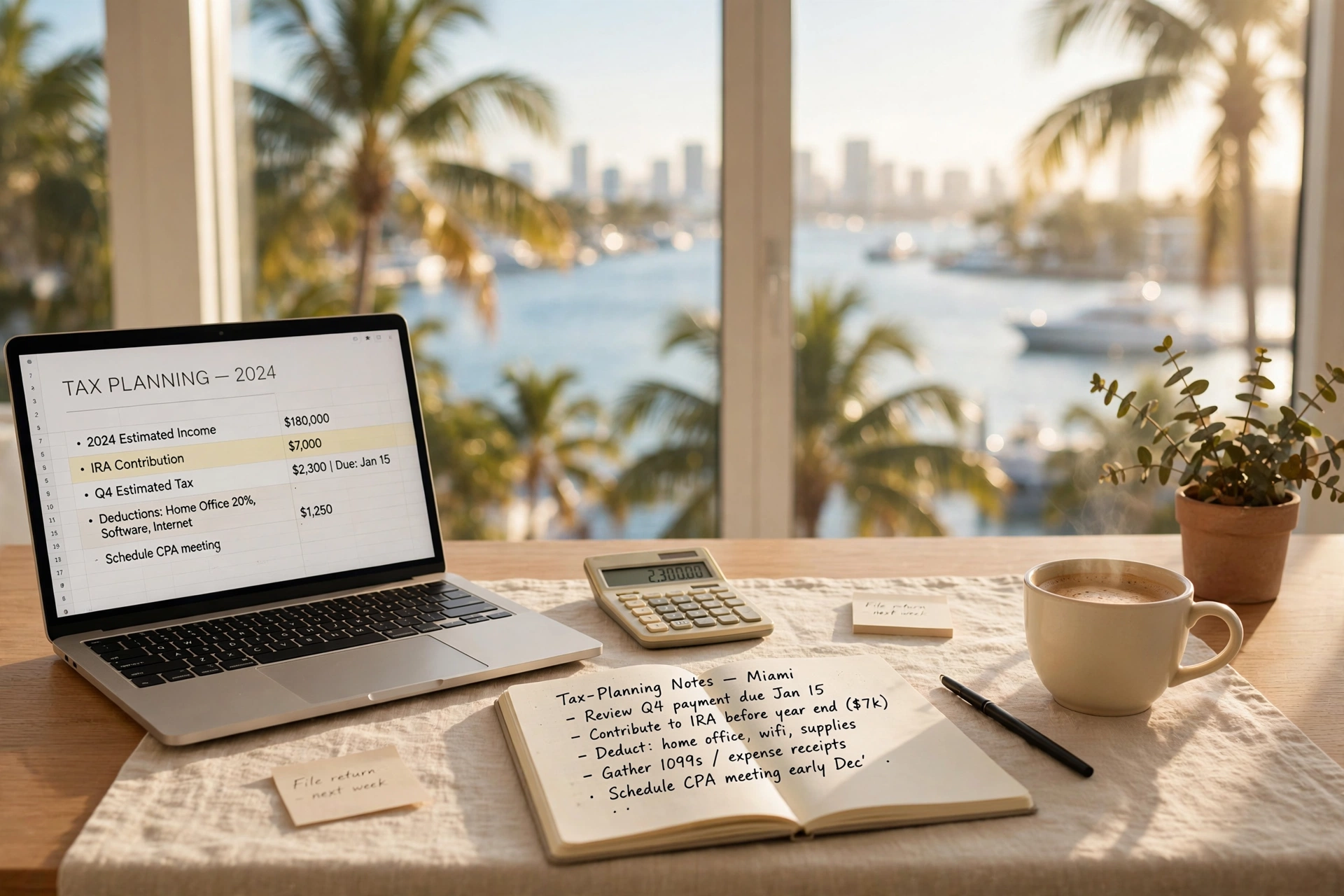
Short answer: moving to Miami from California or New York as a remote worker can erase US$5,200 to US$13,700 a year in state income tax — on a US$150,000 salary, roughly US$9,858 of California tax or US$13,670 of New York state + city tax drops to US$0 in Florida. But the two states play by different rules: California stops taxing you once you are genuinely gone, while New York can keep taxing your wages when you work remotely from Miami for a New York employer — its “convenience of the employer” rule survived another court challenge in July 2026. The move saves real money; the paperwork is what decides whether it sticks.
Updated: October 11, 2026.
¿Prefieres leer en español? Lee esta guía en español
What remote workers actually save in 2026: the numbers
Florida has no personal income tax — the state constitution effectively bars it, and the Department of Revenue imposes no filing requirement on individuals. California’s top rate is 13.3%, the highest in the country; New York’s top state rate is 10.9%, plus up to 3.876% for New York City residents. Here is what that means in practice (planning estimates, single filer; federal tax is identical everywhere):
| Salary | CA tax you stop paying | NYC (state + city) tax you stop paying | FL tax you start paying |
|---|---|---|---|
| US$100,000 | ≈ US$5,208 | ≈ US$8,302 | US$0 |
| US$150,000 | ≈ US$9,858 | ≈ US$13,670 | US$0 |
These are computed from the official 2026 rate schedules, before personal credits; real bills vary. For New York movers, the deeper state-by-state comparison is worth reading separately — and the part most remote workers miss is not the rate, it is what happens after you move.
California leavers: the clean break (with one catch)
California is aggressive about residency audits, but it does not have a convenience-of-the-employer rule. As a nonresident, California taxes you only on the days you physically perform services in California — work from your Miami home for a California company and those days are not California-taxable. The catch: any day you fly in to work at the California office is taxable there, apportioned by workdays. Keep a travel log, and file a part-year resident return for the year you move — the Franchise Tax Board publishes the move-year rules with its Form 540 instructions.
New York leavers: the trap most remote workers miss
New York is the mirror image. Its convenience-of-the-employer rule says that if you work for a New York employer from outside the state, those wages are still New York-source income unless the remote arrangement exists because your employer requires it — not because you chose it. A state appeals court upheld the rule again in July 2026 (Matter of Zelinsky), holding that work which “could be performed anywhere” stays taxable even when the employer’s New York office is closed. Translation for the Miami-bound remote worker: if your company is fine with you working from Brickell by choice, New York may still take its cut. The only clean exits are an employer-mandated remote arrangement — get it in writing — or leaving the New York job behind. New York also runs one of the country’s most aggressive exit-audit programs, with two separate tests (domicile and the 183-day statutory residency rule) that decide whether you still owe tax on worldwide income.
What most people don’t know
Three facts that decide whether the savings survive contact with reality:
1. “183 days” is not a Florida law. There is no Florida statute that makes you a resident at 183 days — domicile is a facts-and-circumstances test. The paper trail is what counts: file a Declaration of Domicile with the Miami-Dade Clerk, get a Florida driver’s license within 30 days of establishing residency, register to vote in Florida, and move your bank accounts, doctors and memberships. If you buy, file for homestead exemption by March 1 — it cuts up to about US$51,000 off your taxable value in 2026 and caps annual assessment growth.
2. Your employer’s payroll department is part of the plan. Give payroll your new Florida address before the first Miami paycheck so California or New York withholding stops. If withholding continues, you reclaim it on a part-year resident return — but the money sits with the wrong state until then. For New York, update withholding with your employer via Form IT-2104.
3. The move year always has a tax return on both sides. Expect a part-year resident return in California or New York for the year you move, plus your federal return. The federal SALT cap is US$40,000 for 2025–2029 under the 2025 federal tax law, so if you itemize, the federal math of staying changed a bit — the state-level savings of moving did not.
Cost of living in Miami: where the savings actually land
The tax line is the loudest, but it is not the only one. A one-bedroom in Miami averages US$2,500 a month (Zumper, October 2026) — below coastal California and New York City norms — and Florida’s overall cost-of-living index sits at 100.8 against the US average of 100 (MERIC, Q2 2026). Counterweights to price in: homeowners insurance averages US$8,471 a year in Florida in 2026, the highest in the country, and the combined state-plus-county sales tax runs 7–8% in Miami-Dade. If you rent when you land, budget the first month plus deposit up front — here is how security deposits in Miami actually work (Florida sets no statutory cap).
Testing Miami before you commit?
Plenty of remote workers land on a three-month furnished lease to try a neighborhood before signing a year. If winter is your window, this is what a winter 2026–2027 season in Miami really costs. And our Miami relocation guides hub collects every playbook in this series.
Frequently asked questions
I work remotely from Miami for a California company. Do I owe California tax?
Not on the days you work from Miami — California taxes nonresidents only on days physically worked in the state. But days you spend working at the California office are taxable there, so keep a travel log and file a part-year return for the move year.
My employer is in New York and I am moving to Miami. Am I done with New York tax?
Not automatically. Under the convenience-of-the-employer rule, New York keeps taxing those wages unless your employer requires the remote arrangement — employee choice does not count. Get the employer’s requirement in writing, or plan for continued New York withholding.
Is spending 183 days in Florida enough to make me a Florida resident?
No. Florida has no 183-day residency statute; domicile is proven by facts and circumstances. Build the paper trail: Declaration of Domicile, Florida license within 30 days, voter registration, homestead filing by March 1.
Should I keep my old driver’s license “for convenience”?
Do not. Florida requires a new license within 30 days of establishing residency, and keeping the old one actively undermines your domicile claim if California or New York audits you.
This article is general information about relocation planning, not tax or legal advice. Confirm your strategy with a qualified tax professional before you move.
Yara Coker — SETTLE, relocation services in Miami.
Want help with your move to Miami?
Tell us where you are moving from and when — we will map the domicile checklist, the timeline and the neighborhoods that fit your remote-work life.
Sources
State tax rates and brackets: Tax Foundation, “2026 State Income Tax Rates and Brackets” (Jan 2026); NY Dept. of Taxation and Finance, Form IT-2105-I (2026); California FTB, 2026 Form 540-ES instructions. Worked savings examples computed from those schedules. Convenience rule: NY Appellate Division, Third Dept., Matter of Zelinsky (July 2026). Florida: FL Constitution Art. VII §5; FL DOR “Tax Information for New Residents” (GT-800025). Homestead: FL Stat. §196.031; Miami-Dade Property Appraiser (filing deadline March 1). Rents: Zumper Miami rent research (Oct 2026). Cost-of-living index: MERIC Q2 2026. Insurance: Insurance.com (2026).
Versión en español: Impuestos para trabajadores remotos: vivir en Miami viniendo de California o Nueva York en 2026
