
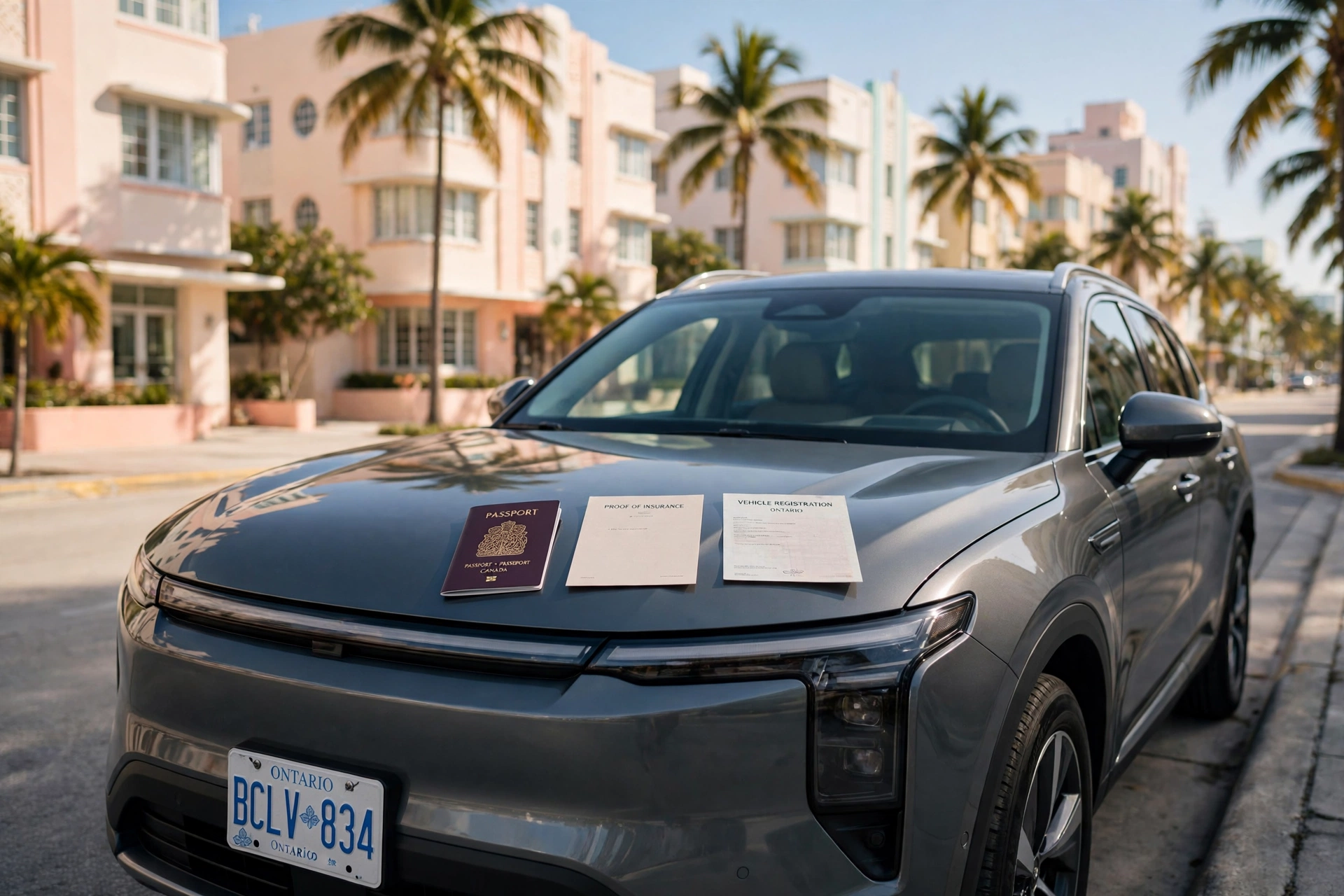
Short answer: if you are moving to Miami for the winter in your own car, you can legally drive it on Canadian plates all season — no Florida registration, no Florida plates, no import duty — as long as three conditions hold: (1) you stay a nonresident in Florida’s eyes (you do not take a job here and you do not enroll kids in a Florida public school — either one triggers Florida registration within 10 days under Florida Statute 320.38), (2) your car stays under the U.S. Customs temporary-entry limit of 1 year for nonresidents, and (3) your Canadian insurer knows, in writing, before you cross. That third condition is where the money is: a typical provincial minimum of about C$200,000 in liability is thin in a U.S. claim paid and litigated in U.S. dollars, and the Canadian Snowbird Association’s long-standing advice is to raise it to at least C$2 million for a Florida winter. Your valid Canadian driver’s licence is all Florida asks of a visitor — no International Driving Permit — and since April 2025 there is one new paper that has nothing to do with the car: if you drive across the land border, stay 30 days or more and were not issued a Form I-94, you must register online with USCIS Form G-325R.
Updated: October 15, 2026.
¿Prefieres leer en español? Lee esta guía en español
Moving to Miami on Canadian plates: what Florida actually requires
| Question | Typical snowbird (no job, no kids in school) | If your situation changes |
|---|---|---|
| Florida registration? | No — exempt under Florida Statute 320.37 if the car is properly registered at home and displays its plate | Yes, within 10 days, if you accept employment in Florida or enroll children in public school (320.38) |
| Florida driver’s licence? | No — a valid licence from your province is enough as a visitor | Yes, within 30 days of becoming a resident: job, voting, homestead filing, kids in public school, or living here more than 6 consecutive months |
| U.S. Customs / duty? | Duty-free temporary entry for personal use, up to 1 year, no sale in the U.S. | Staying beyond 1 year means exporting the car or formally importing it (safety/emissions compliance) |
| Insurance that counts | Your Canadian policy, with your insurer notified in writing of the Florida stay | If you ever register in Florida: Florida-issued PIP $10,000 + PDL $10,000 minimums are required first |
| Immigration paper (2025) | Check for an I-94 after crossing by land; if none and stay is 30+ days, file USCIS Form G-325R | Arriving by air usually generates an electronic I-94 — that already counts as registration |
That exemption is the legal backbone of the whole snowbird drive south, and it is narrower than most people assume: it does not cover vehicles run for hire, commercial vehicles, or recreational vehicles and mobile homes kept in Florida for six consecutive months or more. A family car used privately for a winter season sits squarely inside it. Our Canadian snowbird guide to Miami for winter 2026–2027 shows where the drive fits in the full season calendar, from booking the rental to the day-count that matters for taxes.
Cost of living in Miami with your own car: the insurance decision
Bringing your own car is usually the cheapest way to hold down the cost of living in Miami for a season — no four-month rental, no rideshare drip — but only if the policy travels with you on paper, not just in your glove box. Canadian auto policies generally recognize coverage in the United States, yet three details vary by province and by insurer, and all three belong in an email to your broker before departure, not after a crash on I-95:
1. Notify the stay, and keep the answer. Some brokers want formal notice of your departure and return dates and may charge a supplementary premium for operating the car abroad, especially beyond 30 days. If your insurer learns about a five-month Florida garaging from a claim report instead of from you, you have handed them an argument.
2. Raise the liability limit. Claims in Florida are priced in U.S. dollars and your policy pays out up to its limit in Canadian dollars. The gap between a C$200,000 provincial minimum and a serious U.S. injury claim is exactly the gap the Canadian Snowbird Association warns about when it recommends at least C$2 million. Compared with a season’s rent in the best neighborhoods in Miami for snowbirds, the premium difference is small; compared with one uninsured excess claim, it is the whole story.
3. Check the out-of-province clock and the rental gap. Policies can limit how long the car may be outside its home province, how roadside and rental-car benefits work in the U.S., and whether you pay a U.S. repair or rental bill up front in U.S. dollars and wait for reimbursement in Canadian dollars. Budget a credit card with room for that float — it surprises people every winter.
Do not confuse any of this with Florida’s own minimums. The $10,000 of Personal Injury Protection and $10,000 of Property Damage Liability that Florida requires are conditions for registering a car in Florida with a Florida-licensed insurer. A visiting Canadian-plated car is not registered here, so those numbers are not your test — your Canadian policy’s territory, duration and liability limit are.
What most people don’t know
The 2025 registration rule catches drivers, not flyers. Canadians who fly in are generally issued an electronic I-94, which counts as their U.S. registration. Canadians who drive in at a land border may or may not get one. After you cross, look up your record on CBP’s I-94 site: if there is no I-94 and your stay will reach 30 days, file Form G-325R online through a USCIS account — it is free, Canadians are exempt from fingerprinting for this filing, and a recent admission through a NEXUS lane also counts as registration. Print the proof and carry it; adults are expected to carry evidence of registration. This is separate from taxes and separate from your car paperwork.
Leaving the car in Florida all year breaks the simple story. The exemption and most Canadian policies assume a car that lives in Canada and visits Florida. A car garaged in Miami twelve months a year — while you fly back and forth — is a different risk on paper, and many Canadian policies will not quietly cover permanent U.S. garaging. If that is your plan, say so before you buy or store: the honest options are usually a Florida-titled second car with Florida insurance, or a storage arrangement your insurer agrees to in writing.
Your lease can ban the car your province allows. Plenty of Miami condos assign one parking space, charge an extra monthly fee for a second vehicle, or require the building’s own vehicle registration and decal — with the plate on file. Ask for the parking rules before you drive 2,500 km to a building that has no space to sell you, and read how security deposits in Miami actually work before you hand over a parking deposit on top of the rental deposit.
Tolls will find a Canadian plate — slowly, and at the higher rate. Miami’s toll roads are largely cashless. Without a transponder, Toll-By-Plate invoices the registered owner at a higher toll rate plus an administrative charge per invoice, mailed to the address on the registration — an address sitting empty in Ontario until spring. A SunPass transponder on the windshield, with your Canadian plate registered to the account, pays the lowest rate and ends the paper chase. Express lanes require a transponder outright.
Selling the car in Florida is not an exit option. A car brought in under the nonresident temporary entry may not be sold in the United States and must be exported within the year if it does not meet U.S. standards. If you fall in love with winter and want the car to stay permanently, that is a formal import conversation — not a private sale in March.
Best neighborhoods in Miami for a winter with your own car
A car changes which of the best neighborhoods in Miami actually work for a snowbird season. With your own vehicle, the Fort Lauderdale–Hollywood–Hallandale corridor and Aventura reward you with easier parking and quick highway access to both airports, while Brickell rewards you with a parking bill — condo parking beyond the first space is scarce and priced like rent. Browse the full comparison in our moving-to-Miami guides for Canadian snowbirds and other newcomers before you pick the building, because the parking line in the lease matters more than the ocean view in February traffic.
Frequently asked questions
Can I drive in Florida with just my Canadian licence?
Yes. Florida’s highway safety authority says a visitor must carry a valid licence issued in their name by their country of residence. Canadians do not need an International Driving Permit in Florida. You only need a Florida licence within 30 days of becoming a resident — for example by taking a job, filing for homestead, enrolling kids in public school, or living here more than six consecutive months.
Do I have to register my Canadian-plated car in Florida for a 4-month stay?
Not if you remain a nonresident and the car is properly registered at home: Florida Statute 320.37 exempts you. The exemption is lost in specific cases — accepting employment or enrolling children in public school triggers registration within 10 days — and it never covered for-hire or commercial use.
Is my Canadian insurance valid in Florida?
Generally yes for U.S. travel, but validity is not the same as adequacy or permission for a long stay. Tell your insurer the dates in writing, confirm the out-of-province duration your policy allows, and raise liability toward the C$2 million level recommended for U.S. driving. Keep the insurer’s reply with your registration and licence in the car.
What if I ship the car instead of driving it?
The same temporary-entry logic applies — up to one year, personal use, no sale — but the carrier handles the border paperwork and you should confirm in the shipping contract who files what, plus whether your policy covers the car while it is in transit. And the 30-day registration check still applies to you: if you fly in, verify your electronic I-94 was issued.
This article is general information about relocation planning, not legal, immigration or insurance advice. Registration, insurance territory and immigration registration turn on your province, your policy and how you entered the U.S. — confirm your setup with your insurer and, where needed, a cross-border professional before you cross.
Yara Coker — SETTLE, relocation services in Miami.
Want help with your move to Miami?
Tell us where you’re driving from, how long you’re staying and which building you’re renting — we’ll check the parking rules, the season calendar and the paperwork order before you turn the key.
