
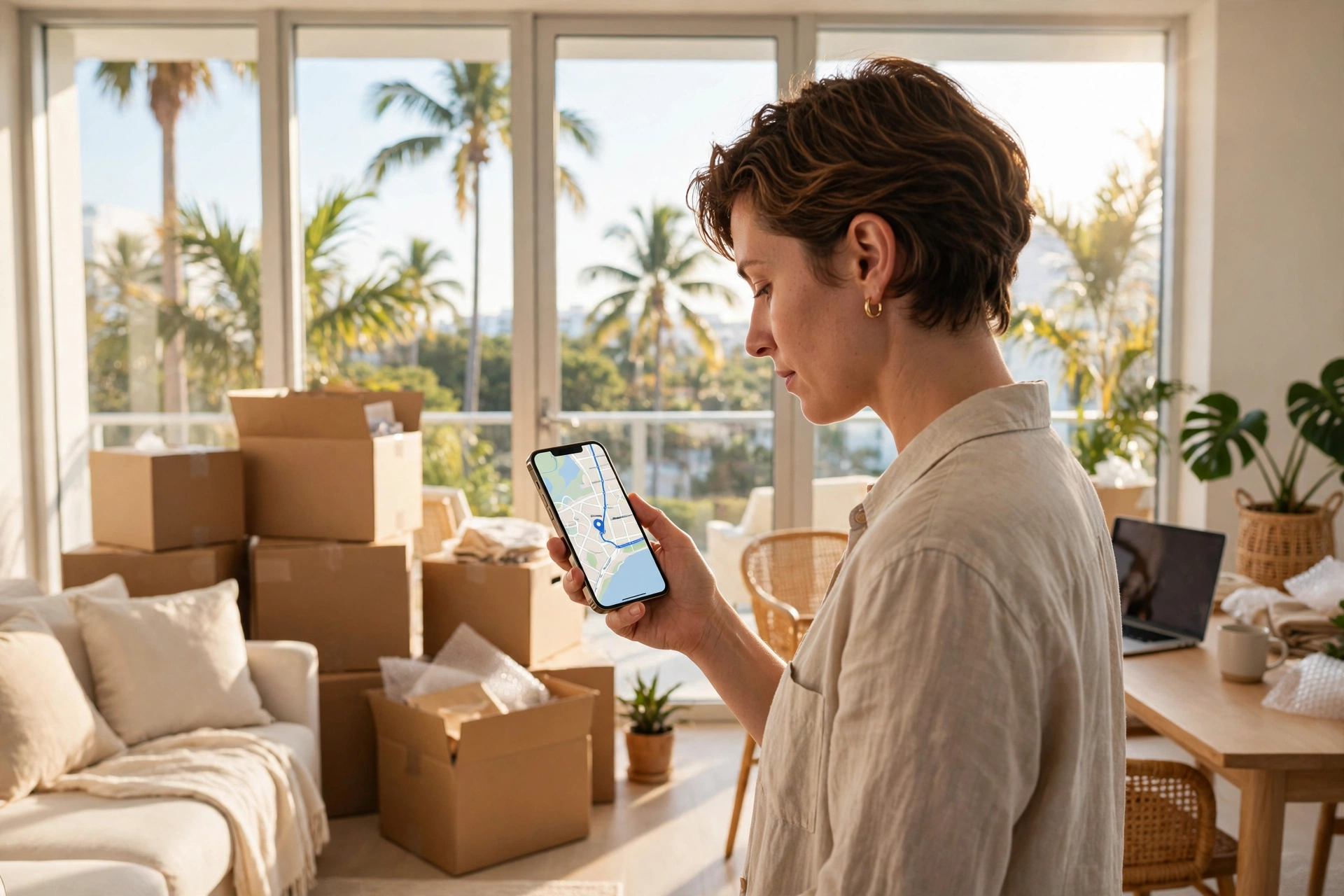
Short answer: Cell phone plans for newcomers in 2026 — if you are moving to Miami without a Social Security number or a US credit file, the $25 plan beats the $75 plan, and it is not close. The cheapest honest option is prepaid on a major network: Visible runs on Verizon’s network at US$25 a month with taxes and fees already included, no credit check, no SSN. The big carriers’ entry postpaid plans advertise US$50–65 a month, but Florida adds some of the heaviest wireless taxes in the country — the Tax Foundation’s July 2026 tally puts the combined burden at 29.5% — plus a US$35 connection charge per line, so a US$65 plan really closes near US$75–85 a month. That gap, about US$670–790 per line per year on my modeling, is a real line in your cost of living in Miami budget, and in year one the expensive plan buys you almost nothing the $25 plan does not.
Updated: October 16, 2026.
¿Prefieres leer en español? Lee esta guía en español
Moving to Miami: cell phone plans for newcomers, priced honestly
Compare what you actually pay, not the headline. Every price below was checked in October 2026 against the carrier’s own pages or first-level trackers, and the source list at the end separates the official figures from my models.
| Plan | Network | Advertised price (1 line) | What you really pay | SSN / credit check? |
|---|---|---|---|---|
| Visible (base, prepaid) | Verizon | US$25/month | US$25/month — taxes and fees included, unlimited data, talk and text, unlimited hotspot at 5 Mbps, unlimited talk and text to Mexico and Canada | No — prepaid, no credit check |
| Mint Mobile Unlimited (prepaid) | T-Mobile | US$15/month in intro promotions | US$30/month only if you prepay 12 months (US$360), taxes and fees extra; renewing every 3 months costs US$40/month | No — prepaid, no credit check |
| T-Mobile Essentials Saver (postpaid) | T-Mobile | US$50/month | US$50 plus taxes and fees — reviewers estimate roughly US$56–60 all-in — plus a one-time US$35 device connection charge | Yes — official terms require credit approval; a deposit may be required |
| Verizon Unlimited Welcome (postpaid) | Verizon | US$65/month with AutoPay | US$65 plus taxes and fees — on Florida’s 29.5% combined wireless burden, plan on roughly US$75–85 a month (SETTLE estimate) | Yes — credit check; a deposit may be required without a US file |
Run the year, not the month. One line on Visible costs US$300 in a full year, everything included. One line on an entry postpaid plan advertising US$65 costs roughly US$970–1,090 in year one once taxes, carrier fees and the connection charge land. For a family of four the contrast is starker: four Visible lines are US$100 a month, exactly, while four entry postpaid lines start around US$200–260 advertised and close higher. And the phone is not your only first-week cash call — the same week you activate a line you are usually posting a deposit, so read our guide to security deposits in Miami and how they really work before you budget either one.
What most people don’t know
1. Headline prices lie in opposite directions. A postpaid headline excludes taxes and fees, and Florida is one of the worst states for that surprise: 15.11% state and local plus 14.39% federal charges in the Tax Foundation’s July 2026 table, a 29.5% combined load on taxable charges. A prepaid headline with taxes included, like Visible’s $25, is the final number. And a prepaid headline can lie the other way: Mint’s widely advertised $15 a month is an introductory promotion for new customers. On Mint’s own plan pages, Unlimited renews at $30 a month only on the 12-month prepay, $35 on six months and $40 on three months, with taxes and fees extra. Budget the renewal price of any plan, never the doorway price.
2. Without an SSN, prepaid is not the budget option — it is the door. Postpaid service is a credit product: the carrier checks your file, and with no US file the answer is often a deposit, a partial approval or a trip to a store with your passport hoping for an exception. Prepaid removes the gate entirely — you pay first, so there is nothing to approve: no SSN, no credit check, no deposit, activation by eSIM in minutes. You give up device financing promotions and some priority data at busy towers; on the same towers, in the best neighborhoods in Miami and everywhere else in the city, the coverage map is the host network’s map.
3. Your US number works like an ID document here. Banks, landlords, delivery apps and government portals send verification codes by SMS, and those short-code messages routinely fail to reach foreign numbers — and are often blocked on free internet-based numbers too. Get a real US mobile number in week one and put it on every application from then on; it pairs with the account itself, as our guide to opening a US bank account without an SSN explains. Keep your number from home alive on the second SIM slot or eSIM: your home bank’s codes and your WhatsApp history live on it. Dual-SIM is not a luxury for a newcomer — it is how you stay reachable in two countries at once.
4. A locked phone from home will not take a US SIM — check it before you fly. Under the FCC’s guidance and the CTIA standard carriers follow, a postpaid phone unlocks once it is paid off and the contract terms are met, and a prepaid phone must be unlockable no later than one year after activation. A handset still locked to a carrier back home rejects a US SIM or eSIM no matter which plan you buy. Before landing: confirm your phone is unlocked, check its IMEI on the US carrier’s compatibility tool, and confirm it supports eSIM if you want same-day activation. If it is locked, the fix happens with your home carrier, not in a Miami store.
5. The $30 government internet discount is gone — and so is the excuse to overpay. The Affordable Connectivity Program ended on June 1, 2024, and there is no active enrollment in October 2026, whatever outdated websites still advertise it. What survives is Lifeline, worth up to $9.25 a month off broadband or a bundled service ($5.25 for voice-only) if your household qualifies by income or program participation. Seasonal residents should note the same math applies to a part-time line: our Canadian snowbird guide to a winter in Miami covers the rental side of a winter base, and a $25 prepaid line you can pause beats a postpaid contract billing a empty condo. For the full library, browse our Miami relocation guides hub.
Frequently asked questions
Can I get a cell phone plan in Miami without a Social Security number?
Yes — prepaid is built for exactly this. Visible, Mint and the other prepaid brands activate with a passport and a payment method, with no SSN and no credit check, often by eSIM before you even leave the airport. Postpaid plans from the big three run a credit approval; without a US credit file they may require a deposit or decline the account, which is why I start every newcomer on prepaid and revisit postpaid later.
How much does a cell phone plan cost in Miami in 2026?
For one line: US$25 a month all-in on Visible’s prepaid base plan; US$30 a month on Mint Unlimited if you prepay a year (US$360, taxes extra); roughly US$56–85 a month all-in on entry postpaid once Florida taxes and fees land on the US$50–65 advertised prices. That spread — US$300 versus roughly US$970–1,090 in year one — is why the phone belongs in your cost of living in Miami plan from day one, not as an afterthought.
Should I keep my phone number from home?
Yes, on the second slot. Keep your home number active on a dual-SIM phone or eSIM for your home bank’s verification codes and for WhatsApp, and run daily life on your new US number. What you should not do is live on your home plan’s roaming in Miami: roaming is priced for trips, not for a lease, and local landlords, employers and banks expect a US number that receives US short codes.
When does switching to postpaid start to make sense?
Once you have an SSN and a few months of US banking and payment history, postpaid can make sense if you want to finance a new phone through the carrier or need its premium data and international perks. Revisit the decision around month six — by then the credit file exists, the deposit problem usually disappears, and you can compare the real all-in prices against the prepaid line that has been costing you US$25–30 in the meantime.
Yara Coker — SETTLE, relocation services in Miami.
Want help with your move to Miami?
Send us your arrival date and the phones you are bringing — we will tell you which plan to activate first, whether your handset will take a US eSIM, how to keep your home number alive, and what your real monthly cost of living in Miami looks like once rent, deposits, utilities and phone are all on one page. That check takes minutes before you land and prevents the most common first-week dead ends.
Sources
Visible official plan page, checked October 2026: base plan US$25 a month (or US$275 a year) with taxes and fees included, unlimited data, talk and text on Verizon’s networks, unlimited hotspot use, unlimited talk and text to Mexico and Canada. Mint Mobile official 12-month plan pages, checked October 2026: Unlimited at US$30 a month on a US$360 upfront payment, taxes and fees extra, with renewals at US$40 a month on 3 months and US$35 on 6 months; introductory US$15-a-month promotions are for new customers. T-Mobile Essentials full terms (as republished with Samsung US plan listings): credit approval and deposit may be required, US$35 device connection charge in stores and on service calls, per-line regulatory and recovery fees plus federal and local surcharges apply; Essentials Saver single-line price of US$50 a month plus taxes and fees per October 2026 plan comparisons (Spenza, Clark.com, Allconnect), with third-party all-in estimates of roughly US$56–60. Verizon Unlimited Welcome at US$65 a month with AutoPay, plus taxes and fees, per the same October 2026 comparisons. Tax Foundation, Taxes on Wireless Services, July 2026: Florida state and local wireless rate 15.11%, federal rate 14.39%, combined 29.50%. Federal Communications Commission, cell phone unlocking guidance and the CTIA Consumer Code commitment: postpaid devices unlock after contract or financing terms are fulfilled and the account is in good standing; prepaid devices no later than one year after activation. FCC and Congressional Research Service: the Affordable Connectivity Program ended June 1, 2024; USAC Lifeline benefit of up to US$9.25 a month for broadband or bundled service and US$5.25 for voice-only. Year-one totals and all-in postpaid ranges are SETTLE estimates built from those figures; your carrier fees, discounts and usage will move them.
Versión en español: Vivir en Miami: Por qué el plan de celular de US$25 le gana al de US$75 en 2026
