
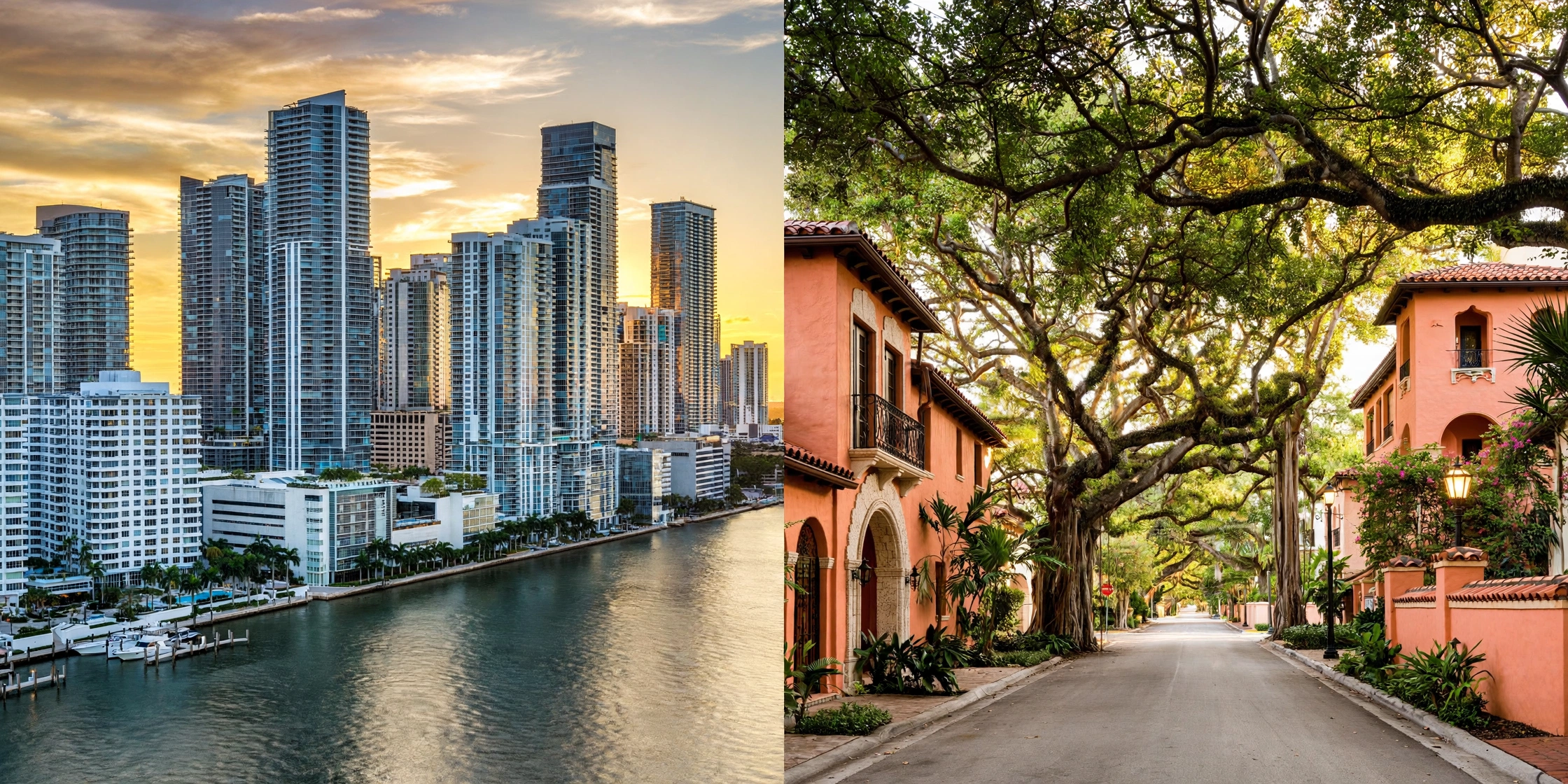
Short answer: If you’re moving to Miami as an executive, Brickell and Coral Gables are two of the best neighborhoods in Miami — but they solve different problems. Brickell is the walkable financial district: towers, a free Metromover, and your office potentially an elevator ride away, with an average 2-bedroom at $4,085/month (RentCafe, September 2026). Coral Gables is the established executive suburb: houses with yards, some of Miami-Dade’s strongest public schools, and a 10-minute drive to the airport, with an average 2-bedroom at $4,028/month (apartments.com, June 2026). The literal question behind this guide — “Brickell vs. Coral Gables for executives moving to Miami” — has a practical answer: the rents are nearly identical; the decision is lifestyle, commute, and kids. And the two are only 8–15 minutes apart by Metrorail or car (Rome2Rio, October 2026), so the choice is reversible.
Updated: October 9, 2026.
¿Prefieres leer en español? Lee esta guía en español
The two profiles: who picks which
After placing dozens of relocating professionals, the pattern is consistent. Pick Brickell if your office is in Brickell or Downtown, you want a car-optional life, and your household is one or two people — or young kids in private school. Brickell is 74% renter-occupied (U.S. Census via RentCafe), which means the whole neighborhood is built for people who arrived recently: flexible leases, furnished options, and a social scene that doesn’t require a decade of local roots.
Pick Coral Gables if you have school-age kids, want a house with a yard, or your travel schedule makes airport access a weekly factor. Median household income here is $113,341 with 51% of adults holding a bachelor’s degree or higher (apartments.com, 2026) — it’s the neighborhood where Miami’s established professional class actually lives. Only 42% rent; this is an ownership culture, which shows in how quiet the streets are at 10pm.
The cost of living in Miami: Brickell vs. Coral Gables, line by line
This is where the cost of living in Miami gets concrete for an executive household. The headline rents are a wash — the differences hide in the lines below them:
| Monthly line | Brickell | Coral Gables |
|---|---|---|
| 2BR rent (average) | $4,085 (RentCafe, Sep 2026) | $4,028 (apartments.com, Jun 2026) |
| 2BR rent (range) | $3,500–$4,800 standard; $6,500+ luxury high-rise (AptAmigo, 2026) | $4,120+ average (Apartment List, Oct 2026); house rentals average $9,631 (apartments.com) |
| Parking | Most towers include one space; a second usually costs extra — confirm with the building | Typically included (driveway or garage) |
| Getting around | Free Metromover; Walk Score 93 | Free trolley along Ponce de León; Walk Score 60/100 — you will drive |
| Buying | 2BR resale $900,000–$2,200,000; HOA $0.95–$1.65/sq ft/month | Median sale price $1,295,000; median single-family $2,200,000 (Homes.com, Jun 2026) |
| Brickell ↔ Coral Gables commute | 5.4–6.2 miles; 8 min by Metrorail ($3, every 15 min) or 8–15 min by car (Rome2Rio, Oct 2026) | |
| Drive to MIA airport | Longer — allow extra time at rush hour | ~10–11 min (5–6 miles, Rome2Rio) |
The SETTLE read: executives fixate on the rent line and miss the structural costs. In Brickell it’s the HOA (up to $1.65/sq ft/month adds $2,000+/month on a 1,200 sq ft unit if you buy) and the second car. In the Gables it’s homeowner insurance on a seven-figure house — a Florida line item that dwarfs renter’s insurance. And in both, Florida charges no state income tax, which is the real reason the math works for relocating executives.
Schools: the factor that decides it for families
For executives moving to Miami with kids, this is usually the tiebreaker. Coral Gables is one of the few Miami zones where strong public schools — Coral Gables Preparatory Academy and the Gables school cluster — are genuinely part of the draw; families often arrive assuming private school is mandatory in Miami, and in the Gables it isn’t always. Brickell families typically go private (Ransom Everglades, Gulliver Prep, and Riviera Prep are minutes away in Coconut Grove and South Miami), which means budgeting application deposits and a fall application calendar — deadlines for the following school year typically land between November and January, so a January corporate move needs school applications filed before you land.
What most people don’t know
The 8-minute Metrorail makes the choice reversible. Live in the Gables, work in Brickell: station to station is 8 minutes, $3, every 15 minutes. Most executives assume they must live where they work — in Miami, these two neighborhoods are effectively one commute.
Brickell’s older towers carry the post-Surfside legacy. Florida’s structural reserve law (SB 4-D) requires condo buildings to fund structural reserves — older Brickell towers can levy special assessments in the five and six figures. Before signing a long lease or buying, ask for the building’s reserve study and any pending assessments.
Coral Gables is a 1925 planned city — and it shows in the rules. Strict zoning, Mediterranean design codes, and tree protections keep the “City Beautiful” intact, but they also mean renovations need approvals that Brickell condo owners never face. If you’re buying a Gables house to remodel, budget the timeline, not just the money.
Winter changes the Gables commute. December through March, seasonal residents swell the roads between the Gables, Brickell, and the airport. Test-drive your actual commute in season, not in August.
Frequently asked questions
Which is cheaper, Brickell or Coral Gables? For a 2-bedroom rental, they’re nearly identical: $4,085 vs. $4,028 on average. The real difference is lifestyle cost — Brickell adds premiums on parking, dining, and building amenities; the Gables trades those for car dependence and, if you buy, higher insurance.
Can I live without a car in Brickell? Yes — Walk Score 93 plus the free Metromover covers Brickell, Downtown, and the connection to the Metrorail. In Coral Gables, no: Walk Score 60/100 means you’ll drive for almost everything outside downtown Gables and Miracle Mile.
Which is better for a family with school-age kids? Coral Gables, for the combination of yards, strong public schools, and a quieter ownership culture. Brickell works well for families with young children or those committed to private school — but the tower lifestyle gets tight as kids grow.
My office is in Brickell — should I still consider Coral Gables? Yes. The Metrorail connects Douglas Road station to Brickell station in 8 minutes, so many executives live in the Gables and commute car-free to a Brickell office — more space, strong schools, and a 10-minute airport run.
Yara Coker — SETTLE, relocation services in Miami.
Want help with your move to Miami?
Moving to Miami for an executive role — or relocating your family on a corporate package? SETTLE handles the neighborhood search, the school timeline, and the lease review, so you land with the right address instead of a year of second-guessing. Tell us your office location, your family setup, and your timeline:
Versión en español: Vivir en Miami: Brickell vs. Coral Gables para ejecutivos
### Sources
- RentCafe, average rent in Brickell FL (updated September 30, 2026): https://www.rentcafe.com/average-rent-market-trends/us/fl/brickell/
- AptAmigo, 2-bedroom apartments in Brickell 2026: https://www.aptamigo.com/FL/Miami/Apartments/2-bedroom-apartments-brickell
- Mondial Realty, Brickell condo market 2026 (Walk Score 93, free Metromover): https://mondialrealty.com/condos/florida/miami/brickell/
- Apartments.com, Coral Gables FL rent market trends (June 2026): https://www.apartments.com/rent-market-trends/coral-gables-fl/
- Apartments.com, Coral Gables local guide (demographics, walkability): https://www.apartments.com/local-guide/coral-gables-fl/
- Apartment List, Coral Gables average rent (October 2026): https://www.apartmentlist.com/fl/coral-gables/page-3
- Homes.com, Coral Gables home trends (June 2026): https://www.homes.com/coral-gables-fl/houses-for-sale/
- Riley Smith Group, Coral Gables market snapshot (June 2026): https://rileysmithgroup.com/should-you-buy-a-house-in-coral-gables-fl-june-2026/
- Rome2Rio, Coral Gables ↔ Brickell and airport routes (October 2026): https://www.rome2rio.com/s/Coral-Gables/Brickell
