
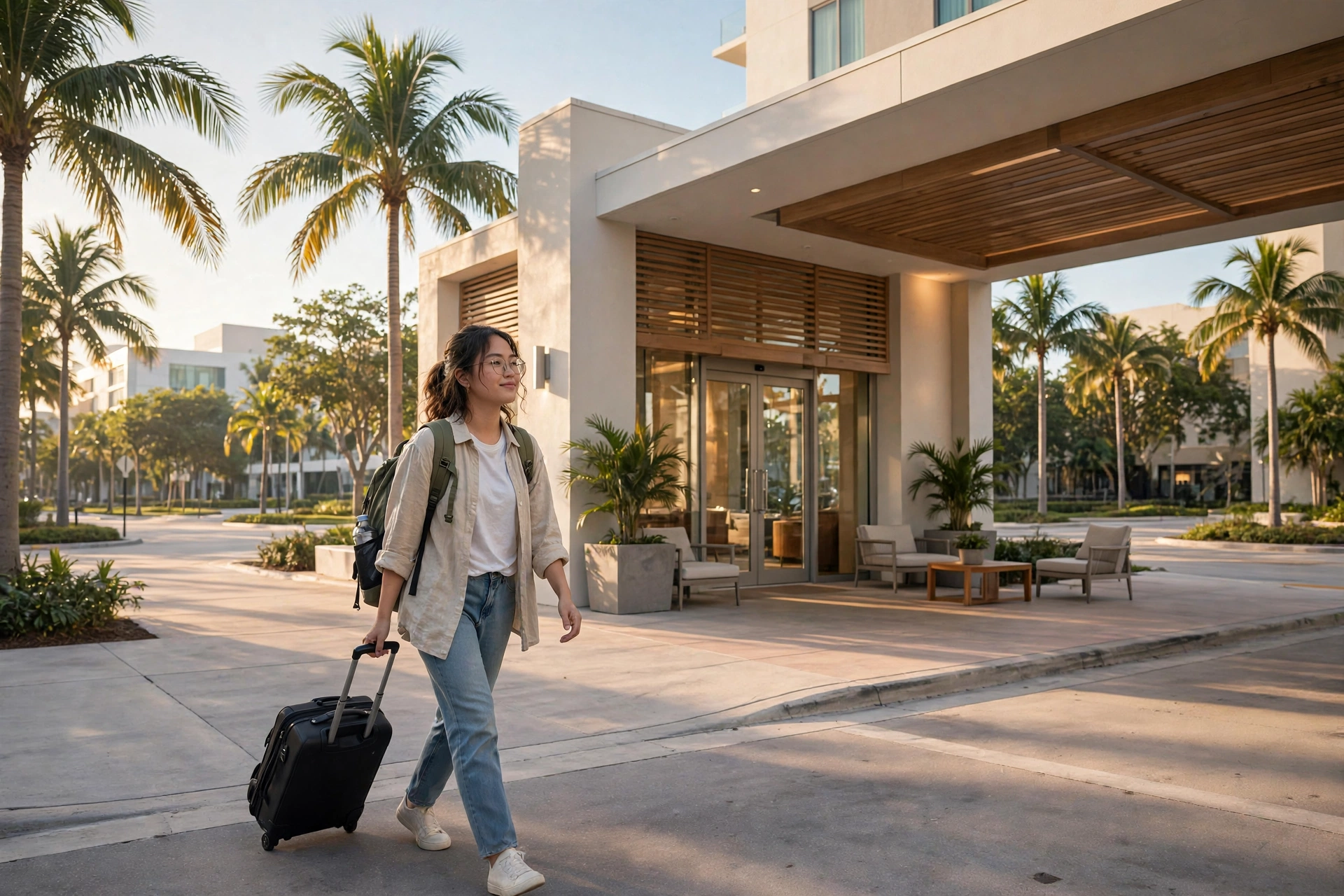
Short answer: if you are moving to Miami for classes, your first two weeks should almost never be 14 hotel nights. Federal rules let a new F-1 student enter the United States up to 30 days before the program start date on the I-20, but no Miami school opens its doors 30 — or even 14 — days early. For Fall 2026, the University of Miami opened housing to new students on August 10–11 and started classes on August 17; FIU opened housing on August 20–22, held its mandatory international orientation on August 21 and started classes on August 24; Miami Dade College, which has no dorms at all, also started on August 24. Price the mistake: 14 hotel nights at Miami’s early-August average daily rate of about US$164 cost US$2,296 before tax and about US$2,594 with the roughly 13 percent transient tax stack — and US$3,401 at the US$215 a night FIU itself publishes for its partner hotel. The 2 to 3 nights the calendar actually requires cost about US$371 to US$729 with tax. Arriving in Miami before classes start — hotels and short stays for the first two weeks — is a calendar problem, not a shopping problem, and it decides a real slice of your cost of living in Miami before you have attended a single class.
Updated: October 20, 2026.
¿Prefieres leer en español? Lee esta guía en español
Moving to Miami before classes: the only three dates that set your arrival
Every international student I work with arrives carrying three different dates and treating the wrong one as the deadline. The first day of classes is the date on the brochure. It is not the date that should set your flight. These are:
| School — Fall 2026 | Door opens | Mandatory international moment | Classes begin | Hotel nights you actually need |
|---|---|---|---|---|
| University of Miami (Registrar calendar, updated May 8, 2026) | Housing for new students: Mon–Tue, August 10–11. Packages accepted only from August 3 — anything shipped earlier is rejected | International orientation: August 11 (undergraduates), August 14 (graduates) | Monday, August 17 | Land August 9–10: 0 to 2 nights, only as a flight buffer. From August 10 you sleep in your own room, and ‘Cane Kickoff runs August 12–16 |
| FIU (OneStop calendar; Housing; ISSS) | Fall move-in: Thu–Sat, August 20–22. Unassisted move-in: August 17–18, one-hour slots, no staff help | ISSS international orientation is mandatory for every new F-1 student: Friday, August 21, 9:30 a.m.–12:30 p.m. | Monday, August 24 | Land August 19: 1 night. Do not book your move-in appointment on the morning of August 21 — it collides with the mandatory orientation |
| Miami Dade College (Procedure 1075 calendar) | No door. MDC has no on-campus housing at any of its eight campuses — your lease is your move-in day | Your campus orientation and placement steps, in the week before classes | Monday, August 24 | Your bridge runs until your lease starts, not until classes start. Negotiate the lease first, then count the nights |
Read the table the way an advisor reads it: the gap between landing and a bed of your own is measured in single nights for dorm students, and in lease-negotiation days for everyone else. A student who books a hotel from August 10 to August 24 “to be safe” at FIU is paying for ten nights in which the dorm is closed, orientation has not happened and nothing at the university can be done in person that could not be done on August 20.
What 14, 7, 3 and 1 hotel nights really cost in Miami
Miami in August is, counterintuitively, the cheapest hotel moment of the fall. CoStar put Miami occupancy at 65.8 percent with revenue per available room of US$107.60 in the week of August 2–8, 2026 — an implied average daily rate of about US$164 (SETTLE calculation). By late September the same market’s rate was US$177.65, and US$186.73 in the week ending October 3. August arrivals dodge the winter peak entirely. What they do not dodge is tax: under Florida Statute 212.03, every stay of six months or less pays the 6 percent state transient tax — the only exemption is a bona fide written agreement for more than six months — and Miami-Dade adds its own transient taxes, for a total of roughly 13 percent on a hotel bill outside Miami Beach and about 13 to 14 percent in Miami Beach. Before you sign the long lease that follows the bridge, read how that deposit will be held and returned in our guide to security deposits in Miami and how they work in Florida — the bridge is short, but the contract after it is not.
| Bridge length | At the August ADR of ~US$164/night, with ~13% tax | At FIU’s published partner rate of US$215/night, with ~13% tax |
|---|---|---|
| 1 night | ~US$185 | ~US$243 |
| 3 nights — the targeted arrival | ~US$556 | ~US$729 |
| 7 nights | ~US$1,297 | ~US$1,701 |
| 14 nights — the default mistake | ~US$2,594 | ~US$3,401 |
All figures are SETTLE calculations from the CoStar August 2026 rate and FIU Global First Year’s published partner-hotel price of US$215 a night at the Courtyard Miami at Dolphin Mall in Doral, plus the roughly 13 percent tax stack; resort fees, parking and incidental holds are extra, and a hotel room without a kitchen also means every meal is bought out for two weeks. Now the comparison that reorders the decision: a full 30-day month of furnished housing in Miami runs about US$2,100 in this series’ verified benchmark — less than 14 hotel nights with tax. So the rule is not “hotels are expensive.” The rule is: price a gap of up to 3 nights by the night, price a gap of 10 nights or more by the month, and never price 14 nights by the night.
What most people don’t know
Your visa allows 30 days. Your university rewards about 3. The earliest admission date printed on your I-20 is a legal ceiling, not a recommendation — and since 2023 the United States will even issue the F-1 visa up to 365 days in advance while still refusing entry more than 30 days before the program starts. Students routinely read “I can enter 30 days early” as “I should arrive early to settle in,” then discover that settling in requires an open dorm, an open international office and a signed lease — none of which exist a month out. The productive version of early is narrow: land one day before your move-in or lease date, sleep off the flight, and be first in line on the morning everything opens. Transfer students are the exception the rule hides: if you are transferring your SEVIS record from another U.S. school, the 30-day entry cap works differently — confirm your exact window with your new school’s international office before booking.
An 18- to 20-year-old can be refused a prepaid room. This is the trap inside the trap, and it catches solo freshmen every August. Major Miami hotels publish a minimum check-in age of 21 — Hyatt Centric South Beach states it plainly: guests must be at least 21 to check in unless accompanied by a parent or legal guardian, with photo ID and a payment card required. Florida law lets hotels set that age, and prepaying does not override it. FIU’s own arrival page quietly solves it: its partner hotel is described as ideal for students under 18 arriving before move-in. If you are under 21 and traveling alone, your bridge stay must be one of three things — a university partner hotel, a property whose published policy accepts 18-plus guests, confirmed in writing with a name attached, or a stay with a parent or guardian on the reservation. A screenshot of a booking confirmation is not proof you will be allowed through the lobby.
“No early move-ins” is a policy, not a suggestion — and it repeats every term. FIU Global First Year tells arriving students, in so many words, that no early move-ins are allowed and that anyone arriving before check-in books a hotel at their own expense; the same page runs the identical pattern for Spring 2027, with a January 6 check-in day. Dorm calendars are built around cleaning, inspections and staffing, and an international flight itinerary is not an exception category. The students who beat the system do not argue with it — they aim their flight at the unassisted or first move-in window (FIU: August 17–18 unassisted, August 20–22 assisted) and spend the saved hotel money on the deposit instead.
August is hurricane peak, so the bridge nights must be refundable. The Atlantic hurricane season runs June 1 to November 30, and its peak runs from mid-August through late October — exactly your arrival window. A non-refundable bridge booking made in June is a bet that no storm will close Miami International or your campus in the one week you cannot move. Pay the small premium for flexible cancellation on the flight and the stay, and keep the bridge short: a short, flexible bridge can be rebooked; a long, prepaid one can only be lost. Students weighing a longer furnished stay against a hotel can borrow the logic seasonal residents use in the Canadian snowbird guide to Miami for winter 2026–2027 — in Miami, the month almost always beats the night.
The SETTLE playbook for the first two weeks
1. Set the flight from the door, not the classroom. UM dorm student: land August 9 or 10. FIU dorm student: land August 19. MDC or off-campus student: land the day before your lease start date, and negotiate that date before you book anything else. If your lease starts September 1 and your classes start August 24, you do not have a hotel problem — you have a lease problem. Ask for an August 20 start or a prorated early entry; even at a full month’s rent it usually beats 12 hotel nights.
2. Match the product to the gap. One to three nights: a hotel near campus or the airport, chosen for a 24-hour desk (your flight may land at midnight) and written confirmation of the check-in age. Four to nine nights: an extended-stay or aparthotel with a kitchen, near your campus — the kitchen is the savings, because two weeks of bought meals quietly rival the room bill. Ten nights or more: stop shopping nightly and price a 30-day furnished stay against the hotel total, remembering that platform bookings add a guest service fee of roughly 14 to 16.5 percent on Airbnb-type platforms, on top of tax.
3. Use the bridge days for the three errands that cannot be done from home. Immigration check-in with your school’s international office as soon as it opens; the in-person lease signing and walk-through of the unit you will actually live in, with the move-in condition documented in photos; and your transit setup — in the best neighborhoods in Miami for a student, the right address is the one on a Metrorail or campus-shuttle line, and you confirm that by riding it once before classes start, not by trusting a map.
4. Keep proof of the plan in your carry-on. Passport, I-20, admission letter, proof of funds and the address of your first night — printed, not only on a phone that can die in immigration. Officers can ask where you will stay, and “a hotel, I think” is a weak answer next to a confirmed reservation that matches your earliest admission date.
Frequently asked questions
How early can I legally enter the United States as a new F-1 student?
Up to 30 days before the program start date printed on your I-20 — that earliest admission date is printed on the form itself. Entering earlier is not possible on the student visa, even though the visa itself can now be issued up to 365 days in advance. Entering after the program start date is not guaranteed and is at the discretion of the border officer, which is why the buffer day before move-in matters.
How many hotel nights do I really need before Fall 2026 classes in Miami?
For a dorm student, one to three: UM opened new-student housing on August 10–11 for August 17 classes, and FIU opened housing on August 20–22 for August 24 classes, with mandatory international orientation on August 21. Budget about US$185 to US$243 for one night with tax at August rates, or about US$556 to US$729 for three nights. Off-campus and MDC students should count nights until their lease start date instead — and negotiate that date down before accepting a long bridge.
I am 19 and traveling alone. Can I check into a Miami hotel?
Often, no. Many Miami hotels require the checking-in guest to be 21, and Florida law allows the policy even on a prepaid reservation. Use a university partner hotel — FIU publishes one at US$215 a night and describes it as suitable for under-18 arrivals — or a property that confirms an 18-plus policy to you in writing, or travel with a parent or guardian who is on the reservation.
Is a 14-night Airbnb cheaper than a hotel for the first two weeks?
Usually yes per night, but run the full stack before assuming: nightly rate, a guest service fee of roughly 14 to 16.5 percent on Airbnb-type platforms, cleaning fee and the roughly 13 percent transient tax. At about ten nights and beyond, compare both against a full 30-day furnished month at roughly US$2,100 — the month frequently wins outright, and it can double as your housing while you sign a longer lease in person. More comparisons like this live in our Miami relocation guides hub.
Yara Coker — SETTLE, relocation services in Miami.
Want help with your move to Miami?
Tell me your school, your I-20 start date and whether you will live on or off campus — I will set your arrival date from your move-in window, price the bridge nights honestly, and check the lease that follows them before you sign. That sequence is how our clients keep the first two weeks from becoming the most expensive fortnight of their degree.
Sources
30-day entry rule and earliest admission date: U.S. federal regulation as stated by university international offices (USC Office of International Services; Wesleyan University Office of International Student Affairs; University of Washington International Student Services), checked October 20, 2026. Visa issuance up to 365 days in advance with entry still capped at 30 days: U.S. Department of State policy announced February 21, 2023, as summarized by Columbia University ISSO. University of Miami Fall 2026 dates — housing for new students August 10–11, international orientation August 11 and 14, ‘Cane Kickoff August 12–16, classes begin August 17; packages accepted from August 3: University of Miami Registrar academic calendar for Fall 2026 (updated May 8, 2026) and Housing and Residential Life move-in pages, checked October 20, 2026. FIU Fall 2026 — term August 24 to December 12 and classes begin August 24: FIU OneStop academic calendar; move-in August 20–22 and unassisted move-in August 17–18: FIU Housing and Residential Experience; mandatory ISSS orientation Friday, August 21, 2026, 9:30 a.m.–12:30 p.m.: FIU ISSS orientation flyer, Fall 2026. No early move-ins, partner hotel Courtyard Miami at Dolphin Mall at US$215 per night and its suitability for under-18 arrivals: FIU Global First Year arrival page, checked October 20, 2026. Miami Dade College classes begin August 24, 2026: MDC Manual of Procedures 1075, College Academic Calendar 2026–2027; MDC has no on-campus housing (series-verified October 2026). Hotel market: CoStar data via Hospitality Net (week of August 2–8, 2026: Miami occupancy 65.8 percent, RevPAR US$107.60) and CoStar weekly summaries for September 20–26 (Miami ADR US$177.65) and September 27–October 3, 2026 (Miami ADR US$186.73). Transient taxes: Florida Statute 212.03 (6 percent state transient tax; exemption only for a bona fide written agreement longer than 6 months); Florida Department of Revenue local-option transient rental tax list (Miami-Dade 6 percent for most of the county, 7 percent Miami Beach); Miami Beach resort tax structure summarized from Miami-Dade County Tourist and Restaurant Taxes. Check-in age: Hyatt Centric South Beach Miami official hotel policies (21 or older unless accompanied by a parent or legal guardian); Florida Statute 509.092 as summarized by Legal Clarity. Platform fees and the US$2,100 monthly furnished benchmark: SETTLE series analysis of Furnished Finder and Airbnb, October 14, 2026. Hurricane season dates (June 1–November 30, peak mid-August to late October): NOAA. All nightly totals, tax-inclusive figures and per-gap comparisons are SETTLE calculations from those sources, as labeled in the text.
Versión en español: Vivir en Miami: Llegar a Miami antes de que empiecen las clases — hoteles y estadías cortas para las primeras dos semanas
