
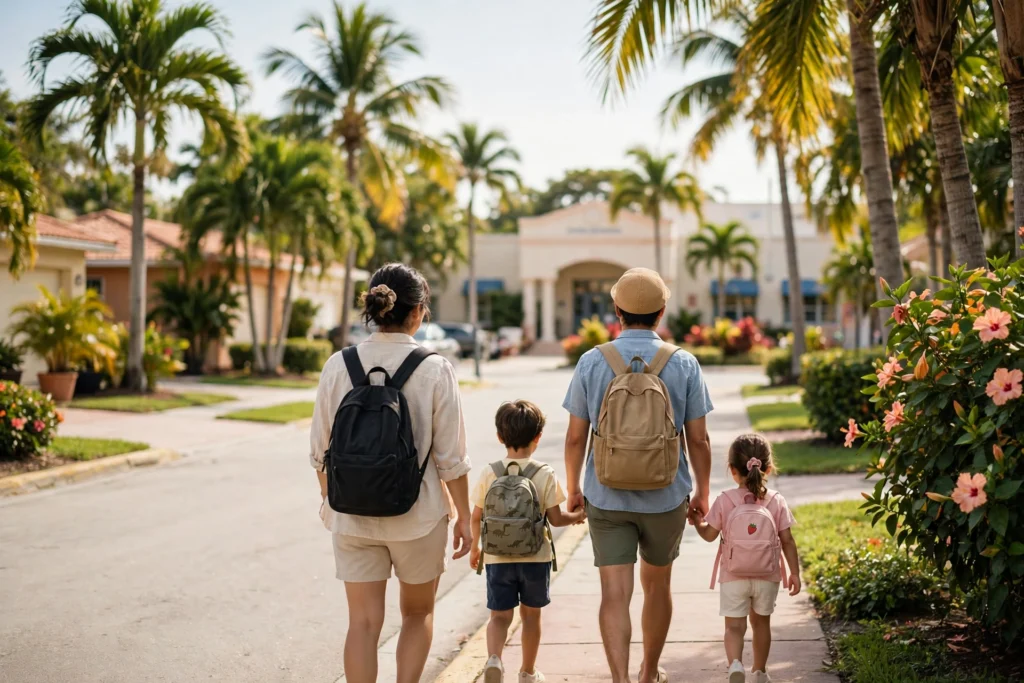
Short answer: Moving with kids to Miami flips the real question from “where do I want to live” to “where will my kids go to school” — and that one answer redraws the whole map. Miami-Dade County Public Schools (M-DCPS) is one of the largest districts in the US — roughly 347,500 students across 562 public schools plus 183 charter schools — and the district has been A-rated by the state for seven straight years. But quality swings hard by attendance zone, so families moving to Miami routinely pick the school zone first and the home second. Public education is free; Florida’s universal voucher covers about $8,000/year toward private school through the Family Empowerment Scholarship — worth knowing when private tuition in Miami runs $15,000–$57,000+/year and full-time infant daycare averages $13,560/year. Start the paperwork 60–90 days before you land: enrollment requires two proofs of residency plus Florida’s DH 680 (immunization certificate) and DH 3040 (health exam within one year).
Updated: October 4, 2026.
¿Prefieres leer en español? Lee esta guía en español
Moving to Miami with kids: the school system in 2026 numbers
| Metric | Figure and source |
|---|---|
| District size | ~347,500 students · 562 public schools · 183 charter schools (nicholasguzmanestates.com, Sep 2026) |
| District grade | A — 7th straight year (M-DCPS School Board Chair Mari Tere Rojas, Aug 2026) |
| Magnet programs | ~300 district-run themed programs — the largest magnet menu in the US (Supt. José Dotres, Aug 2026); application window typically opens in the fall for the next school year; admission by lottery or audition |
| Charter enrollment | ~94,700 students; admission by lottery; charters cannot use academic testing for admission |
| Private-school share | 21% of Miami-Dade K-12 students attend private school (vs. 14% statewide) |
| Private tuition range | $15,000–$57,000+/year; county average $17,330 (vs. $13,830 statewide). Ransom Everglades: $57,300 (2026-27); Gulliver Prep: $30K–$42K |
| Voucher (FES-EO) | Average ~$8,000/year, universal since HB 1 (2023) — no income cap; 2026-27 applications open (Step Up For Students) |
| Infant daycare | $13,560/year average in Miami-Dade (Women’s Fund Miami-Dade) |
| 2026-27 school year | Classes began August 13 in Miami-Dade; 9 schools were closed/consolidated over summer 2026 (enrollment shifts) |
The four routes: zoned public, magnet, charter, private
1. Your zoned public school — free, automatic, address-driven. Every street address is zoned to a specific elementary, middle, and high school. This is the default option and it enrolls newcomers year-round — but school quality varies street by street, so verify the exact address in the district’s school locator before you sign a lease, not after.
2. Magnet / school-choice programs — free, applied-for. Roughly 300 themed programs (STEM, arts, IB, international studies with Spanish, French, and Mandarin immersion). Applications go through the district’s centralized choice portal, and the window typically opens in the fall for the following school year — miss it and you’re zoned for that year. Popular programs admit by randomized lottery or talent audition.
3. Charter schools — free, independently run. Public schools operated outside the district structure with their own culture and curriculum; ~94,700 students in Miami-Dade charters. Admission is by lottery and they cannot screen academically — a real option if your zoned school is weak.
4. Private school — $15,000–$57,000+/year, with the voucher changing the math. Miami-Dade’s average private tuition is $17,330 — meaningfully above the Florida average. The universal Family Empowerment Scholarship (avg. ~$8,000) covers roughly half the county average, and many schools add their own aid on top (Ransom Everglades distributes $7.2M/year in aid with average grants near $30,884). Belen Jesuit is the notable value at $18K–$22K thanks to its Jesuit subsidy.
The enrollment checklist for newcomers
Bring these to the zoned school or enrollment office — public schools enroll arriving families year-round:
- Birth certificate or passport (age and legal name verification)
- Two proofs of current residence — properly executed lease agreement plus a current electric bill in the parent’s name, or purchase documents
- Florida Certificate of Immunization — DH Form 680 (from a private doctor or local health provider; foreign records must be transferred onto this form)
- School-entry health exam — DH Form 3040, performed within one year before enrollment (includes clinical TB screening)
- State-issued photo ID for the parent/guardian
- Previous school records or report card for grade placement (foreign records are interpreted by the district’s compliance office)
Stuck on the health forms? The district’s Comprehensive Health Services line is (305) 995-4111.
Best neighborhoods in Miami for families: rents vs. school reality
| Zone | 2BR rent (2026, base prices excl. fees) | School angle | Commute to Brickell/Downtown |
|---|---|---|---|
| Coral Gables | $4,060 (apartments.com, May 2026) | A-rated cluster; walkable with the free trolley | 15–20 min |
| Pinecrest | $2,470 (ApartmentList, Sep 2026) | Pinecrest Elementary — A; large-lot suburbia | ~17 min |
| Palmetto Bay | $2,792 (RentHop median, Sep 2026) | Coral Reef Elementary — A; the middle ground | ~22 min |
| Doral | $3,002–$3,027, −1.2% YoY | A-rated (Dr. Toni Bilbao Prep, Eugenia B. Thomas K-8); bilingual community | ~22 min |
| Kendall | ~$2,150 (low end of the family-suburb range) | Nine A-rated elementaries; Metrorail to Brickell from Dadeland | ~16 min + Metrorail |
| Cutler Bay | Lowest rents of the group | A-rated stars — but verify the address: Cutler Ridge and Gulfstream Elementary were rated B in 2024-25 | ~28 min |
Caution: Coconut Grove ($2.5–2.9M median sold) and Brickell are lifestyle picks, not family-value picks — zoning there needs extra care. And because 9 schools closed or consolidated in summer 2026, boundaries moved: the representative schools above are not guarantees for any address.
The SETTLE take: pick the zone, then the home
Zone first, lease second. Sign the lease only after the district’s school locator confirms the zoned schools for that exact address. A landlord promising “the kids can go to a great school nearby” is not an enrollment — get the zoned assignment from the school itself.
Land mid-year? The zoned school is your day-one plan. It enrolls with the document checklist above; magnets and charters run on application windows, so target those for year two.
Run the voucher math before paying a rent premium. A $8,000/year voucher plus school aid can make a $15K–$25K private school cheaper than the rent difference between a weak-zoned area and a top-zoned one. Run both numbers.
Don’t rent the building, rent the zone. A Brickell or Edgewater tower with a great gym often zones to schools families don’t love. Check the address first — the view doesn’t go to college.
What most people don’t know
- Nine schools closed or consolidated in summer 2026 as enrollment shifted toward charters and private schools. Boundaries moved — never pick a zone from an old map or an old blog post.
- Charter lotteries cannot test your child — but magnet programs can require auditions or portfolios. Know which game you’re applying to.
- Most voucher money goes to families already in private school — about 70% of vouchers are used by students already enrolled in private school (Tampa Bay Times, Sep 2026). New arrivals applying mid-cycle get priority ordering, so apply the moment you have Florida residency documents.
- The DH 3040 exam must be within one year — schedule a Florida pediatrician or urgent-care school-entry exam in your first week; many do them same-day, and it removes the single most common enrollment delay.
- Florida grades every school A–F each year (Florida Dept. of Education) — a “great neighborhood” can still hide a B or C school on your street. The grade is public; look it up.
- Daycare costs more than state university tuition. The $13,560/year Miami-Dade infant-daycare average is more than double in-state tuition at a Florida state university — and unlike tuition, it’s paid week by week, not financed over decades.
Frequently asked questions
Can my child enroll mid-school-year if we move in January?
Yes. Your zoned public school enrolls arriving families year-round with the document checklist above. The constraint is magnet and charter programs, which admit through application windows — for those, your first year is the zoned school and you apply for the next.
Do we need Social Security numbers to enroll?
No. Miami-Dade’s published enrollment requirements list birth certificate/passport, two proofs of residency, the DH 680 and DH 3040 health forms, parent photo ID, and school records — no SSN and no immigration-status document appears on the list.
Private school or top zoned public — which is the better value?
Run the voucher math first: the ~$8,000/year universal scholarship covers roughly half of Miami-Dade’s $17,330 average private tuition, and many schools add their own financial aid. In some cases a mid-tier private school with the voucher costs less than the rent premium of a top-zoned neighborhood. In others, a free A-rated zoned school wins outright. It depends on the address — which is exactly the calculation to make before signing the lease.
When do magnet applications open?
The district’s choice window typically opens in the fall for the following school year. If you’re moving now, plan the zoned school for year one and apply the first fall you’re eligible — that window is the single most important date on a relocating family’s calendar.
Yara Coker — SETTLE, relocation services in Miami.
