
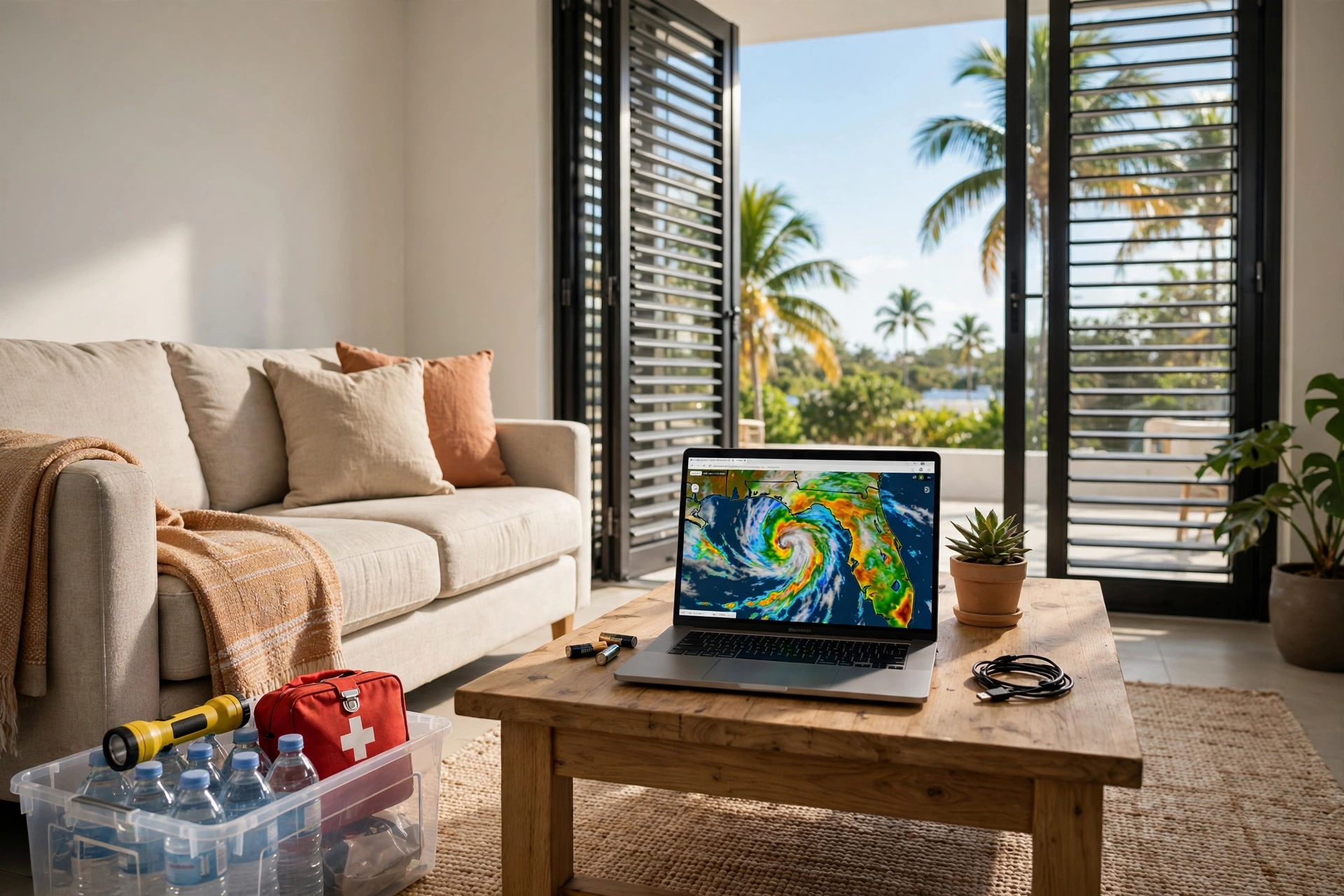
Short answer: Hurricanes: what newcomers must prepare before season comes down to dates, a zone, and a kit. The Atlantic season runs June 1 to November 30 — 183 days. NOAA forecast a below-normal 2026 season (8 to 14 named storms, 3 to 6 hurricanes, 1 to 3 major hurricanes in May, updated in August to 7 to 13 named storms and a 75% chance of below-normal activity), and NOAA’s own warning is the one that matters when you are moving to Miami: it only takes one storm. Before the season peaks, do three free things — find your storm surge planning zone, read the two hurricane clauses in your lease, and register for evacuation help if anyone at home depends on electricity — then stock water at 1 gallon per person per day. Everything else is shopping. Hurricane prep is a small, one-time line in the cost of living in Miami, not a second rent — but only if you buy it before a storm has a name.
Moving to Miami and the cost of living in Miami: what hurricane prep actually costs
Most newcomers overbuy gear and underbuy time. The kit itself is modest; the expensive version is the one assembled in a crowded store 72 hours before landfall. Florida quietly changed the math in your favor: since August 1, 2025, core disaster supplies are permanently exempt from sales tax — there is no tax holiday to wait for in 2026. In Miami-Dade, where the combined sales tax is 7%, that exemption is real money on the big items.
| Item | How much a newcomer household needs | Florida sales tax today |
|---|---|---|
| Water | 1 gallon per person per day — a family of 4 planning for 7 days needs 28 gallons | Groceries/water: not the issue — storage space is |
| Batteries (AA, AAA, C, D, 6-volt, 9-volt) | Enough for flashlights, radio and fans for several days | Exempt year-round |
| Portable generator, 10,000 running watts or less | Optional for renters — see the carbon monoxide rule below first | Exempt year-round — on a $700 generator that saves about $49 at 7% |
| Gas can, 5 gallons or less | 1, only if you have a generator or a car to keep fueled | Exempt year-round |
| Waterproof tarp, 1,000 sq ft or less | 1 — mostly for owners; renters usually need the landlord’s version | Exempt year-round |
| Smoke detectors, carbon monoxide alarms, fire extinguishers | 1 CO alarm minimum if any fuel-burning device will run nearby | Exempt year-round |
| Flashlights, candles, food coolers | Still buy them — just know the old holiday list lied to you | Taxable — they did NOT carry into the permanent exemption |
That last row is the trap of 2026: the supplies people reach for first — flashlights — are taxed, while the supplies that prevent the deadliest post-storm accident — carbon monoxide alarms — are exempt. Buy in that order. And if you are comparing the cost of living in Miami vs another city, add hurricane prep honestly: it is a one-time kit plus a few days of food you will eat anyway, not a monthly bill.
Know your zone before you pick from the best neighborhoods in Miami
Miami-Dade evacuates by Storm Surge Planning Zone, lettered A through E. Zone A can flood from storm surge in a Category 1 hurricane; Zone E only in a Category 5. Three facts newcomers get wrong:
- Your surge zone is not your flood zone. They are different maps answering different questions. Your surge zone decides whether you leave; your FEMA flood zone decides insurance. Confusing them is how people in surge zones stay home because their insurance map looked safe — and it is exactly why we tell clients to read our guide to renters insurance in Florida and what it actually covers before the season, not after a claim.
- Evacuation is ordered by zone — or part of a zone — based on the storm’s track and expected surge, regardless of category. A “weak” storm can still call your zone.
- Looking it up takes two minutes and costs nothing: enter your exact address on the county’s hurricane page at miamidade.gov, use the Ready MDC app, or call 311. Do it the week you sign the lease, for the address you actually signed — a neighborhood name is not a zone.
If your zone is called, the county’s advice is unglamorous and correct: go to family or friends inland, outside the evacuation area. Evacuation centers are a last resort, and not every center accepts pets. Decide your inland address now, while it is a phone call and not a negotiation in traffic.
The 7 things to do before the season peaks
- Find your zone (above) and save your inland destination and route.
- Build the kit for several days: water at 1 gallon per person per day, a several-day supply of non-perishable food and a manual can opener, a battery-powered or hand-crank NOAA weather radio, flashlights, a first aid kit, extra batteries, phone chargers and a backup battery, prescription medications, and pet food with extra water for pets (Ready.gov’s basic list — build it once, rotate it each June).
- Register for evacuation help if you need it — before any storm exists. Miami-Dade’s Emergency and Evacuation Assistance Program (EEAP) provides evacuation transportation and special-needs sheltering for registered residents: people on oxygen, people who depend on electric-powered medical equipment, people who cannot evacuate on their own. Register at 305-513-7700. Registration closes before an evacuation order is issued, and each person in the household registers separately. This is the single deadline in this article that cannot be fixed later.
- Photograph everything. Walk every room with your phone, open drawers, film serial numbers. If you ever file a claim — or fight over a deposit — the video you shot in June is the evidence. It pairs with the documentation habits in our emergency numbers and hospitals guide for newcomers, which you should also save offline.
- Read your lease’s two hurricane clauses (next section) and get the shutter answer in writing.
- Keep the car above half a tank from August on, keep some cash in small bills, and keep documents — IDs, lease, policies — photographed and in one waterproof pouch.
- Plan the power outage, not just the storm. Most hurricane misery in Miami is the 48 to 96 hours after: no power, no elevator, no card readers. Your kit in step 2 is really for those days.
What most people don’t know
- A below-normal forecast changes nothing about your address. The August 2026 NOAA update raised the below-normal chance to 75% — and still kept up to 2 major hurricanes in range. Andrew hit in a quiet season. The forecast describes the basin; your zone describes your home.
- There is no 2026 tax holiday — because there doesn’t need to be. Batteries, qualifying generators, gas cans, tarps, smoke and CO alarms and fire extinguishers have been tax-free every day since August 1, 2025. Anyone “waiting for the holiday” is waiting for a sale that already happened permanently.
- The generator is the most dangerous item in the kit. Carbon monoxide is odorless and kills more than 400 people a year in the US in non-fire incidents. CDC rule, no exceptions: generators run outside only, more than 20 feet from doors, windows and vents — never in a garage, not even with the door open. Many renters cannot legally or safely place one 20 feet away, which means the honest answer for most apartment renters is: skip the generator, buy the CO alarm and the battery fan.
- Seasonal residents face the same calendar. If you are here only part of the year, your empty unit still needs a shutter and absence plan — the same logic our Canadian snowbird guide to a Miami winter applies to winter applies in reverse to the summer you are away.
If you rent: the two lease questions that decide your hurricane
1. Who puts up the shutters? Florida law does not specifically require a landlord to provide hurricane shutters, and who deploys them is a lease question, not a statute. Landlords must comply with applicable building and housing codes, but if your lease is silent and nobody deploys the shutters, nobody deploys the shutters. Ask before the season, in writing: are there shutters or impact glass, where are the panels stored, and whose job is it?
2. What happens if the home is damaged? Florida Statute 83.63 is the renter’s hurricane clause, and it is stronger than most newcomers expect. If the premises are damaged or destroyed — other than by your own wrongful or negligent act — so that your enjoyment is substantially impaired, you may terminate the rental agreement and vacate immediately. If only part of the home is unusable, you vacate that part and your rent is reduced by the fair rental value of the part destroyed. If the agreement is terminated, the landlord must handle your deposit under section 83.49(3). What 83.63 does not do: an evacuation order alone, or a scary week without power in an intact home, does not by itself end a lease or erase rent. The damage test is about the premises, not the forecast.
Frequently asked questions
When is hurricane season in Miami? June 1 to November 30 for the Atlantic basin. Risk is not evenly spread — the practical rule is to have the kit and the zone done before August, not before the first cone graphic with your street in it.
How much water should I store? Ready.gov’s standard is 1 gallon per person per day for several days, for drinking and sanitation. For a family of four planning a full week, that is 28 gallons — plus extra for pets. Most newcomers store three days and discover the outage lasts four.
Do I have to evacuate if my zone is ordered and my building “feels solid”? Evacuation orders in Miami-Dade are issued zone by zone based on expected storm surge — water, not wind feel. A solid building can still become an island with no power, no water pressure and no emergency access. The order is about the water around the building, not the building.
Can I break my lease after a hurricane? Only through the damage test in Florida Statute 83.63: substantial impairment lets you terminate and leave immediately; partial damage reduces rent by the damaged part’s fair rental value. Photograph the damage, notify the landlord in writing, and keep the deposit rules of 83.49 in view. More newcomer guides live in our complete Miami relocation guides hub.
¿Prefieres leer esto en español? Lee la versión en español: Vivir en Miami en temporada de huracanes: basta una tormenta.
Want help with your move to Miami?
Tell us your dates, your neighborhood and whether you are arriving before or during the season — we will tell you your surge zone, what your lease should say about shutters, and what to stock first. That local check is part of how SETTLE helps people land in Miami prepared, not just moved.
Yara Coker — SETTLE, relocation services in Miami.
