
Short answer: Grocery costs in Miami vs. other US cities are the smallest surprise of moving to Miami — if you budget them honestly. On the Numbeo groceries index (New York = 100), Miami scores 77.8: the same basket that costs US$500 in New York costs about US$389 in Miami, US$448 in Chicago and US$426 in Los Angeles — but US$334 in Houston and US$349 in Austin. For the monthly budget itself, the USDA’s official Moderate food plan for August 2026 puts food at home at about US$441 a month for one adult and US$1,388 for a family of four at US-average prices; in Miami I tell newcomers to plan roughly 10–15% above that — about US$485–505 for one person and US$1,525–1,595 for a family of four — because Miami grocery inflation has recently run hotter than the nation’s (food at home rose 3.8% in a year in the Miami metro, against 1.8% nationally). Groceries will not make or break your cost of living in Miami. Your rent will. Your supermarket habit might come second.
Updated: October 18, 2026.
¿Prefieres leer en español? Lee esta guía en español
Moving to Miami and the grocery bill: mid-pack prices, not a premium city
Newcomers arrive with one of two wrong assumptions: that everything in Miami costs New York prices, or that Florida is cheap across the board. Groceries fit neither story. Miami is a mid-pack grocery city — clearly cheaper than the coasts people move from, clearly more expensive than Texas. And the gaps are modest: the entire spread between Miami and Houston on a US$500 basket is about US$55, roughly 2% of a typical one-bedroom rent. Compare that with the rent lines in our full real cost of living in Miami breakdown, where the same city choice moves thousands of dollars a month. Food is priced nationally more than locally, because supply chains, brands and wholesale costs are national — which is exactly what the federal data shows.
| City | Groceries index (New York = 100) | The same US$500 New York basket costs |
|---|---|---|
| San Francisco | 101.8 | ≈US$509 |
| New York | 100.0 | US$500 |
| Boston | 96.9 | ≈US$485 |
| Chicago | 89.6 | ≈US$448 |
| Los Angeles | 85.2 | ≈US$426 |
| Miami | 77.8 | ≈US$389 |
| Dallas | 70.7 | ≈US$354 |
| Austin | 69.7 | ≈US$349 |
| Houston | 66.8 | ≈US$334 |
Read the table as a relocation table, not a shopping table. If you are choosing between the best neighborhoods in Miami and a Texas suburb, groceries argue weakly for Texas (about US$55–120 a month at family scale) while rent, insurance and taxes argue in the thousands. If you are arriving from New York, San Francisco, Boston, Chicago or Los Angeles, your grocery line quietly improves by 9–24% — one of the few lines that does. Spend your negotiating energy where the money is: the lease. Before any landlord collects from you, read how security deposits in Miami really work, because the deposit on a Miami rental is routinely larger than two months of family groceries.
What most people don’t know
1. Groceries barely move when you move — and that is a federal finding, not an opinion. The Bureau of Economic Analysis splits regional prices into goods, rents and services. Rent parities swing wildly across the country (roughly the mid-50s to the mid-150s against a national 100), while goods parities cluster in a narrow band around the average. Food rides on national wholesale prices, national brands and national trucking; local rent and labor add only a modest markup. That is why the whole New York-to-Houston grocery spread fits inside about US$166 on a US$500 basket, while the rent spread between the same two cities is measured in thousands per month. Budget your move around housing. Treat groceries as a rounding error with good PR.
2. Miami’s grocery inflation recently ran hotter than the country’s. In the Bureau of Labor Statistics’ Miami metro release for June 2025, food prices rose 4.8% in a year and food at home rose 3.8%, with meats, poultry, fish and eggs up 7.8%. Nationally, by September 2026, food at home was up only 1.8% in a year — eggs had fallen 20.6% while coffee rose 7.1% and ground beef 5.4%. Two lessons follow. First, a Miami budget copied from a national calculator will drift low within a year; that is why our planning figures carry the 10–15% cushion. Second, the pain is item-specific, not aisle-wide: the proteins and the coffee are where a Miami cart gets expensive, while eggs and dairy have been deflating nationally.
3. In Florida, staple groceries are tax-free — and prepared food is taxed twice: by the markup and by the state. Under Florida Statutes §212.08(1), food products for home consumption are exempt from sales tax: a US$500 cart of staples costs exactly US$500 at a Miami register. But hot prepared food, deli items sold ready to eat, candy and soft drinks are taxable — at 7% in Miami-Dade (6% state plus 1% county). The same US$500 spent on prepared food leaves the store at US$535, after already paying the prepared-food markup. Newcomers who “cook at home” mostly through the deli counter and the rotisserie case are running the most expensive grocery strategy in the state, and the tax line on the receipt is the receipt’s way of telling them.
4. Where you shop inside Miami moves the bill more than the Miami-vs.-Chicago gap. The index gap between Miami and Chicago is about 13%. The gap between a household that defaults to the premium supermarket for everything and one that splits the cart — pantry basics at a discounter or warehouse club, produce and meat where the Latin supermarkets compete hardest, the premium store for its weekly buy-one-get-one deals — is larger than that, and it is available on day one, in any neighborhood. Miami’s grocery map is unusually competitive: a dominant premium chain, aggressive Latin chains (Sedano’s, Presidente) that fight on produce, meat and the staples newcomers from Latin America and Spain actually cook with, discounters like Aldi, Walmart for shelf goods, and warehouse clubs for bulk. The city hands you the discount. You have to build the route.
5. The USDA benchmark assumes every meal happens at home — real households do not live that way, and the gap is the restaurant line. The Bureau of Labor Statistics’ Consumer Expenditure Survey for 2024 shows the average US household spent US$6,224 a year on food at home (about US$519 a month) and another US$3,945 eating out — about 39 cents of every food dollar goes to food someone else cooked. That is why real grocery spending lands below the USDA Moderate plan: part of the food budget leaked into restaurants, where prices rose 3.5% nationally in the year to September 2026 and 6.9% in the Miami metro’s last full reading. A newcomer budget that copies the USDA number for groceries and forgets the eating-out line will miss by hundreds a month in the city where the temptation is strongest — a warning seasonal residents learn fast, which is why our Canadian snowbird guide to a winter in Miami budgets the winter kitchen separately from the winter restaurant habit.
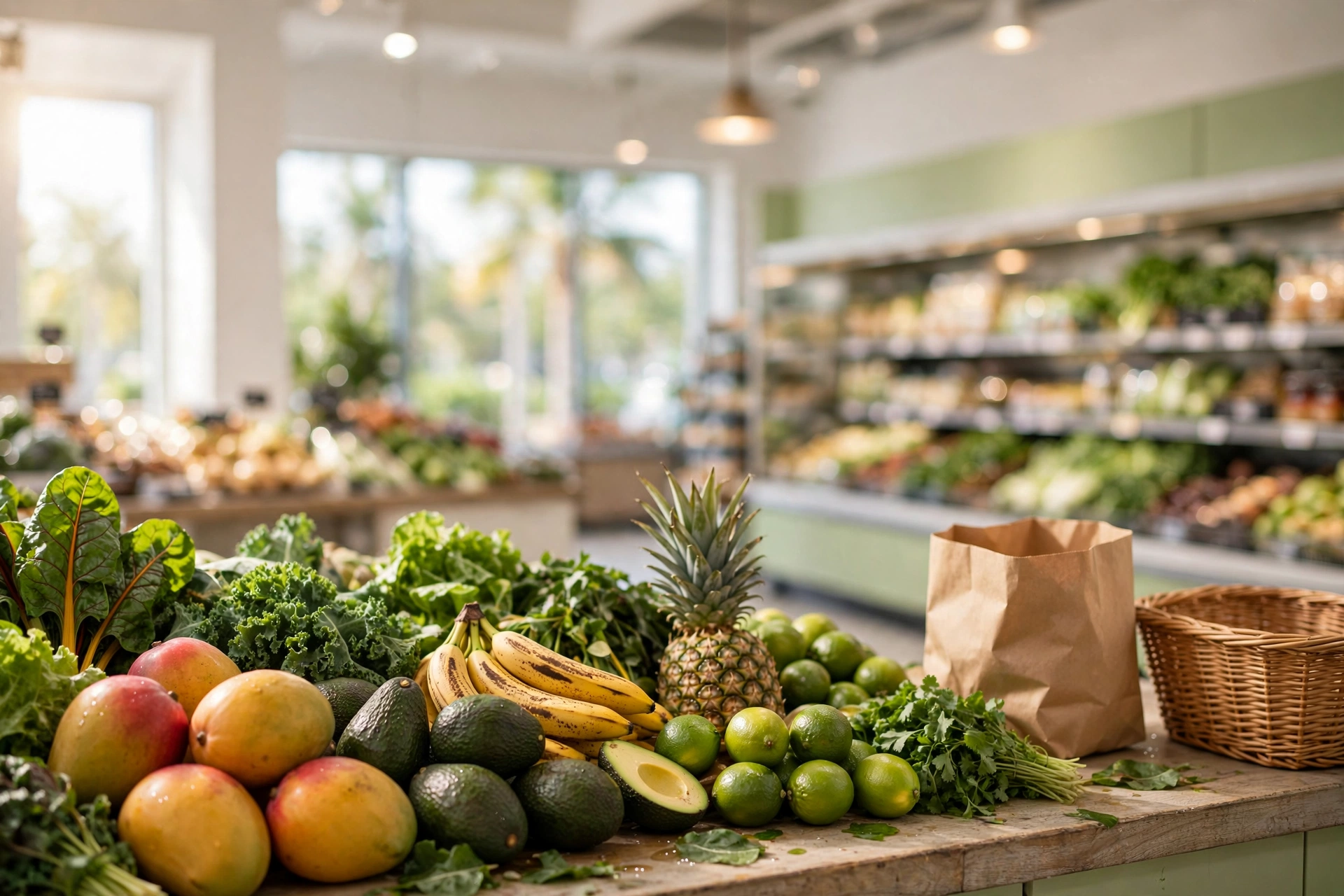
6. Tropical staples flip price direction in Miami. Bananas, plantains, avocados, mangoes, limes and coffee are import luxuries in much of the US; Miami is one of the main ports of entry for Latin American produce, with the distribution infrastructure to match. Households that cook Latin or Caribbean at home often find their real cart cheaper than the index suggests, while a cart built on imported European cheeses and specialty goods runs above it. Your cuisine is a budget variable here — one more reason to price your own actual basket, store by store, in your first two weeks, using the full picture in our Miami relocation guides hub.
The SETTLE budget: what to actually write into your Miami plan
| Household | USDA Moderate plan, Aug 2026 (US average) | Miami planning figure (SETTLE: USDA + 10–15%) |
|---|---|---|
| 1 adult, cooking at home | ≈US$441/month | ≈US$485–505/month |
| 2 adults | ≈US$808/month | ≈US$890–930/month |
| 3 people | ≈US$1,114/month | ≈US$1,225–1,280/month |
| Family of 4 (2 adults, 2 kids) | US$1,388/month | ≈US$1,525–1,595/month |
| 5 people | ≈US$1,648/month | ≈US$1,815–1,895/month |
Three honest caveats. First, the USDA plans price a nutritious diet cooked entirely at home, with the Thrifty plan (US$1,024 a month for the family of four) as the floor and the Liberal plan (US$1,679) as the comfortable ceiling — your real number should land inside that corridor. Second, the Miami planning column is our budgeting guidance, not an official statistic: it exists because Miami food prices have been rising faster than the national ones the USDA plan is built on. Third, none of this includes eating out. Add your restaurant habit as its own line, at Miami prices and Miami tax, or it will add itself.
Frequently asked questions
How much should a single person budget for groceries in Miami?
Start from the USDA Moderate plan for one adult — about US$441 a month at national prices in August 2026 — and plan on roughly US$485–505 in Miami, cooking most meals at home. If your actual spending lands near the national household average the BLS measured for 2024 (US$519 a month on food at home across all household sizes), check the split before you cut the food: about 39% of the typical food budget goes to eating out, which is usually the leak, not the supermarket.
Are groceries taxed in Florida?
Staple groceries are not. Florida Statutes §212.08(1) exempts food products for home consumption from the 6% state sales tax and the county surtax, so the sticker price of a basic cart is the price you pay. Prepared and hot food sold ready to eat, candy and soft drinks are taxable — in Miami-Dade you pay 7% on those items.
Are groceries more expensive in Miami than in Houston or New York?
More than Houston, less than New York — by clear margins in both directions. On the Numbeo groceries index (New York = 100), Miami is 77.8, Houston is 66.8 and New York is 100: a US$500 New York basket runs about US$389 in Miami and US$334 in Houston. The Miami premium over Houston is real but small — about US$55 on that basket — next to the rent differences between the two cities.
Why does my Miami grocery bill feel higher than these numbers?
Usually three compounding habits: shopping the premium chain for the entire cart instead of splitting it across Miami’s competitive store map, buying a large share as prepared food (which carries both a markup and Florida’s 7% tax in Miami-Dade), and letting eating out blur into the grocery line while restaurant prices rise faster than grocery prices. Price your own ten staple items in three stores during your first two weeks — in Miami, that one exercise is worth more than any national index.
Yara Coker — SETTLE, relocation services in Miami.
Want help with your move to Miami?
Tell us your household size, the cities you are comparing and the way you actually eat — we will build your Miami budget line by line (rent, deposit, groceries, eating out, transport) with the same verified figures we publish, and flag the lines where your money actually moves. In Miami the grocery bill is the easy line. The expensive mistakes happen at the lease signing and in the first month of habits — both are fixable before you land.
Sources
US Department of Agriculture, Cost of Food at Home, August 2026 (official food plans): reference family of four (two adults 20–50, children 6–8 and 9–11, all meals at home) — Thrifty US$1,024 per month, Low-cost US$1,126, Moderate-cost US$1,388, Liberal US$1,679; Moderate-cost for one adult about US$441 per month and for two adults about US$808, applying the USDA household-size adjustments (plus 20% for one person, plus 10% for two, plus 5% for three, minus 5% for five or six). US Bureau of Labor Statistics, Consumer Expenditure Survey 2024: average US household spending on food at home US$6,224 per year and on food away from home US$3,945, total food US$10,169 (12.9% of total spending). US Bureau of Labor Statistics, Consumer Price Index, Miami-Fort Lauderdale-West Palm Beach, June 2025 (release 25-1161-ATL): food index up 4.8% over the year, food at home up 3.8%, meats, poultry, fish and eggs up 7.8%, food away from home up 6.9%. US Bureau of Labor Statistics, Consumer Price Index, September 2026 (national): food up 2.5% over the year, food at home up 1.8%, food away from home up 3.5%, eggs down 20.6%, coffee up 7.1%, ground beef up 5.4%. Numbeo, Cost of Living Index by City 2024 Mid-Year, groceries index (New York = 100): San Francisco 101.8, New York 100.0, Boston 96.9, Chicago 89.6, Los Angeles 85.2, Miami 77.8, Dallas 70.7, Austin 69.7, Houston 66.8; basket equivalents are SETTLE calculations from that index. US Bureau of Economic Analysis, Regional Price Parities (framework): goods price parities cluster in a narrow band across regions while rent parities range widely. Florida Statutes §212.08(1): food products for human consumption are exempt from sales tax; prepared food, candy and soft drinks are taxable, at a combined 7% in Miami-Dade (6% state plus 1% county surtax). Miami planning figures are SETTLE budgeting guidance (USDA Moderate plan plus 10–15%), not official statistics; your results depend on your household, your cuisine and where you shop.
Versión en español: Cuánto cuesta vivir en Miami: el mercado cuesta un 22% menos que en Nueva York — ¿por qué igual sorprende al recién llegado?
