
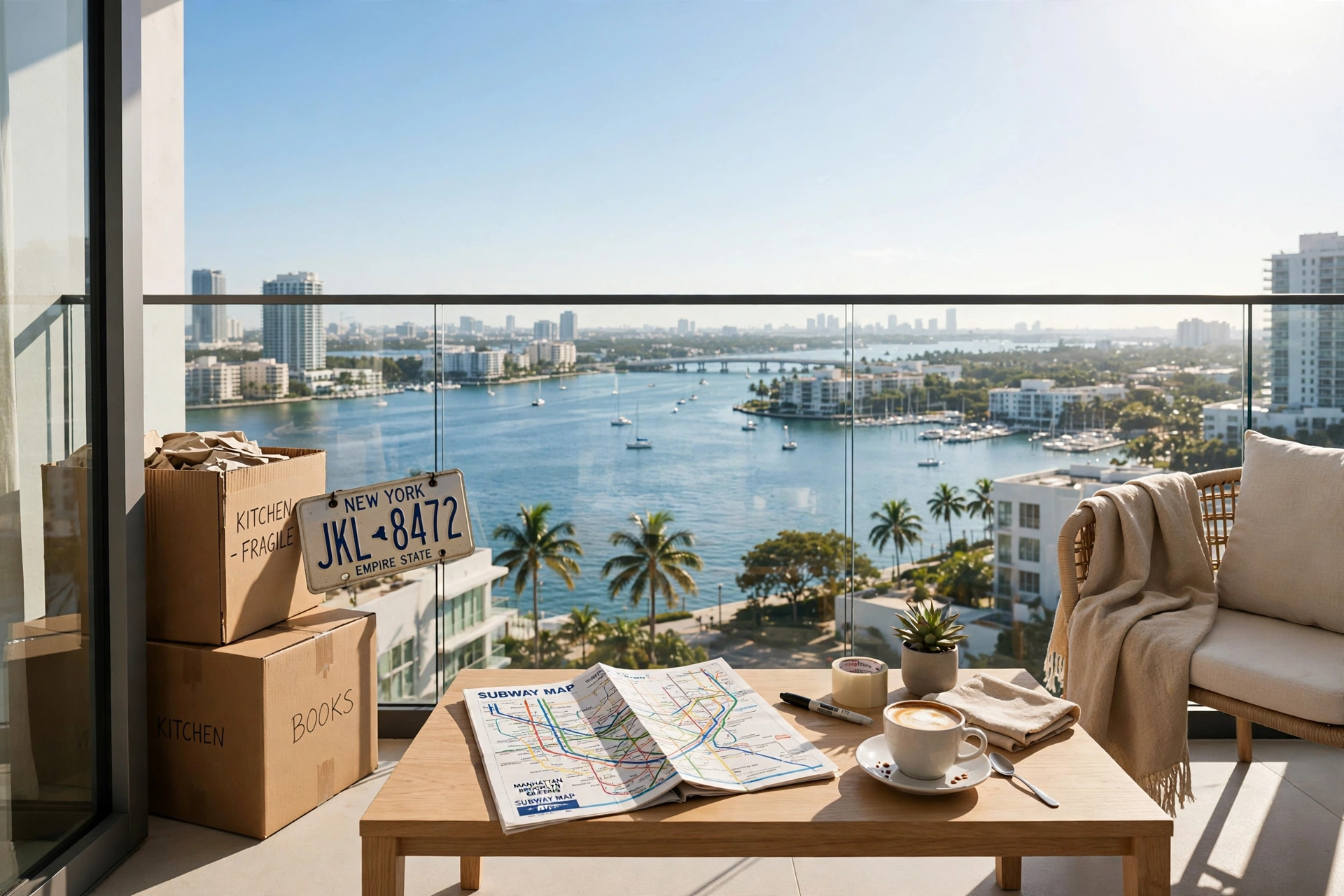
Short answer: if you are moving to Miami from New York — the literal question behind this page is best Miami neighborhoods for New York transplants — the honest answer is that only two Miami neighborhoods let you keep the no-car life you had in New York: Brickell and Downtown, where a one-bedroom averages US$3,298 and US$3,069 (RentCafe, September 30, 2026) against a Manhattan median rent of US$4,900 in September 2026, the second-highest on record. Every other neighborhood on this list trades part of that rent saving for a car. That is the real cost of living in Miami vs New York: the neighborhood you pick decides whether the move stays cheap. Below, the five neighborhoods New Yorkers actually pick, matched to the New York life you are leaving — and the rent math behind each.
Updated: October 15, 2026.
¿Prefieres leer en español? Lee esta guía en español
Moving to Miami from New York: start with the car question, not the rent
New Yorkers are the single largest group making this move: 23,436 New York driver’s licenses were exchanged for Florida licenses in the first half of 2026 alone, the #1 origin state (Florida DHSMV data, via Florida Realtors). And the first mistake most of them make is shopping Miami the way they shopped New York — by neighborhood vibe and rent — when the variable that changes everything here is transportation. In New York, the subway made every neighborhood viable. In Miami, transit is real but narrow: the Metrorail runs one main corridor (Government Center, Brickell, Coconut Grove, Douglas Road and University stations, US$2.25 a ride in 2026), the Metromover loops Brickell and Downtown for free across 21 stations, and outside that corridor you are driving. A New York subway ride, for comparison, has cost US$3.00 since January 4, 2026 — Miami’s rail is cheaper, but it reaches far fewer places.
| Neighborhood | 1-bedroom avg. | 2-bedroom avg. | Car needed? | The New York life it replaces |
|---|---|---|---|---|
| Brickell | US$3,298 | US$4,085 | No — Metrorail + free Metromover | Manhattan high-rise living |
| Downtown Miami | US$3,069 | US$3,754 | No — Metromover + Brightline | Midtown / FiDi convenience |
| Wynwood | US$3,061 | US$4,171 | Mostly — walkable core, car for the rest | Williamsburg / Bushwick energy |
| Coral Gables | US$3,268 | US$4,954 | Yes — free trolley helps locally | Upper West Side calm, with schools |
| Coconut Grove | US$3,330 | US$4,380 | Yes — Metrorail station, car for daily life | Brooklyn brownstone streets |
| Miami Beach | US$3,001 | US$4,303 | Not in South Beach — free trolley | Beach-first living, no NY equivalent |
| Aventura | US$2,340 | US$2,850 | Yes, always | Suburban value with city services |
| Doral | US$2,516 | US$3,036 | Yes, always | Space-first suburbia |
Rents: RentCafe neighborhood averages (Yardi Matrix), September 30 – October 1, 2026. Miami Beach figures are citywide. Manhattan median: Miller Samuel for Douglas Elliman, September 2026.
1. Brickell and Downtown: the only true no-car landing
Brickell Avenue addresses score as high as 96 on Walk Score (address-level scores), the Metromover is free and frequent, and the Metrorail’s Brickell and Government Center stations put the airport corridor and the Grove on one line. Downtown adds Brightline’s MiamiCentral station — Fort Lauderdale in about 35 minutes, Orlando in about three and a half hours — which matters more to ex-New Yorkers than they expect: it is the closest thing to the Northeast Corridor habit. The math: a Brickell one-bedroom at US$3,298 is US$1,602 a month below the Manhattan median — US$19,224 a year — before you count the bigger prize, Florida’s zero state income tax against New York State’s 4%–10.9% plus New York City’s 3.876%. The honest trade: Brickell gives you back the vertical, elevator-building life — doorman, amenities, small square footage. If you left New York to escape exactly that, keep reading.
2. Coral Gables and Coconut Grove: the space upgrade — with a car
This is where New Yorkers who wanted a Brooklyn-style street, a yard and a real school zone land. The Grove’s one-bedrooms average US$3,330 and the Gables’ US$3,268 — Manhattan money on paper — but the unit is bigger, the street is green, and a two-bedroom in the Gables (US$4,954) buys a house-like life no US$4,900 Manhattan median touches. Both sit on the Metrorail (Coconut Grove and Douglas Road/University stations) and the Coral Gables trolley is free and connects at Douglas Road — yet daily life here still runs on a car: school runs, groceries, the beach. Budget the car honestly — payment, Florida insurance and parking — and the Gables/Grove advantage over Brickell narrows to lifestyle, not savings. New Yorkers who skip the car budget are the ones who end up saying Miami is “not actually cheaper.”
3. Miami Beach: the one with no New York equivalent — and one legal trap
South Beach is genuinely walkable (Ocean Drive addresses score 88–94 on Walk Score), the city trolley is free, and citywide one-bedrooms average US$3,001. The trap is legal, not financial: in most residential districts of Miami Beach, renting for less than six months and a day is prohibited — so the classic transplant move, a three-month furnished lease while you decide, is often not legally available in the buildings you are looking at. New Yorkers land here in two groups: those who sign a full-year lease from day one, and those who land in Brickell or Downtown first and move to the Beach once they can commit to the term. I almost always recommend the second path.
What most people don’t know
The Metromover being free changes the Brickell-vs-Downtown math. Downtown one-bedrooms average US$229 a month less than Brickell, and the free Metromover erases most of the practical difference — you live in Downtown and socialize in Brickell on a free train.
Your neighborhood pick is also a tax-domicile signal. New York audits departing residents, and a Miami lease in your name, a Florida license and days physically in Florida are part of how you prove the move was real. Signing a full-year lease in the neighborhood you actually live in — instead of a friend’s couch in another state — is evidence, not just housing.
Aventura is the quiet value play New Yorkers miss. One-bedrooms at US$2,340 and two-bedrooms at US$2,850 are the lowest on this list by a wide margin, with strong services and the beach ten minutes east — the cost is total car dependence and a 30–45 minute drive to Brickell. For remote workers who rarely commute, it is the best rent-to-life ratio on this page.
Wynwood’s two-bedrooms cost more than Brickell’s. At US$4,171 vs. US$4,085, the “cheaper, edgier” neighborhood is only cheaper for one-bedrooms — loft-style stock is scarce, and families pay for it.
Frequently asked questions
Can I live in Miami without a car, like in New York?
Yes — in Brickell and Downtown, on the Metrorail corridor with the free Metromover, and in South Beach with the free trolley. Everywhere else on this list, plan on a car from month one.
Which Miami neighborhood feels most like Manhattan?
Brickell: high-rises, doormen, walk-to-dinner density, and addresses scoring up to 96 on Walk Score. Downtown feels more like the Financial District — quieter at night, cheaper by about US$229 a month on a one-bedroom.
Where do New York families with kids usually land?
Coral Gables and Coconut Grove, for space, greenery and school zones — with a car. Two-bedrooms average US$4,954 in the Gables and US$4,380 in the Grove (RentCafe, September 2026).
Is Miami actually cheaper than New York once everything is counted?
For a no-car Brickell or Downtown landing, decisively yes: roughly US$19,000 a year on rent against the Manhattan median, plus zero Florida state income tax. If you add a car, Florida insurance and a two-bedroom in a premium suburb, the gap narrows — the neighborhood choice is what keeps the saving real.
Yara Coker — SETTLE, relocation services in Miami.
Want help with your move to Miami?
Tell me which New York life you are leaving — no-car Manhattan, Brooklyn space, or beach-first — and I will tell you which of these neighborhoods keeps your numbers working, and which buildings New Yorkers actually renew in. First call is free and there is no obligation.
Sources: RentCafe neighborhood market trends (Yardi Matrix), data as of September 30 – October 1, 2026 (Brickell, Downtown Miami, Wynwood, Coral Gables, Coconut Grove, Miami Beach citywide, Aventura, Doral average asking rents). Manhattan median rent, September 2026: Miller Samuel Real Estate Appraisers and Consultants for Douglas Elliman (US$4,900, second-highest on record). Transit: Miami-Dade County Department of Transportation and Public Works (Metrorail US$2.25 fare in 2026; Metromover free, 21 stations; Coral Gables and Miami Beach trolleys free per their city operators); New York subway fare US$3.00 effective January 4, 2026 (MTA). Walk Score figures are address-level examples (Brickell Avenue 96; Ocean Drive 88–94; 390 Bird Road, Coral Gables 87), not neighborhood averages. Migration: Florida Department of Highway Safety and Motor Vehicles license-exchange data via Florida Realtors, first half of 2026 (New York #1 origin state, 23,436 exchanges). Miami Beach minimum rental term: City of Miami Beach code — rentals of less than six months and one day are prohibited in most residential districts. New York tax context: New York State Department of Taxation and Finance (state rates 4%–10.9%; New York City resident rate up to 3.876%); Florida levies no individual income tax (Florida Constitution, Article VII, Section 5).
Versión en español: Vivir en Miami viniendo de Nueva York: los 5 barrios que realmente eligen los neoyorquinos
