
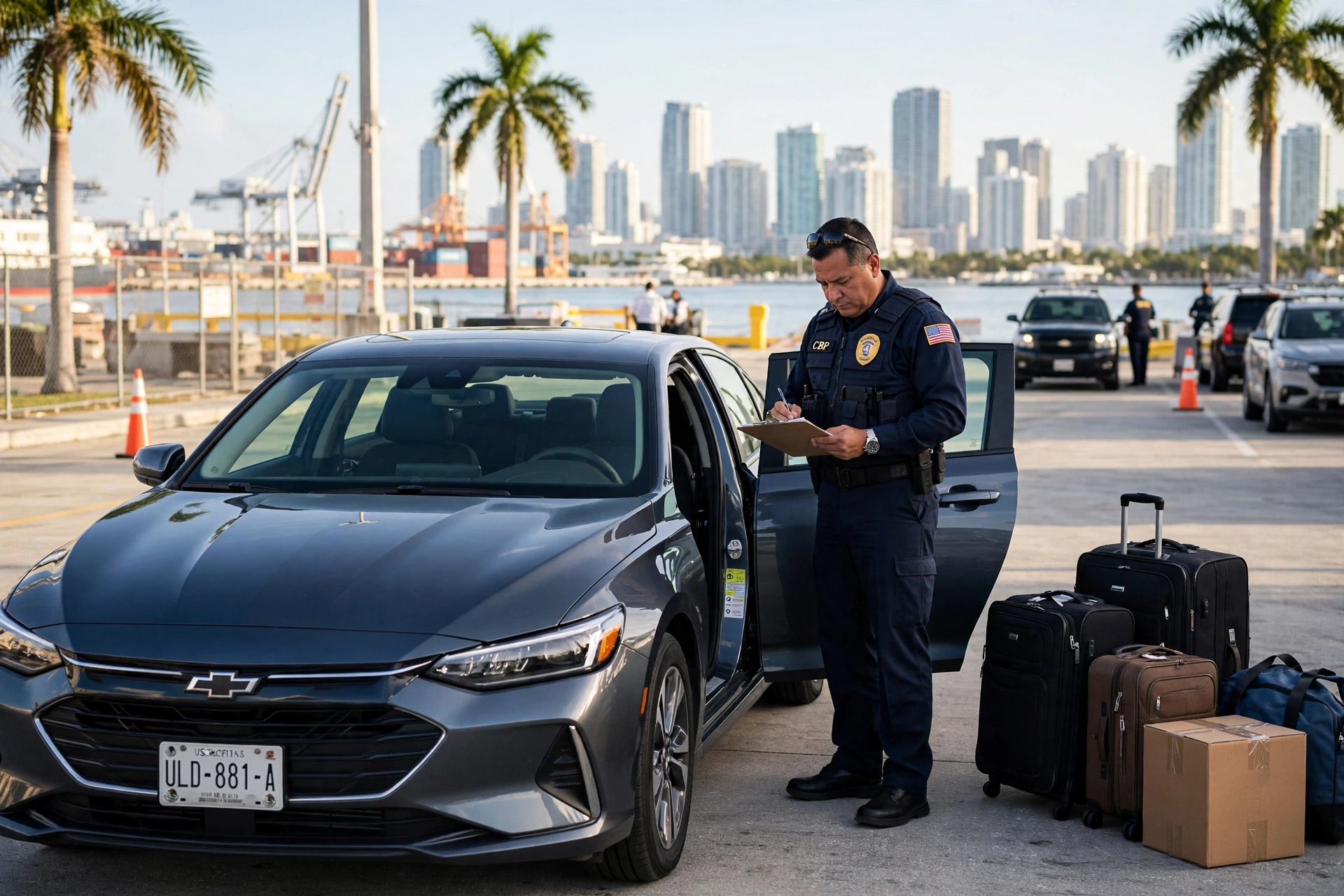
Short answer: Sell the car in Mexico or bring it? For most families moving to Miami, my answer is: sell it in Mexico. A car sold new in Mexico for the Mexican market, under 25 years old and without genuine US certification labels, cannot simply be driven or shipped in and registered in Florida. Permanent import means passing two federal gates — EPA emissions (Form 3520-1) and DOT safety (Form HS-7) — and a nonconforming car can only enter through a Registered Importer with a DOT bond of 150% of the car’s dutiable value, plus a separate EPA importer, before you pay US$1,200–3,000 in sea freight on the Veracruz–Florida corridor and US$225 in Florida initial registration. Bring the car only in three cases: it carries real US EPA and DOT labels, it is old enough for the age exemptions (25 years for DOT, 21 years for EPA), or a written conversion quote still beats selling it.
Updated: October 15, 2026.
¿Prefieres leer en español? Lee esta guía en español
The two labels that decide everything — check them before you price anything
Forget the brand. A Toyota, a Nissan or a Chevrolet sold in Mexico is not automatically a US car, even when the same model name is sold in Miami. What CBP looks for at entry is physical proof: a manufacturer certification label near the driver-side door stating the vehicle meets US safety standards, and an EPA emissions label in the engine compartment. If your car has both, or the manufacturer gives you a letter stating that exact VIN conforms to EPA and DOT standards, the import is paperwork: ownership documents, foreign registration, the bill of lading if you ship it, Form HS-7 and Form 3520-1 at the port. If it has neither, CBP treats it as what it legally is: a nonconforming vehicle. And CBP is blunt about what happens next — a nonconforming vehicle must be brought into compliance, exported, or destroyed. There is no fourth option where Florida registers it anyway. I walk through the whole Mexico move sequence in our guide to moving from Mexico to Miami: what to bring, what to sell, what it costs and how long it takes — the car decision belongs at the start of that sequence, not at the port.
| Your car’s situation | Permanent import route | My verdict |
|---|---|---|
| US EPA + DOT labels (or manufacturer conformity letter for that VIN) | File HS-7 + 3520-1 with CBP, pay applicable duty, title in Florida | Bring it — this is the only easy route |
| No US labels, under 25 years old, model also sold in the US | Only if NHTSA has determined it eligible, via a Registered Importer (DOT) + an EPA Independent Commercial Importer, bond at 150% of dutiable value | Get a written RI/ICI quote first — usually sell |
| No US labels, under 25 years old, Mexico-only version / engine / trim | Petition for eligibility first; if not substantially similar to a US model, process becomes very complex and costly, with no guaranteed result | Sell it in Mexico |
| 25 years old or more (from manufacture date) | DOT-exempt under HS-7 Box 1; EPA-exempt at 21+ years in original configuration (3520-1 Code E) | Bring it — the classic route works |
| Coming temporarily, not relocating | Nonresidents may enter a car duty-free for personal use for up to 1 year; it must then be exported and may not be sold in the US | Not a moving strategy — see below |
What the Registered Importer route really involves
People hear “an importer can fix it” and imagine a workshop bill. The legal sequence is heavier. First, NHTSA must have determined your exact model eligible for importation — eligibility exists when the car is substantially similar to a US-certified model of the same year and can readily be altered to meet every Federal Motor Vehicle Safety Standard. If it has never been determined eligible, someone must file a petition, and for a model with no similar US version that petition needs test evidence. Second, you must contract with a DOT Registered Importer before the car enters, and post a DOT conformance bond of one and a half times the dutiable value — on top of the normal customs entry bond — with copies attached to the HS-7. The RI, not you, modifies and certifies the car. Third, emissions are a separate federal problem: a nonconforming car must go through an EPA Independent Commercial Importer, the car is not released to you until that work is done, and CBP and EPA both warn that those fees are very high and that some vehicles cannot be successfully modified at all. EPA’s own guidance puts it plainly: converting a nonconforming vehicle is usually very expensive and sometimes impossible or impractical. That is why I never quote a conversion price in an article like this — there is no official tariff, it is quoted per model by the RI and the ICI, and anyone who gives you a confident number before seeing your VIN and the eligibility list is guessing with your money.
The money, line by line — and why duty is the smallest problem
| Cost line | Figure | Note |
|---|---|---|
| Sea freight, Veracruz ↔ Port Everglades / Miami (RoRo) | US$1,200–3,000, 7–14 days | Published corridor range by vehicle size and method — before inland transport in Mexico |
| Customs duty (CBP general rates) | Cars 2.5% / trucks 25% of price paid or payable | USMCA duty-free is hard to prove for a used personal car — CBP says pre-2020 vehicles are not likely eligible, and post-July 2020 vehicles need producer certifications. Since April 2025 a Section 232 auto tariff adds another layer, applied to USMCA vehicles only on their non-US content — get a broker’s current written quote |
| DOT conformance bond (nonconforming cars) | 150% of dutiable value | This is security posted, not a fee — but you pay the premium and the RI contract on top of the normal entry bond |
| RI (DOT) + ICI (EPA) conversion | No fixed price — quoted per model | Agencies warn: very high, sometimes impossible. Quote in writing BEFORE shipping |
| Florida title + initial registration | US$225 initial registration fee, plus title/plate fees | Florida insurance required first; VIN verification; keep your CBP-stamped HS-7 and 3520-1 for titling |
Run the honest comparison on a typical family car worth about US$12,000 in Mexico. Even before any conversion bill, you are spending four figures on freight, a broker, bond premium and Florida titling — to own, in Miami, a Mexican-market car with no US warranty and a thin resale and parts path for Mexico-only trims and engines. If the RI/ICI quote lands on top of that, the gap against selling in Mexico and buying its US version here usually becomes thousands of dollars. That alternative is not a leap of faith: I cost it step by step in our guide to buying a car after landing in Miami, including the first-90-days numbers.
What most people don’t know
1. Driving it across the border changes nothing. The land route feels informal — families drive up through Texas every week — but a permanent import at a land port faces the same HS-7 and 3520-1 analysis as a car unloaded at Port Everglades. The border is a port of entry, not a loophole.
2. The 1-year temporary entry is not a relocation plan. CBP lets a nonresident bring a car duty-free for personal use for up to one year, in conjunction with their arrival. A nonconforming car under that provision must be exported within the year, may not be sold in the US, and there is no extension. If you are actually relocating — job, lease, kids in school in Florida — you are establishing residence, and Florida expects your vehicle titled and registered within 10 days of that point. A car that legally must leave the country cannot be the car your new life runs on.
3. The age exemptions do not line up — there is a 4-year gap. DOT lets go at 25 years; EPA lets go at 21 years, and only if the car is in its original configuration. A 22-year-old car is EPA-exempt and still fully subject to DOT — it still needs conformity or an RI. Families counting birthdays should count from the date of manufacture, not the model year on the registration.
4. Your car is not a shipping container, and its undercarriage is inspected. CBP prohibits using the car to move personal belongings — everything inside must be declared, and many carriers refuse cars with contents. USDA also requires the undercarriage to be free of foreign soil: steam-clean it before shipping or pay for cleaning at the port.
5. Some Mexican-market cars were built in the US — and some US-name cars were not built for the US. Origin stories cut both ways, which is why the rule is boring and absolute: photograph the door label, photograph the engine-compartment label, and send both to a Registered Importer and a customs broker before you list the car for sale or book a ship. Ten minutes of photos decides a five-figure question.
My decision rule, the one I give every Mexican client
Bring it if the labels (or a manufacturer letter for your VIN) prove US conformity, or the car is 25 years old or more and in original configuration, or it is genuinely special and a written RI + ICI quote — obtained before shipping — still leaves you ahead of selling. Sell it in every other case, sell it early while you still control the timing in Mexico, and land in Miami planning to buy the US version in your first 90 days. If your move runs on the work calendar as well, sequence the car sale with your start date the same way I sequence it in our TN visa guide for Mexicans: the USMCA work route to Miami — a car problem at the port should never be the thing that delays a first day of work. More Mexico-route guides live in our Miami relocation guides hub.
Frequently asked questions
Can I just drive my Mexican-plated car to Miami and register it in Florida?
Only if the car is US-conforming (labels or manufacturer letter), or age-exempt. Florida titling for an imported vehicle runs on the CBP-stamped import forms, and CBP will not stamp a permanent entry for a nonconforming car under 25 years old outside the Registered Importer process. Driving to a land port instead of shipping does not change the EPA or DOT analysis.
How long can I keep a Mexican car in Florida on the temporary entry?
Up to one year, and only as a nonresident importing it for personal use in conjunction with your arrival. A nonconforming car under that provision must be exported within the year and cannot be sold in the United States — CBP states there is no exemption or extension of that export requirement. It does not work as the bridge car for a permanent relocation.
How much duty will I pay on a car from Mexico?
CBP’s general rates are 2.5% for autos and 25% for trucks, on the price paid or payable. Do not budget on that alone in 2026: USMCA duty-free treatment requires meeting strict automotive rules of origin that CBP says pre-2020 vehicles are not likely to meet, and the Section 232 auto tariff in force since April 2025 adds a further layer that depends on the vehicle’s US content. A licensed customs broker should quote your car’s current treatment in writing before it ships.
My car is 21 years old — is it exempt?
Half. At 21 years or more, in original configuration, it is exempt from EPA emissions requirements (Form 3520-1, Code E). DOT safety exemption starts at 25 years from the date of manufacture. A car between 21 and 24 years old still needs to meet FMVSS or go through a Registered Importer for the DOT side.
This article is general information about relocation planning, not legal or customs advice. Import eligibility is specific to your vehicle’s VIN, labels and manufacture date — confirm with NHTSA, the EPA, a DOT Registered Importer and a licensed customs broker before buying, selling or shipping any vehicle.
Yara Coker — SETTLE, relocation services in Miami.
Want help with your move to Miami?
Moving to Miami from Mexico and deciding what to do with the car? Send me the year, model and where you are in Mexico, plus photos of the driver-door and engine labels if you have them — I will help you sequence the sale or the import, the housing and the paperwork so nothing stalls at the port or at the Florida tax collector.
Sources
Import framework, documentation (bill of lading, bill of sale, foreign registration, EPA Form 3520-1 and DOT Form HS-7), the conform / export / destroy rule for nonconforming vehicles, ICI route and its very high fees, general duty rates (autos 2.5%, trucks 25%), the nonresident one-year duty-free entry with mandatory export and no extension, USMCA duty-free stringency for vehicles (pre-2020 vehicles not likely eligible; producer certifications for vehicles produced on or after July 1, 2020), the undercarriage soil requirement and the prohibition on using the car as a shipping container: CBP, Importing a Motor Vehicle (cbp.gov), fetched October 15, 2026. The 25-year DOT rule (HS-7 Box 1, age counted from date of manufacture), the Registered Importer route, the DOT conformance bond of one and a half times the dutiable value, eligibility determinations and the petition process for models not previously determined eligible: CBP (same page) and NHTSA, Importation and Certification FAQs and Vehicle Importation Guidelines for vehicles manufactured for sale outside Canada (nhtsa.gov). EPA age exemption at 21 years in original configuration (Form 3520-1 Code E) and EPA’s position that conversion of nonconforming vehicles is usually very expensive and sometimes impossible or impractical: EPA importing-vehicles guidance as summarised by the US Department of Commerce (trade.gov) and EPA import materials, checked October 15, 2026. Section 232 automotive tariff of 25% effective April 3, 2025, applied to USMCA-compliant vehicles only on non-US content, against the prior MFN rates of 2.5% (cars) and 25% (light trucks): Congressional Research Service, Section 232 Automotive Tariffs: Issues for Congress, IN12545 (congress.gov). Sea freight range US$1,200–$3,000 and 7–14 day transit on the Port Everglades / Miami – Veracruz RoRo corridor: All TransportDepot published corridor pricing (rorofromusa.com), checked October 15, 2026. Florida initial registration fee of US$225 for vehicles new to the state, insurance and VIN verification requirements, and the 10-day registration window after establishing residency: Florida Highway Safety and Motor Vehicles (flhsmv.gov). Figures checked October 15, 2026.
Versión en español: Vivir en Miami: ¿Vender el carro en México o traerlo? La realidad EPA/DOT
