
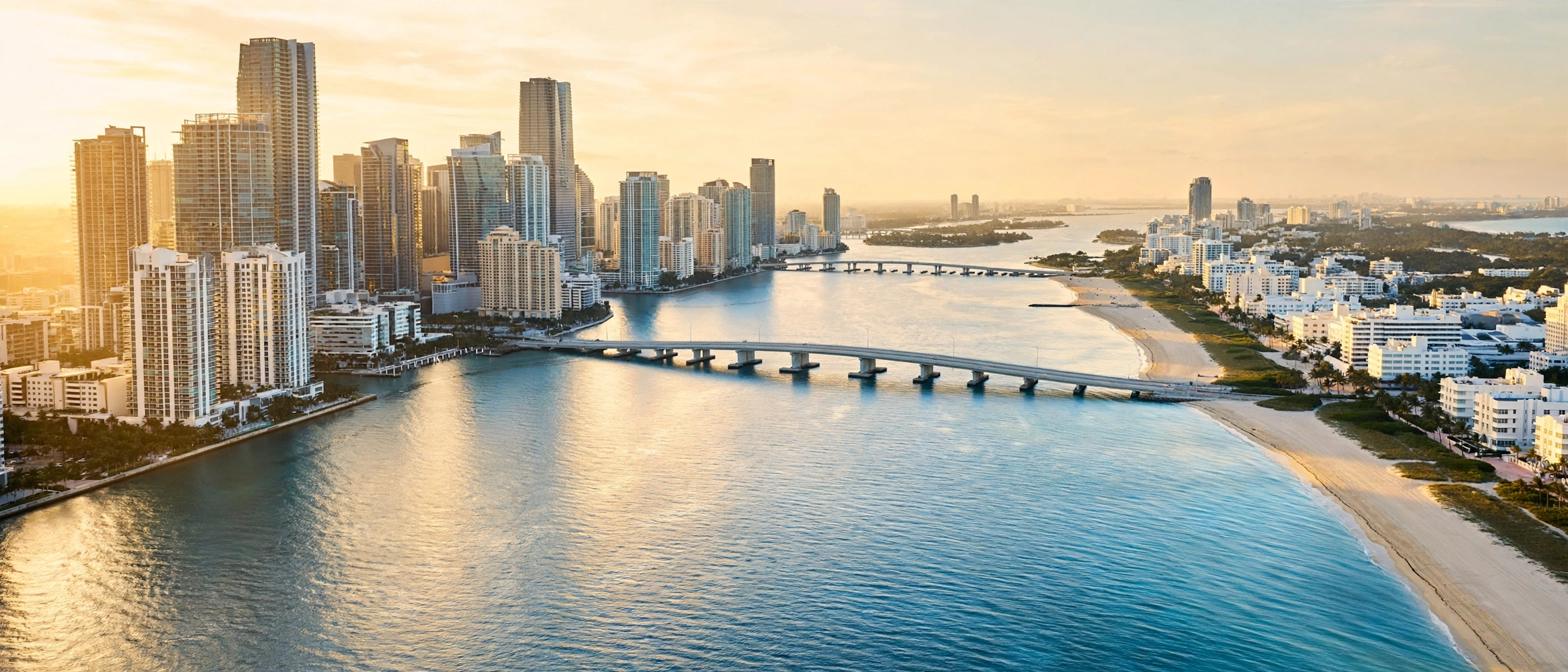
Short answer: Brickell vs. Miami Beach: cost and lifestyle for newcomers — if you are moving to Miami, there is no single winner, because the answer flips with the floor plan. A 1-bedroom averages US$3,298 a month in Brickell vs. US$3,001 in Miami Beach, but a 2-bedroom averages US$4,085 in Brickell vs. US$4,303 in Miami Beach — and the Beach unit is smaller in both cases (704 vs. 815 sq ft for a 1-bedroom; 1,145 vs. 1,205 for a 2-bedroom; RentCafe/Yardi Matrix, September 30, 2026). So the cost of living in Miami in these two postcodes is decided less by rent than by three things listings never show: Brickell is a renter’s tower district (74% of households rent) built around the workday, with the fare-free Metromover at your door; Miami Beach is a separate city across the bay where most residential districts ban rentals shorter than six months and one day, and most of the island sits in FEMA’s Special Flood Hazard Area. Pick by your weekday, not by the beach photo.
Updated: October 14, 2026.
¿Prefieres leer en español? Lee esta guía en español
Moving to Miami: Brickell vs. Miami Beach, priced side by side
Compare the same product — a professionally managed apartment — before you compare impressions, because the averages hide the inversion:
| Area | Studio | 1-bed apartment | 2-bed apartment | Average rent (all) | Share of households renting |
|---|---|---|---|---|---|
| Brickell (City of Miami) | US$2,525 · 545 sq ft | US$3,298 · 815 sq ft | US$4,085 · 1,205 sq ft | US$3,778 | 74% |
| Miami Beach (own city) | US$2,094 · 575 sq ft | US$3,001 · 704 sq ft | US$4,303 · 1,145 sq ft | US$3,435 | 59% |
Three readings matter. First, per square foot the Beach charges more for less room: about US$4.26 per sq ft for a 1-bedroom vs. US$4.05 in Brickell, and US$3.76 vs. US$3.39 for a 2-bedroom. Second, the cheapest door into either area is a Beach studio — US$431 a month below Brickell’s — which is why solo newcomers who work remotely often land there first. Third, Beach rents rose faster last year (+4.84% vs. +3.16% in Brickell): the gap is moving, not fixed. Whichever side you choose, price the move-in cash before the monthly rent — our guide to security deposits in Miami and how they really work shows what that first check actually covers in Florida.
Where each side wins — and what it costs you daily
Brickell wins the workday. It is Miami’s financial district: new, large towers with deep, liquid stock you can actually sign this month, offices, supermarkets and restaurants within walking distance, and the fare-free Metromover — 21 stations across Downtown and Brickell, connecting to the Metrorail (standard fare US$2.25) — which makes living without a car genuinely workable for the only part of Miami where that is true. The trade: you pay the district premium on 1-bedrooms, parking inside the building is usually an extra monthly line, and weekends feel like an office district emptying out.
Miami Beach wins the hours Brickell cannot sell. Morning runs by the water, the sand minutes away, a walkable small-city texture of cafés and Art Deco streets — no mainland neighborhood replicates it, which is why it anchors so many lists of the best neighborhoods in Miami. The trades are structural: your unit will likely be smaller and older for the money, parking is scarce in the boutique stock, every drive to a mainland office crosses one of a handful of causeways, and the city’s calendar of mega-events regularly takes over the streets you live on. If your job is remote or on the Beach itself, none of that may matter. If your job is in Brickell, it matters every single morning.
What most people don’t know
1. In most of Miami Beach, a 3-month lease can be illegal. The city code generally prohibits renting a residential unit for less than six months and one day in most residential districts, with limited exceptions — so the furnished “seasonal” unit you found online may not be a lawful long-term home at all, whatever the listing says. Brickell sits in the City of Miami, where the minimum term is set building by building instead. Anyone planning a winter trial first should start from our Canadian snowbird guide to a winter in Miami and check the lease term against the district before paying anything.
2. Miami Beach is not a Miami neighborhood — it is another city. Its own city hall, services, permits and rental rules apply. Newcomers who file paperwork, register a car or dispute a lease condition assuming “Miami” rules discover the island runs its own. Brickell, by contrast, follows City of Miami rules like any mainland neighborhood.
3. The Beach’s flood map is part of the rent. The city itself notes that most of Miami Beach lies in FEMA’s Special Flood Hazard Area, and its fall king tides — predicted for October 24–30, November 6–9 and November 23–26, 2026 on NOAA’s Virginia Key tables — can flood streets on sunny days with no rain at all. Ground-floor units and street-parked cars carry a real seasonal cost on the island that a Brickell tower unit, for all its own storm exposure, prices differently. Ask for the building’s flood history and insurance position in writing, on either side of the bay.
4. The averages conceal how thin Beach stock is. With 59% of households renting and a large share of units held as second homes or seasonal places, the long-term Beach market is thinner than the listing count suggests — good units go fast and landlords can be selective. Brickell’s 74% renter share and constant tower turnover give a newcomer more choice and more negotiating room, especially outside the January–March peak.
5. The lifestyle gap closes after month three — the commute gap doesn’t. Most newcomers use the beach intensely for the first weeks and then settle into a routine. What never fades is the daily pattern: where you work, where you park, how you cross the bay. Rent for the routine, visit for the postcard — and use the full library in our Miami relocation guides hub before you sign either lease.
Frequently asked questions
Which is cheaper for newcomers: Brickell or Miami Beach?
It depends on the floor plan. Studios and the overall average favor Miami Beach (US$2,094 and US$3,435 vs. US$2,525 and US$3,778), a 1-bedroom favors the Beach on price (US$3,001 vs. US$3,298) but Brickell on space (815 vs. 704 sq ft), and a 2-bedroom favors Brickell on both price and size (US$4,085 and 1,205 sq ft vs. US$4,303 and 1,145 sq ft) — RentCafe/Yardi Matrix, September 2026.
Can I sign a 3-month furnished lease in Miami Beach?
Often, no. In most residential districts the city generally prohibits rentals shorter than six months and one day, with limited exceptions, and each building adds its own rules on top. In Brickell the minimum is set by each tower, and short seasonal terms exist in some buildings. Verify the district and the building’s lease package in writing before paying a deposit.
Which is better if I work in Brickell or Downtown?
Brickell, in almost every case: you can walk or ride the fare-free Metromover to the office and plausibly skip the car. Living on the Beach and working on the mainland means a causeway drive at rush hour every day — price that time honestly before trading it for the shoreline.
Which is better for a family landing in Miami?
Neither is the typical family landing pad — both skew to smaller units and working adults — but between the two, Brickell’s larger 2- and 3-bedrooms (a 3-bedroom averages 1,776 sq ft) and mainland access to schools and services usually serve a family better than the Beach’s smaller stock. This article is general information, not financial advice; verify any specific unit’s rent, term and flood position before signing.
Yara Coker — SETTLE, relocation services in Miami.
Want help with your move to Miami?
Tell us where you will work, how many bedrooms you need and whether you can truly live without a car — we will run the Brickell vs. Miami Beach math on live listings for your exact case, including the lease-term and flood checks, and tell you plainly which side of the bay wins for you.
Sources
RentCafe Market Analysis (Yardi Matrix), updated September 30, 2026: Brickell — average rent US$3,778 (+3.16% year over year); studio US$2,525 / 545 sq ft; 1-bed US$3,298 / 815 sq ft; 2-bed US$4,085 / 1,205 sq ft; 3-bed US$6,359 / 1,776 sq ft; 74% of households renter-occupied. Miami Beach — average rent US$3,435 (+4.84% year over year); studio US$2,094 / 575 sq ft; 1-bed US$3,001 / 704 sq ft; 2-bed US$4,303 / 1,145 sq ft; 59% of households renter-occupied. Per-square-foot figures and annual gaps are SETTLE calculations from those rents and sizes. City of Miami Beach: municipal code section 142-1111 and related ordinances (rentals of residential units for less than six months and one day generally prohibited in most residential districts, with limited exceptions); city flood-protection program (most of Miami Beach is in the FEMA Special Flood Hazard Area; matching funds of up to US$20,000 for floodproofing, 2026 application deadline April 24); 2026 king-tide predictions from NOAA’s Virginia Key tide tables as published by the city (October 7–13 and 24–30, November 6–9 and 23–26). Miami-Dade Transit: Metromover is fare-free, 21 stations serving Downtown and Brickell with Metrorail connections at Government Center and Brickell stations; Metrorail standard fare US$2.25.
Versión en español: Vivir en Miami — Brickell vs. Miami Beach: costo y estilo de vida para recién llegados
