
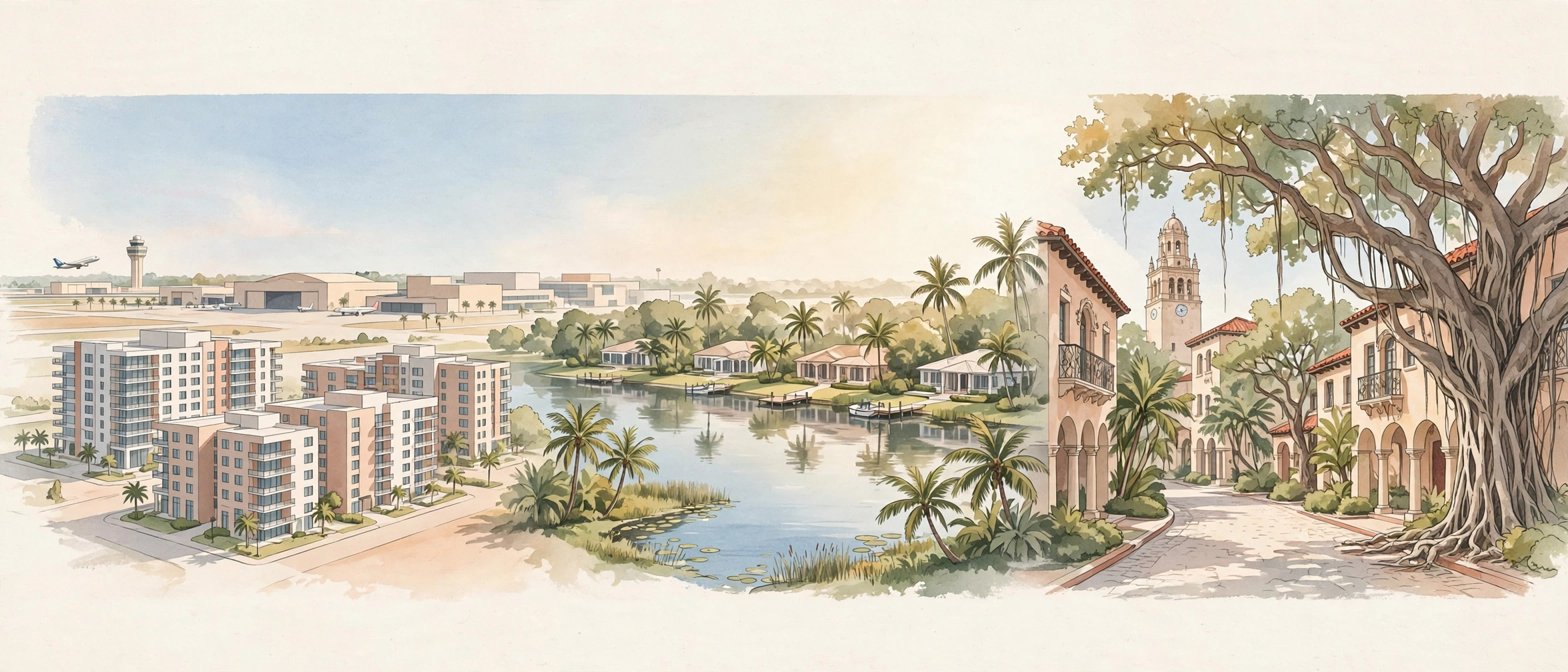
Short answer: if you are moving to Miami and choosing between Doral vs. Weston vs. Coral Gables for living, the same 2-bedroom apartment costs US$2,662 a month in Weston, US$3,036 in Doral and US$4,954 in Coral Gables (RentCafe/Yardi Matrix, September 2026). That is a US$2,292 monthly gap — US$27,504 a year — between the cheapest and the most expensive of three cities newcomers treat as interchangeable. They are not: Doral is a renter’s city built around the airport corridor (53% of households rent), Weston is an owners’ suburb in a different county where apartments are scarce (only 27% rent), and Coral Gables charges a premium for centrality that shows up in the shortest average commute of the three, 23.8 minutes. The cost of living in Miami is decided less by which city is “nicer” than by where you work every morning.
Updated: October 14, 2026.
¿Prefieres leer en español? Lee esta guía en español
Moving to Miami: Doral vs. Weston vs. Coral Gables, priced side by side
Compare the same product — a professionally managed apartment — before you compare houses, because house rents mix in pools, lots and HOA rules that hide the city’s real price:
| City (county) | 1-bed apartment | 2-bed apartment | 3-bed apartment | Share of households renting | Median owner-home value (Census) |
|---|---|---|---|---|---|
| Weston (Broward) | US$2,202 · 831 sq ft | US$2,662 · 1,114 sq ft | US$3,236 · 1,360 sq ft | 27% | US$695,600 |
| Doral (Miami-Dade) | US$2,516 · 770 sq ft | US$3,036 · 1,123 sq ft | US$3,500 · 1,351 sq ft | 53% | US$562,800 |
| Coral Gables (Miami-Dade) | US$3,268 · 760 sq ft | US$4,954 · 1,174 sq ft | US$7,356 · 1,680 sq ft | 36% | US$1,089,900 |
Two readings matter. First, per square foot a 2-bedroom runs about US$2.39 in Weston, US$2.70 in Doral and US$4.22 in Coral Gables — you are not paying for more space in the Gables, you are paying for location. Second, the averages hide availability: Doral’s deep, newer apartment stock means a landing family can actually sign this month, while Weston’s low renter share means most “rentals” there are individual houses at house prices, with far fewer options on any given week. Before any deposit moves, check what that money can legally cover in our guide to security deposits in Miami and how they really work.
Where each city wins — and what it costs you daily
Doral wins on landing logistics. It sits beside Miami International Airport and the west-side office and logistics corridor, it has the largest population of the three (81,634, Census estimate for July 2025) and the most international daily life — 70.3% of residents were born outside the US and 93.3% of homes speak a language other than English. Median household income is US$94,164, the lowest of the three, yet rents are mid-pack: you pay for convenience and community, not for prestige. The average commute is 26.5 minutes.
Weston wins on space per dollar — if your life points north or remote. Its average apartment is the largest of the three (1,154 sq ft) and the cheapest per foot, and median household income is the highest at US$139,825. The trade is written into the map: Weston is in Broward County, not Miami-Dade — a different school district, different county services, and Fort Lauderdale’s airport (FLL) as your natural hub instead of MIA. Its average commute, 29.6 minutes, is also the longest of the three, and that average flatters anyone driving daily to Brickell or the airport corridor.
Coral Gables wins on time and daily texture. The oldest, smallest city here (49,578 residents) pairs the highest rents — up 8.72% in a year on the average apartment — with the shortest average commute (23.8 minutes), a walkable downtown core, and quick access to Brickell, Downtown and the University of Miami. Households are smaller (2.28 people on average, vs. 3.03 in Doral and 3.16 in Weston): the Gables premium is largely paid by couples and executives buying back their mornings, which is exactly why it tops most lists of the best neighborhoods in Miami for people whose office is east.
What most people don’t know
1. Weston is not a Miami suburb in the administrative sense. County lines decide your school district, your property-tax bill, your hurricane-evacuation zone paperwork and even which airport drive feels “close.” Families who choose Weston for Miami reasons discover the Broward reality after signing; families who choose it for Broward reasons — space, schools, FLL — rarely regret it.
2. The Gables gap buys a second car you may not need. US$27,504 a year over Weston is roughly the full cost of owning, insuring and fueling a car in Miami. In walkable parts of Coral Gables many households genuinely drop to one car; in Doral and Weston, two-car life is the default assumption built into every budget. Compare total monthly cost, not rent alone.
3. Doral’s “average rent” is the most honest of the three. With 53% of households renting and a deep stock of large buildings, its average reflects a real, liquid market you can enter this month. Weston’s and the Gables’ averages rest on thin apartment stock — the specific unit you find can sit far above or below the average, so negotiate from live listings, not from the city mean.
4. A winter test changes the ranking. If you are trialing Miami for a season before committing, the math and the lease structures differ completely from a permanent move — seasonal residents should start from our Canadian snowbird guide to a winter in Miami and only then run this three-city comparison.
5. Rent first is cheapest in the city you will probably leave. Many newcomers land in Doral for its availability, then move east or north once work and schools settle. That is a rational sequence, not a failure — plan the first lease at 12 months, keep the exit clean, and use the full library in our Miami relocation guides hub before signing the second one.
Frequently asked questions
Which is cheapest for living: Doral, Weston or Coral Gables?
On comparable apartments, Weston: US$2,202 for a 1-bedroom and US$2,662 for a 2-bedroom (RentCafe, September 2026), with the most space per dollar. Doral follows at US$2,516 / US$3,036, and Coral Gables is the outlier at US$3,268 / US$4,954 — about US$2,292 a month above Weston for a 2-bedroom, before you count the shorter Gables commute.
Is Weston a good base for working in Miami?
Only if your office is remote, in Broward, or near Fort Lauderdale. Weston is a Broward County city with the longest average commute of the three (29.6 minutes, Census) — and that average is not a daily drive to Brickell at rush hour. If your job is at MIA, in Doral’s office corridor or anywhere east, price Doral or Coral Gables first.
Why is Coral Gables so much more expensive?
Scarcity plus centrality: a small, largely built-out historic city (median owner-home value US$1,089,900, Census) minutes from Brickell and the airport, with a walkable core and very little new apartment supply. Its average apartment rent rose 8.72% in the year to September 2026 — the premium is widening, not closing.
Where should a newcomer family land first?
Doral, in most cases: the deepest rental stock, the easiest first signing, and a daily life that works in Spanish and English from day one. Then choose deliberately between Weston’s space (accepting Broward) and the Gables’ time savings (accepting the premium) once you know your real commute and school plan. This article is general information, not financial advice; verify any specific unit’s rent and terms before signing.
Yara Coker — SETTLE, relocation services in Miami.
Want help with your move to Miami?
Tell us where you will work, how many bedrooms you need and whether schools or commute matter more — we will run this three-city math on live listings for your exact case and tell you plainly which city wins for you, before you sign anything.
Sources
RentCafe Market Analysis (Yardi Matrix), average rent pages for Coral Gables (updated September 30, 2026: average US$4,414; 1-bed US$3,268 / 760 sq ft; 2-bed US$4,954 / 1,174 sq ft; 3-bed US$7,356 / 1,680 sq ft; +8.72% year over year; 36% renter households), Doral (updated September 28, 2026: average US$2,867; 1-bed US$2,516 / 770 sq ft; 2-bed US$3,036 / 1,123 sq ft; 3-bed US$3,500 / 1,351 sq ft; 53% renter households) and Weston (updated September 30, 2026: average US$2,798; 1-bed US$2,202 / 831 sq ft; 2-bed US$2,662 / 1,114 sq ft; 3-bed US$3,236 / 1,360 sq ft; 27% renter households). U.S. Census Bureau QuickFacts (population estimates July 1, 2025; American Community Survey 2020–2024): population Doral 81,634, Weston 69,588, Coral Gables 49,578; median value of owner-occupied housing Doral US$562,800, Weston US$695,600, Coral Gables US$1,089,900; median household income Doral US$94,164, Weston US$139,825, Coral Gables US$134,216; mean travel time to work Coral Gables 23.8 minutes, Doral 26.5, Weston 29.6; owner-occupied rate Doral 46.5%, Coral Gables 64.5%, Weston 73.0%; persons per household Coral Gables 2.28, Doral 3.03, Weston 3.16; foreign-born Doral 70.3%, Coral Gables 37.7%; language other than English at home Doral 93.3%, Weston 68.3%, Coral Gables 60.7%. Per-square-foot figures and annual gaps are SETTLE calculations from the RentCafe rents and sizes above.
Versión en español: Vivir en Miami — Doral vs. Weston vs. Coral Gables: la diferencia de $2,292 al mes que nadie te muestra
