
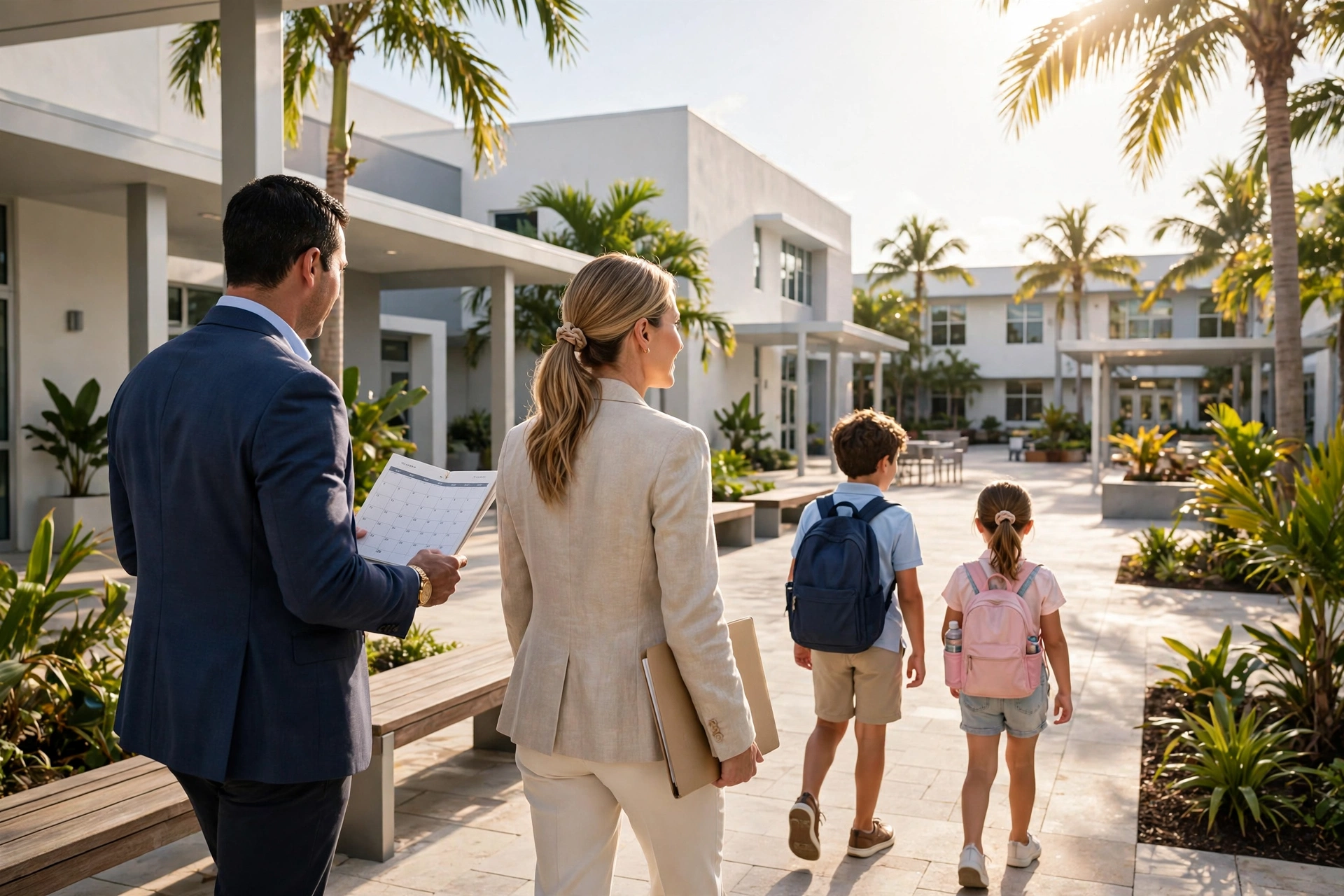
Short answer: If you are moving to Miami as a relocating executive with kids, private school — not housing — sets your calendar. For a fall 2027 start, first-round applications at Miami’s top independent schools close in mid-January 2027, decisions land in late February, and holding the seat takes a deposit of $2,500 at Ransom Everglades or a non-refundable $3,300 at Gulliver Prep — on top of tuition of $56,100–$57,300 a year in grades 5–12. Miss January and you are not “a little late”: you are in wait pools and rolling review, negotiating with whatever seats are left. The cost of living in Miami conversation your employer had with you almost certainly priced rent — this page prices the school clock it ignored.
Updated: October 13, 2026.
¿Prefieres leer en español? Lee esta guía en español
Moving to Miami with kids: the private school timeline that runs your relocation
Corporate relocations are usually negotiated around a start date at the office. In Miami, the binding date is the school’s. This is the real sequence for a fall 2027 entry, built from the schools’ own published calendars:
| When | What happens | Verified anchor |
|---|---|---|
| September 2026 | Applications open. Tours, student assessments and interviews fill first — book them before you have an offer letter in hand if the move is likely. | Gulliver Prep opened applications on September 2; its admissions testing for young applicants ran in December and January. |
| November–December 2026 | Financial-aid files open. If you want aid considered with the admission decision, the aid application runs in parallel — not after. | Miami Country Day’s Clarity deadline for current families is November 30, 2026, and January 4, 2027 for new applicants. |
| Early–mid January 2027 | The wall. First-round applications, recommendations, transcripts and test scores are due. There is no executive fast lane. | Gulliver’s first-round deadline is January 16 for every requirement, including aid. Ransom Everglades’ aid deadline for prospective families is January 10, 2027. |
| Late February 2027 | Decisions arrive — and the deposit clock starts immediately. Families typically have days, not months, to sign and pay. | Gulliver posts decisions February 27; Ransom Everglades emails admission decisions February 26, with aid included. |
| February–March 2027 | You sign the enrollment contract and pay the deposit. From this signature, the contract’s withdrawal schedule — not the deposit — is your real financial exposure. | Deposits below: $2,500 (Ransom Everglades, applied to tuition) and $3,300 non-refundable (Gulliver, applied to tuition). |
| Mid-August 2027 | Classes start in Miami-Dade. Your housing, temp-housing end date and lease start should be reverse-planned from this week, not from your first day at work. | Miami-Dade public schools start in mid-August; private schools follow a similar mid-August rhythm. |
One parallel deadline most relocating families never hear about: Miami-Dade’s public magnet programmes — the strongest free option in the county — take applications from October 1 through January 15, with the January 15, 2027 deadline applied with no exceptions, and out-of-district families must upload transcripts by that same date. Even if private school is Plan A, a magnet application costs nothing and is the only Plan B that expires on the same day as Plan A.
Deposits and tuition in Miami private schools: the real numbers
These are the schools’ own published 2026–27 figures — the level a relocating executive family actually budgets at. Expect a modest increase for 2027–28; the structure, not the last digit, is what matters for your relocation package.
| School | Tuition 2026–27 | Deposit / enrollment fee | What relocating families miss |
|---|---|---|---|
| Ransom Everglades (Coconut Grove, grades 6–12) | $57,300, lunch included | $2,500 enrollment fee paid on enrollment, applied to tuition; plus a $100 matriculation fee for new students, not applied | No sibling discount, and the school does not accept Florida voucher funds |
| Gulliver Prep (Pinecrest area, PK–12) | $36,400 (PK–SK); $40,200 (grades 1–4); $56,100 (grades 5–12) | $3,300 non-refundable enrollment deposit to hold the seat, applied to tuition | The deposit is due to hold the place for the coming year — before you have spent a single day in Miami |
| Miami Country Day (Miami Shores, PK3–12) | Upper grades listed at about $52,900 (Niche) | Deposit set in the enrollment contract; aid only from grade 6 up | The school does not participate in the state Step Up scholarship programmes |
| Carrollton School of the Sacred Heart (Coconut Grove, all-girls PK–12) | About $49,000 (Private School Review, 2026–27) | Application deadline in early January | Single-sex entry point planning matters: siblings of different sexes need two separate school strategies |
Now the math your relocation package has to survive. Two children in grades 5–12 at Gulliver is $112,200 a year in tuition, plus $6,600 in non-refundable deposits due at signing — in February, months before your first Miami paycheck in the new role, and usually before your house in your old city has sold. That February cash moment is exactly what to put on the table when you negotiate: school-search support, application and testing fees, and the deposit itself are legitimate relocation asks, in the same conversation as temporary housing. When temp housing ends and you sign a lease near the school, the same cash-flow logic applies to the rental side — our guide to security deposits in Miami explains how much landlords can charge and when they must give it back, so the school deposit and the lease deposit do not ambush you in the same month.
Cost of living in Miami for executives: why your neighbourhood follows the school
Executives choose a neighbourhood; families with a school place inherit one. Ransom Everglades and Carrollton sit in Coconut Grove, Gulliver in the Pinecrest area, Miami Country Day in Miami Shores — and the daily school run, not the office commute, is what your children will judge the move by. That is why the best neighbourhoods in Miami for a relocating executive family are decided in February, when the school decision lands, and why signing a 12-month lease in Brickell in October — before any school answer exists — is the most common sequencing error we see. If your start date forces temporary housing first, choose it inside the likely school corridor: a 60-day stay that tests the real school run is worth more than a cheaper stay across town. Winter adds one more pressure: a January-to-March housing search competes with peak seasonal demand, the same dynamic our snowbird guide documents for winter rentals in Miami. And when you are ready to compare areas properly, our Miami relocation guides hub puts the neighbourhood and cost breakdowns in one place.
What most people don’t know
- The deposit is the smallest money at risk — the contract is the risk. Families obsess over $2,500–$3,300 and sign without reading the withdrawal schedule. At most independent schools, signing the enrollment contract creates an obligation for the full year’s tuition, released in stages as the year approaches. If your employer can transfer you again — or the relocation falls through in May — what you owe is whatever that schedule says on that date, not the deposit. Read that page before you sign, and ask your employer, in writing, who carries that exposure if the company cancels the move.
- Florida’s roughly $8,000 school voucher does not work at the top schools. The state’s Family Empowerment / Tax Credit scholarships average about $8,000 per student, but Ransom Everglades states it does not accept voucher funds, Gulliver states it accepts no state or federal funds or scholarship programmes, and Miami Country Day states it does not participate in Step Up. Budget the full tuition at this tier; treat any scholarship as relevant only if you choose a participating school.
- Arriving after January does not end the game — it changes it. Off-cycle entry depends on a seat opening when another family leaves, and the biggest intakes are at the natural entry grades (early childhood, 6th and 9th). A family arriving in March with a 7th-grader is fishing in a much smaller pond than the same family with a 6th-grader. The honest strategy is three-track: wait pools at your top choices, rolling review at strong second choices, and a one-year bridge plan you can actually live with — not a year of hoping.
- Both parents’ paperwork matters, even for full-pay families. Schools ask for transcripts covering prior years, teacher recommendations from the current school, and standardised test scores (SSAT or ISEE at the older grades). If your children are coming from a school abroad, certified translations and grade-equivalency questions add weeks. Start the records file in September, in English, before anyone asks for it.
- Aid and admission run on separate clocks — and aid is not a negotiation chip for full-pay executives. Ransom Everglades states plainly that applying as a full-pay family signals you can cover costs for the foreseeable future, and that later aid is reserved for genuine reversals. Decide your lane before you apply; switching lanes after admission rarely works.
Frequently asked questions
We just learned in November that we are moving to Miami. Is it already too late for private school?
No — but the clock is real. November is late for tours and testing slots, not for the application itself: first-round files close in mid-January. Compress the sequence: book assessments and interviews immediately, start the transcript and recommendation requests the same week, and file the magnet application before January 15 as your free safety net.
Can my employer pay the school deposit — and should I ask?
Ask, and ask in the offer stage. School-related costs are a recognised relocation exception at many employers: application and testing fees, a school-search consultant, and the enrollment deposit are small lines next to temporary housing and the household-goods move. What matters is getting the agreed items written into the offer letter with amounts — including who bears the contract exposure if the company cancels the transfer after you sign with the school.
What happens to our deposit if the relocation is cancelled?
At Gulliver the $3,300 enrollment deposit is expressly non-refundable; at Ransom Everglades the $2,500 enrollment fee is applied to tuition once you enrol. Beyond the deposit, your exposure is whatever the signed enrollment contract’s withdrawal schedule says — which is why the cancellation scenario belongs in your employer negotiation before you sign anything with a school.
Should we choose the house first and the school second?
Almost never in Miami. School decisions land in late February and the daily school run defines family life here. Hold housing flexible — temporary housing or a short first lease inside the likely school corridor — until the school place is signed, then commit to the neighbourhood. Your future self, driving that route twice a day, will thank you.
Yara Coker — SETTLE, relocation services in Miami.
Want help with your move to Miami?
Tell us your start date, your children’s ages and where the offer stands — we will build the school-and-housing calendar backwards from the January wall, so no deadline decides for you.
Sources
Ransom Everglades School, official tuition and financial aid page (2026–27): tuition, matriculation and enrollment fees, Clarity aid deadlines (prospective families January 10, 2027), February 26 decision date, and the school’s policy of not accepting Florida voucher funds. Gulliver Preparatory School, official 2026–27 tuition page and admissions checklist: tuition by grade band, the $3,300 non-refundable enrollment deposit applied to tuition, the school’s policy of accepting no state or federal funds, applications opening September 2, the January 16 first-round deadline and February 27 decisions. Miami Country Day School, official tuition assistance page: Clarity deadlines of November 30, 2026 (current families) and January 4, 2027 (new applicants), and non-participation in Step Up For Students programmes; upper-grade tuition of about $52,900 as listed by Niche. Carrollton School of the Sacred Heart: tuition of about $49,000 and an early-January application deadline (Private School Review, verified 2026–27 school update). Step Up For Students: Florida Tax Credit and Family Empowerment (FES-EO) scholarships average about $8,000 per student. Miami-Dade County Public Schools: magnet applications run October 1 to January 15 annually, with the January 15, 2027 deadline and transcript requirements for out-of-district applicants per district and MAST Academy publications. All sources checked October 13, 2026; verify current-year figures with each school before signing.
Versión en español: Vivir en Miami: Ejecutivos con hijos que se mudan — depósitos y tiempos de colegios privados en Miami
