
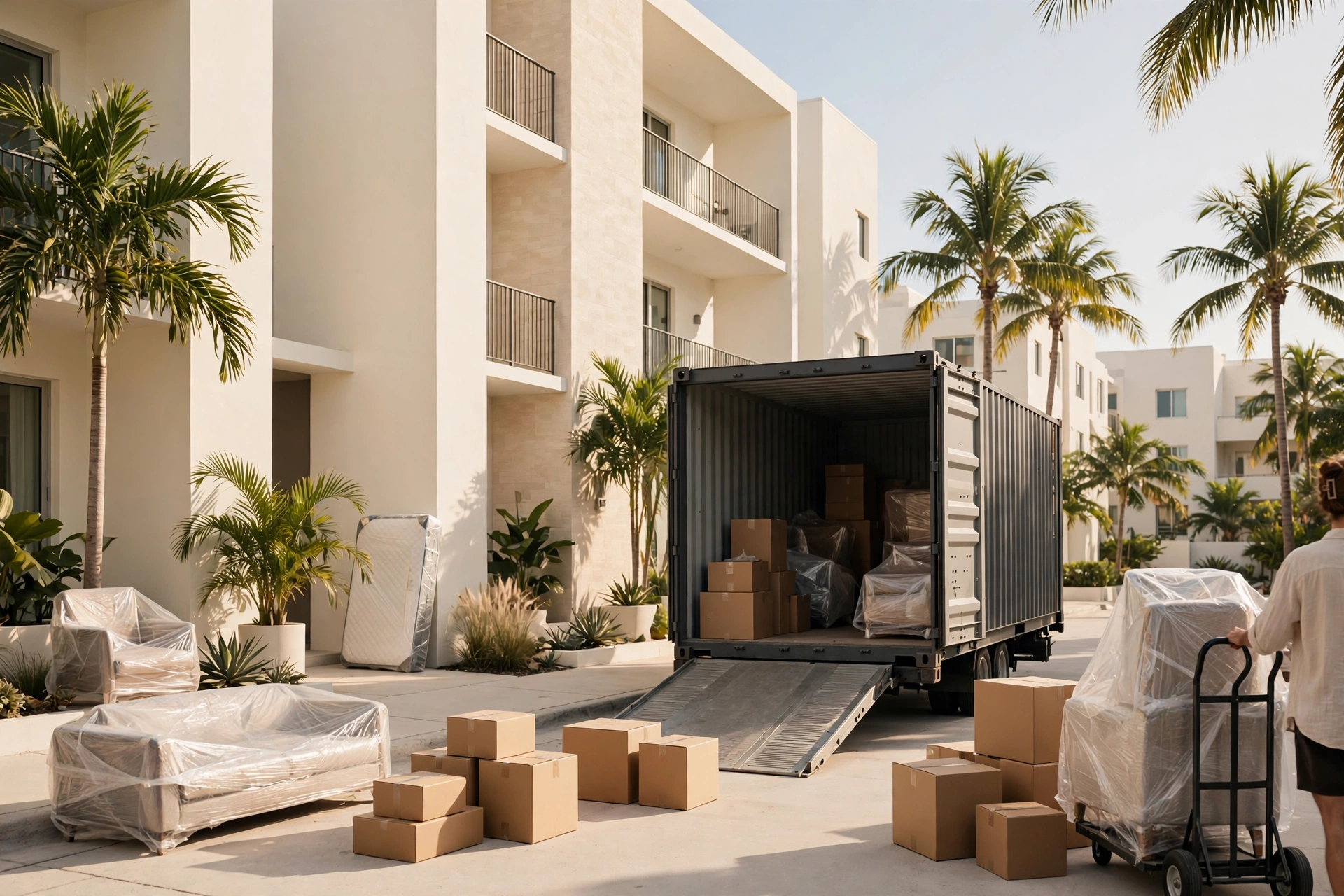
Short answer: moving to Miami from another country costs far more than the shipping quote: a light move (sell the furniture, ship boxes only) runs about US$2,500–3,500 in freight alone, a 1–2 bedroom door-to-door move US$3,000–7,000, and a 3–4 bedroom household US$8,000–13,000 — before flights, insurance and the Miami landing stack. Add the first month of rent (Miami average US$2,761 in August 2026), your deposit, and 4–8 weeks of temporary housing while the container crosses, and a realistic all-in budget is US$9,000–14,000 for a couple moving light and US$18,000–28,000 for a family shipping a full home. The good news: used household goods you have lived with for at least a year enter the US duty-free under CBP rules — if your paperwork proves it.
Updated: October 12, 2026.
¿Prefieres leer en español? Lee esta guía en español
Moving to Miami: what the shipping quote actually covers (and what it doesn’t)
Every international quote is built from the same pieces, but movers choose which pieces to show you. Ocean freight is only one line: a 20-foot container’s freight component on a major route benchmarks at roughly US$2,050–4,550 in 2026, plus terminal handling (US$100–300), documentation (US$50–100) and customs clearance (US$150–350). Professional export packing, the truck at origin, destination delivery and unpacking are separate services — that is why the door-to-door total for the same home is two to three times the “freight” number in a cheap quote.
| Move profile | Door-to-door shipping (US$) | Transit |
|---|---|---|
| Light move — boxes and personal items only, shared container (LCL), 150–250 cu ft minimum | US$2,500–3,500 | 4–8 weeks by sea |
| 1–2 bedroom apartment — furniture included, LCL or small container | US$3,000–7,000 | 4–8 weeks by sea |
| 3–4 bedroom house — full 20–40 ft container | US$8,000–13,000 | 4–8 weeks by sea |
| Air freight for essentials — a few urgent boxes while the container sails | Priced by weight; several times the sea rate per unit | 1–3 weeks |
Two pricing traps hide in that table. First, LCL costs 2–3 times more per cubic foot than an exclusive container — sharing is cheaper in total, never per unit, so past roughly half a 20-foot container a full container wins. Second, the base cover included in most quotes (“released value”) pays only US$0.60 per pound per article if your sofa is destroyed. Real full-value protection costs 1–5% of the insured value — budget it, or you are self-insuring an ocean crossing.
The customs side: duty-free is real, but it is not automatic
US Customs and Border Protection (CBP) lets you import household effects — furniture, carpets, paintings, tableware, linens, books and similar furnishings — free of duty when two conditions hold: you used them abroad for no less than one year, and they are not intended for anyone else or for sale. For goods arriving separately from you, your mover files CBP Form 3299 (Declaration for Free Entry of Unaccompanied Articles), and your complete inventory doubles as the packing list CBP can demand at any point. The port director must be satisfied about that year of use and can ask for evidence beyond your declaration — dated photos, old invoices and a lease abroad are what actually prove it.
Three boundaries surprise newcomers. Vehicles are always dutiable — a car is never a “household effect.” Clothing, electronics and cameras are personal effects, a different category where duty is usually waived only if the items are more than a year old. And the duty-free window closes: import more than 10 years after your last arrival from the country where the goods were used and you need to explain unavoidable circumstances; after 25 years, duty-free entry is gone entirely.
Cost of living in Miami: the landing stack the mover never quotes
Your container lands in a city where the cost of living in Miami starts billing you on day one. RentCafe put Miami’s average rent at US$2,761/month in August 2026 (1-bedroom US$2,444; 2-bedroom US$2,977), and signing means first month plus a deposit plus application and association fees — exactly how that deposit stack works, and how Florida law says it must be returned, is in our guide to security deposits in Miami and how they really work.
Then comes the gap nobody budgets: sea freight takes 4–8 weeks, plus packing days before and customs and delivery days after. You will either pay for a furnished short-term rental for 30–60 days, start your lease early and sleep on an air mattress, or time your lease to the container — the third option is free but requires knowing the real arrival window, not the sales estimate. This is also why some newcomers test the city first with a seasonal stay before shipping anything; our Canadian snowbird guide to a winter in Miami shows the furnished-season math that light movers borrow. For the full first-year picture, our Miami relocation guides hub connects this budget to rents, deposits and neighborhoods.
Ship, sell or store: the SETTLE decision rule
Run every large item through one test: what does it cost to replace in Miami versus what does its volume cost to ship? At LCL rates you are paying premium per-cubic-foot prices, so flat-pack furniture, worn mattresses and 220-volt appliances (the US runs on 120V) almost always fail the test — sell them at origin and buy in Miami. Heirlooms, quality solid-wood furniture, art and a good piano pass it. Storage at origin “for later” is the worst of both worlds: you pay monthly rent on goods whose duty-free clock and condition both decay. Decide before the surveyor arrives, because the quote is priced on the inventory you show that day.
What most people don’t know
1. Duty-free does not mean fee-free. Even a perfectly duty-free shipment pays terminal handling, documentation, customs clearance and delivery — and if CBP selects your container for an exam, the inspection, storage and demurrage costs fall on the importer, not the government.
2. You can verify your mover’s license in two minutes. Companies selling ocean transport to or from the US must be licensed or registered with the Federal Maritime Commission as Ocean Transportation Intermediaries — check yours at fmc.gov before paying any deposit. The classic household-goods scam (a too-cheap quote, then your goods held for “extra fees”) runs through unlicensed operators.
3. Packing your own container can cost you more. Shipments marked “packed by owner” are flagged for intensive customs inspection far more often, adding delays and labor fees — and most insurers reduce or deny cover for owner-packed goods. Professional export packing is the line item people cut that protects every other line item.
4. The cheapest move is a smaller move. Volume is the price: cutting 100 cubic feet before the survey routinely saves more than negotiating 10% off the rate. The families who overspend are not the ones who chose the wrong mover — they are the ones who shipped a house they were about to refurnish anyway.
Frequently asked questions
Do I pay customs duty on my used furniture when moving to Miami?
Generally no. Household effects used abroad for at least one year and not intended for sale enter duty-free with CBP Form 3299 for unaccompanied goods. Vehicles are always dutiable, and newer personal effects can be assessed.
How long does an international move to Miami take, door to door?
Plan on 6–10 weeks total: packing and origin handling, 4–8 weeks of ocean transit, then customs clearance and final delivery in Miami. Air freight for a small essentials shipment takes 1–3 weeks at several times the sea cost.
Is it cheaper to sell everything and buy furniture in Miami?
For a 1–2 bedroom renter, usually yes: shipping runs US$3,000–7,000 against refurnishing basics in Miami, and you avoid the 30–60 day furnished bridge. For a full family home with quality furniture, shipping a container (US$8,000–13,000) typically beats replacing everything.
What is a realistic total budget for an international move to Miami in 2026?
Shipping plus insurance, flights, the first month and deposit on a lease, and temporary housing during the gap: roughly US$9,000–14,000 moving light as a couple, and US$18,000–28,000 for a family bringing a full household. Your origin city and volume move you within — or beyond — those bands.
This article is general information about relocation planning, not customs, tax or legal advice. Duty rules and freight rates change — confirm current requirements with CBP and a licensed mover before booking.
Yara Coker — SETTLE, relocation services in Miami.
Want help with your move to Miami?
Tell us your origin city, your volume and your target date — we will build the ship/sell/store list and the week-by-week budget, so the container, the lease and your arrival line up instead of colliding.
Sources
CBP, “Customs Duty Information” and “What is the process to move my used household goods and personal effects into the United States?” (cbp.gov): household effects duty-free after 1 year of use abroad, not for sale; Form 3299 for unaccompanied articles, inventory as packing list; vehicles always dutiable; 10-year and 25-year duty-free windows. Federal Maritime Commission licensing of Ocean Transportation Intermediaries (46 CFR Part 515; verify at fmc.gov). Door-to-door ranges by home size and LCL minimums/per-cubic-foot premium: published 2025–2026 international mover guides and quotes (Kef International; Asiatic Relo 2026 pricing guide). Freight components (20 ft FCL, terminal handling, documentation, clearance): Basenton container freight benchmarks, China–USA 2026. Released-value limit (US$0.60/lb) and full-value protection at 1–5% of insured value: ConsumerAffairs moving-cost guide 2026. Miami rents: RentCafe average rent, Miami FL (August 2026: average US$2,761; 1-bed US$2,444; 2-bed US$2,977); Zillow ZORI Miami metro, August 2026 (US$2,666).
Versión en español: Vivir en Miami: el costo real de una mudanza internacional en 2026
