
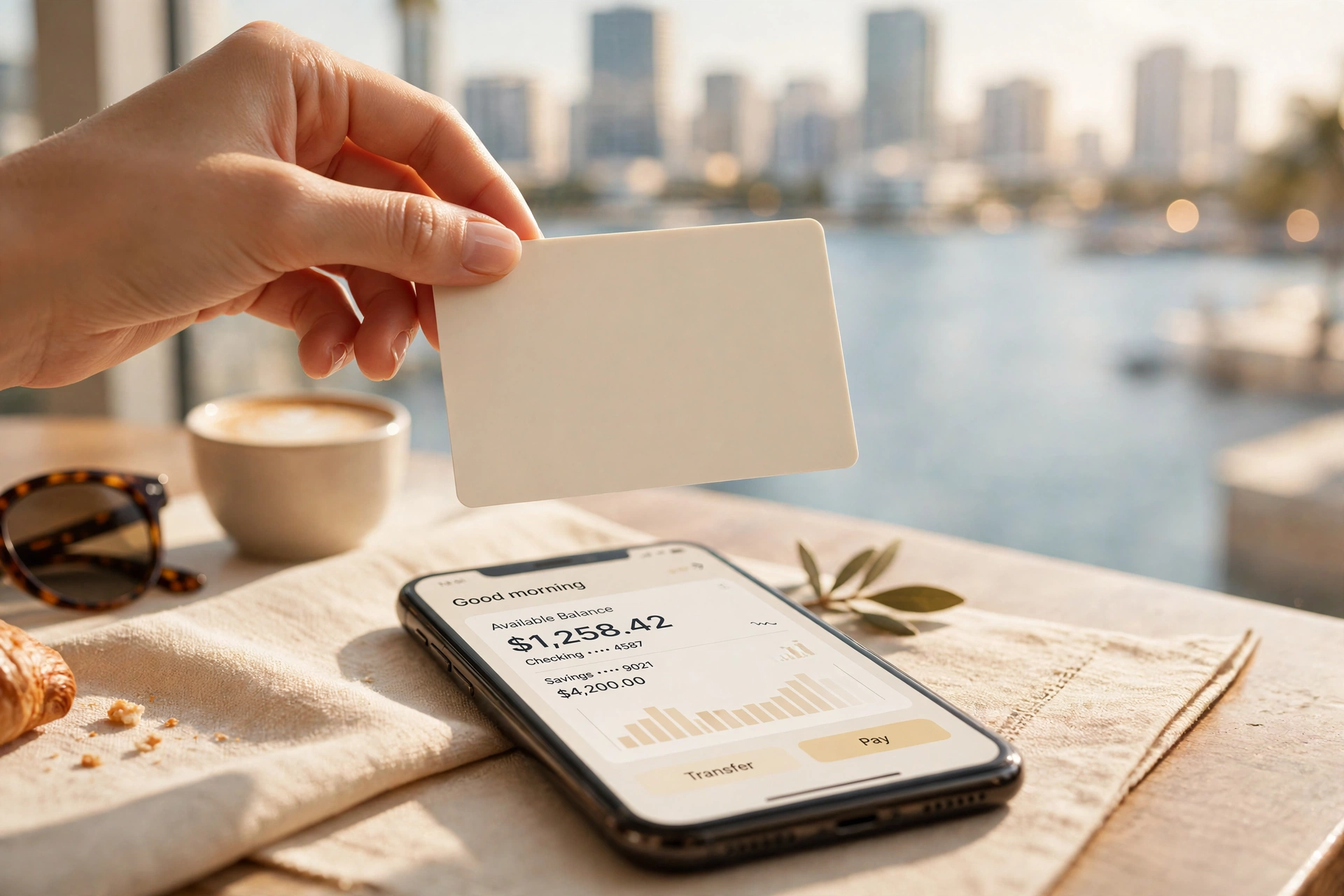
Short answer: moving to Miami without an SSN is no barrier to opening a US bank account: no federal law requires a Social Security number to open checking or savings — each bank’s own policy decides, and Bank of America, Wells Fargo, TD Bank and Citibank all open accounts with a passport plus an ITIN or other accepted ID when you walk into a branch. Plan on US$100 to open at Bank of America (Advantage Plus) or US$25 at Wells Fargo (Everyday Checking), a second ID, and proof of your Miami address — a signed lease works. Expect monthly fees of US$12 at Bank of America, US$15 at Wells Fargo, or US$25 at TD Bank’s Beyond Checking, all waivable with direct deposit or a minimum balance. Apply in person: almost every bank’s online application still hard-requires an SSN.
Updated: October 11, 2026.
¿Prefieres leer en español? Lee esta guía en español
Why moving to Miami without an SSN is a paperwork problem, not a legal barrier
The confusion comes from a real federal law read too broadly. The USA PATRIOT Act’s Customer Identification Program rule does require banks to verify your identity before opening an account — name, date of birth, address, and an identification number. But for a non-US person, that identification number can be a taxpayer number that is not an SSN, and regulators confirmed again in June 2025 that banks have flexibility in how they verify identity. What actually decides your case is each bank’s written policy — and the major banks with Miami branches have policies that work in your favor.
The ITIN: your tax number, not your ID
If you are not eligible for an SSN, the IRS issues an ITIN (Individual Taxpayer Identification Number) — a 9-digit tax processing number used to file US tax returns and reported on some bank forms. Three things to know:
How you get it: file IRS Form W-7 with your federal tax return (or exception documentation) and proof of identity — a valid passport alone proves both identity and foreign status. Three channels: by mail to Austin, Texas; through a Certifying Acceptance Agent who verifies your passport in person; or at some IRS Taxpayer Assistance Centers by appointment.
How long it takes: the IRS says allow 7 weeks, or 9–11 weeks during tax season (January 15–April 30) or from abroad. The IRS mails a CP565 letter with your number — there is no plastic ITIN card, ever. The application itself is free; agents charge their own fees.
What it is not: the ITIN is not government ID, does not prove immigration status, and does not authorize employment. Bring the CP565 letter as your tax-number proof, but it will never count as one of your two IDs.
What banks in Miami actually accept: verified accounts and fees
These are the current published terms (October 2026) for the three accounts most useful to newcomers:
| Bank / account | To open | Monthly fee | How to waive the fee |
|---|---|---|---|
| Bank of America Advantage Plus | US$100 | US$12 | Qualifying direct deposit of US$250+ per statement cycle, or US$1,500 minimum daily balance, or BofA Rewards tier |
| Wells Fargo Everyday Checking | US$25 | US$15 | US$500+ in qualifying electronic deposits, or US$1,500 minimum daily balance, or US$5,000+ in qualifying balances, or primary owner aged 17–24 |
| TD Bank Beyond Checking | US$0 | US$25 | US$5,000+ direct deposits per statement cycle, or US$2,500 minimum daily balance, or US$25,000 combined daily balance |
Bank of America also offers Advantage SafeBalance (US$4.95/month, a checkless account) for the lightest use. Citibank’s own site lists “Social Security number or individual taxpayer identification number (ITIN)” as accepted. Online is the trap: Wells Fargo’s online application explicitly asks for your SSN — with no ITIN option — while its in-branch form lists driver’s license, state ID, or Consular ID as valid identification. Schedule an in-branch appointment and bring your documents.
What to bring to the branch
Banks ask for two IDs plus proof of address. The combination that works at virtually every Miami branch:
- Primary ID: valid passport (unexpired).
- Second ID: ITIN letter (CP565), national ID card, consular ID — the Mexican matrícula consular and Colombian consular IDs are accepted by several banks as secondary ID — visa, or foreign driver’s license. Some branches accept two foreign documents; call ahead and ask for a banker who opens ITIN accounts.
- Proof of Miami address: your signed lease or a utility bill in your name. This is where your rental paperwork does double duty — here is how security deposits in Miami actually work when you sign that lease (Florida sets no statutory cap).
- Initial deposit: US$25–US$100 in cash or check, depending on the account.
What most people don’t know
1. ChexSystems is the report that actually matters. When you apply, most banks check ChexSystems — a consumer reporting agency that tracks your checking and savings history (overdrafts, unpaid fees, closed accounts), not your credit score. No credit history does not block you; a bad banking history in another country sometimes does. You can request your free report once a year.
2. FDIC insurance does not care about your citizenship. The FDIC’s own brochure is explicit: a person does not have to be a US citizen or resident to be insured. Your deposits are covered up to US$250,000 per depositor, per insured bank, per ownership category — exactly like everyone else’s, SSN or not.
3. Zelle unlocks once the account exists. With a checking account open, you can enroll in Zelle through your bank’s app using a US mobile number — and Zelle becomes your rent-splitting, bill-paying workhorse, with money moving in minutes. It cannot be reversed, so only send to people you trust.
4. Secured cards are the bridge to credit. Several major issuers — including Capital One, Chase, Citi and Bank of America — accept an ITIN instead of an SSN on card applications, with secured cards as the usual starting point for newcomers. Pay in full each month and the bureaus build your history under your ITIN.
Cost of living in Miami: budget the real banking numbers
Banking costs are small next to rent, but they land in your first month: the opening deposit (US$25–US$100) plus one monthly fee while you set up direct deposit — that is US$12–US$25 before your first waiver kicks in. The cheapest path for most newcomers: Bank of America’s US$12 Advantage Plus with a US$250 payroll direct deposit set up in the first pay cycle, which zeroes the fee permanently. If you travel back and forth seasonally, the winter cost picture matters more than the bank fees — set up the account once and the direct deposit follows you. Our Miami relocation guides hub collects every first-month playbook.
Frequently asked questions
Can I open a US bank account with only my passport?
No federal law forbids it, and a few community banks do it — but the big Miami banks’ policies expect two forms of ID plus a tax number (ITIN) or foreign equivalent. Passport alone is the exception, not the rule.
How long does it take to get an ITIN?
Plan on about 7 weeks, or 9–11 weeks if you apply during tax season (January 15–April 30) or from outside the US. If you need an account faster, open it with the documents the bank accepts now and add the ITIN when it arrives.
Can I open the account online from abroad before I move?
Effectively no, for the big banks: online applications require an SSN and electronic identity verification. Open it in person during your first week in Miami — it takes one branch visit.
Can I receive international wire transfers to my new account?
Yes. Give the sender your bank’s SWIFT code plus your account and routing numbers — most banks post incoming international wires in 1–5 business days. Confirm any incoming-wire fee with your branch when you open the account.
This article is general information about relocation planning, not financial or legal advice. Bank policies change — confirm fees and document requirements with the branch before your appointment.
Yara Coker — SETTLE, relocation services in Miami.
Want help with your move to Miami?
Tell us where you are moving from and when — we will map the first-week checklist, from the lease that becomes your address proof to the bank branch that opens ITIN accounts.
Sources
ITIN application and processing times: IRS, “How to apply for an ITIN” (irs.gov). CP565/CP566/CP567 notices: IRS ITIN notices. CIP rule: USA PATRIOT Act §326; FDIC/OCC/NCUA joint exemption order (June 27, 2025). Bank of America Advantage Plus fees: BofA Personal Schedule of Fees (08/2026). Wells Fargo Everyday Checking fees: wellsfargo.com account fees summary; online-application SSN requirement: wellsfargo.com. TD Beyond Checking fees: td.com checking pages. Citibank ITIN acceptance: online.citi.com / citi.com. ITIN acceptance in-branch (Chase and others): Bankrate, “How Non-US Citizens Can Open A Bank Account” (2026). ChexSystems: Capital One consumer guide. FDIC coverage: FDIC “Your Insured Deposits” brochure ($250,000 per depositor, per insured bank, per ownership category; no citizenship requirement). Zelle enrollment: zelle.com. Credit cards with ITIN: Bankrate issuer table (2026).
Versión en español: Vivir en Miami sin SSN: cómo abrir una cuenta bancaria en EE.UU. en 2026
