
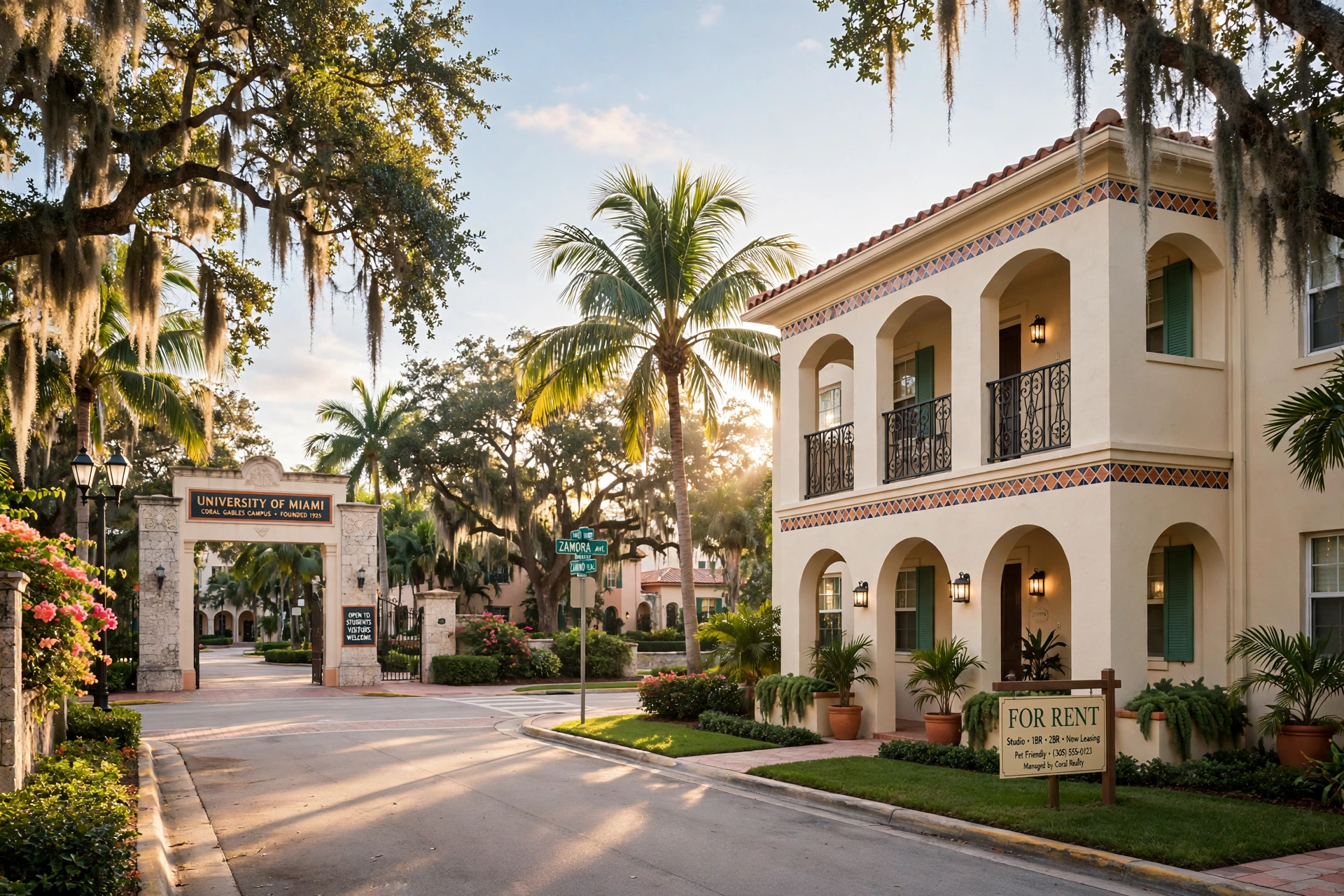
Short answer: If you’re moving to Miami as an international student to study at UM, expect landlords near campus to ask for five things: a passport, proof you can pay (3 months of bank statements, since you have no US pay stubs), a qualifying guarantor — or a guarantor service — a non-refundable application fee of about $50, and — the part that surprises families — three months’ rent in cash at move-in (first + last + security deposit), because UM’s own housing guidance says Coral Gables landlords commonly ask for two months’ rent plus a deposit. On a $2,162/month one-bedroom (Zumper’s October 2026 Coral Gables average), that’s $6,486 before you get the keys. And as of October 1, 2026, Florida’s HB 1293 made getting a lease with fake documents or a borrowed identity a third-degree felony. The literal question behind this guide — “renting near UM as an international student: what landlords actually ask for” — has one more rule: start your search on offcampus.miami.edu, UM’s official listing portal, not WhatsApp or Facebook groups, because rental scams specifically target arriving international students.
Updated: October 10, 2026.
¿Prefieres leer en español? Lee esta guía en español
Moving to Miami with no SSN or US credit: the 5-item landlord checklist
Miami rental applications are built for American renters: SSN, credit score, pay stubs proving income of 3× the rent. You have none of that — and landlords near UM already know it, because they sign international students every semester. Here is the real checklist:
| # | What the application asks for | What an international student shows instead |
|---|---|---|
| 1 | Government photo ID | Your passport (a foreign driver’s license works too) |
| 2 | Social Security number | Leave it blank — write “N/A, international student.” UM’s student paper quoted an Ecuadorian student: “Neither myself nor my family have a social security number or even a credit score, both asked for when filling out a housing application.” (The Miami Hurricane) |
| 3 | Income ≥ 3× monthly rent (pay stubs, W-2) | 3 months of bank statements (yours or your family’s) proving you can cover the lease, plus your I-20 and enrollment letter proving you’re a real student |
| 4 | US-based guarantor | A parent who qualifies (roughly 700+ credit and income of 4–5× the annual rent) or a guarantor service: TheGuarantors (40% to just over one month’s rent), Insurent (70–90% of one month’s rent with US credit; 98–110% for non-US applicants who show cash assets of 50× the monthly rent, held anywhere in the world), or Leap (4.5–8% of the annual rent). Read our full guide on guarantors, leases, and the scams targeting international students. Warning: acceptance is not universal — confirm in writing that your building accepts the specific service before you pay the non-refundable premium. |
| 5 | Application fee + background check | About $50, non-refundable, per application. Don’t spray 10 applications — that’s $500 gone with nothing to show. |
Most leases near UM run 12 months (per UM’s housing guidance), and you’ll often see standard Florida Association of Realtors lease templates. There is no official Florida Realtors guide written for international tenants — so read every line before you sign, or have someone read it for you.
The cost of living in Miami as a UM international student: the move-in math
Real October 2026 numbers around the Coral Gables campus:
| Housing option | Monthly cost (Oct 2026) | Source |
|---|---|---|
| Coral Gables 1BR, citywide average | $2,162 | Zumper, Oct 2026 |
| Coral Gables 2BR, citywide average | $3,639 | Zumper, Oct 2026 |
| South Miami 1BR (cheaper, ~10 min) | $2,240 | apartments.com, Jun 2026 |
| Shared bedroom, 0.2 mi from campus, all-in | $1,350–$1,400/bedroom | offcampus.miami.edu listings, Oct 2026 |
| Shared bedroom, Coconut Grove | ~$1,600/bedroom | offcampus.miami.edu listings, Oct 2026 |
| Room in shared house, 3.4 mi out | $850 | offcampus.miami.edu listing, Oct 2026 |
The move-in math on that $2,162 one-bedroom: first month ($2,162) + last month ($2,162) + security deposit ($2,162) = $6,486, plus the $50 application fee. If you need a guarantor service as a non-US applicant, add roughly 98–110% of one month’s rent (Insurent’s non-US band): another $2,119–$2,378, non-refundable. Realistic cash to get the keys: $8,500–$9,000. On an F-1 visa you may work only 20 hours a week on campus while school is in session (per USCIS), and off-campus work is off-limits until you complete one full academic year — so this money has to exist before you land. On deposits, Florida’s rule (§83.49): the landlord must return your deposit within 15 days of move-out, or notify you by certified mail within 30 days if keeping any of it — and you get 15 days to object. Read the full security-deposit guide before you hand over a $2,162 deposit.
What most people don’t know
Faking one document is now a felony in Florida. Since October 1, 2026, HB 1293 (Chapter 2026-143) created the crime of “fraudulent entry of a residential dwelling unit”: getting a lease with a false identity, forged bank statements or pay stubs, or someone else’s documents is a third-degree felony (up to 5 years in prison, up to a $5,000 fine) — and the landlord can terminate the lease on 7 days’ notice with no chance to fix it. Florida is the first state to make rental application fraud its own crime. The law sets no immigration-status requirement for renting, and a legitimate foreign document is not a forged one — but the pressure some students feel to “borrow” a cousin’s SSN or inflate a bank statement now carries criminal risk. Legal alternatives exist: Insurent qualifies non-US applicants on cash assets of 50× the monthly rent, held anywhere in the world.
Guarantor services are insurance, not deposits — the fee never comes back. That 98–110% of a month’s rent is a one-time, non-refundable premium. And buildings don’t have to accept every service: always confirm in writing that your building takes the specific guarantor company before you pay.
UM’s own housing guide warns about a program that doesn’t exist. Scammers tell arriving students about a “University of Miami Protection Program” that will “guarantee the transaction” — UM’s official off-campus guide says flatly: “This program does not exist! The University of Miami does not have any role in any transaction.” UM’s real red flags: a landlord who won’t meet face-to-face, payment demands via Western Union or cashier’s checks, and prices far below the market numbers in the table above. When in doubt, verify the listing on offcampus.miami.edu, which carries fraud warnings on every listing.
Florida sets no cap on security deposits. One month is standard, but two is common in Coral Gables condos and associations — which is how “first + last + deposit” becomes the real move-in formula. Budget for three months; hope for two.
Frequently asked questions
Can I rent near UM without a guarantor or US credit history? Sometimes — some landlords accept 2–3 months of prepaid rent or a larger deposit instead. But most buildings near campus expect a guarantor, and guarantor services are the standard workaround: budget 40% to 150% of one month’s rent for the one-time premium, and confirm the building accepts the service first.
Does UM help international students find housing? With listings, yes — with transactions, no. UM runs offcampus.miami.edu (its official listing portal, with fraud warnings on every listing), publishes an off-campus housing guide with scam red flags, and its Intensive English Program page links the FTC’s rental-scam resources. But UM “does not have any role in any transaction” — anyone claiming otherwise is running the scam UM warns about.
How much cash do I need before I fly to Miami? For a one-bedroom at Coral Gables’ October 2026 average of $2,162: $6,486 for first + last + deposit, $50 for the application, and $2,119–$2,378 if you need a guarantor service as a non-US applicant. Call it $8,500–$9,000 to be safe. A shared bedroom near campus cuts the move-in to roughly $4,000–$4,800.
What if I’m missing a document the landlord wants? Ask what alternatives they accept — then provide a real one. Never submit anything false: since October 1, 2026, Florida’s HB 1293 makes fraudulent rental applications a third-degree felony, and landlords can end the lease on 7 days’ notice without letting you fix it.
Yara Coker — SETTLE, relocation services in Miami.
Want help with your move to Miami?
Moving to Miami for school — as the student, or as the family behind one? SETTLE vets the neighborhood, reads the lease line by line, and handles the guarantor conversation with landlords near UM, so you land with a signed lease instead of a scam story. Tell us your school, your start date, and your budget:
Versión en español: Vivir en Miami como estudiante internacional: lo que realmente piden los arrendadores cerca de UM (y la ley que convirtió falsear un documento en delito)
For the full collection of student and newcomer playbooks, browse our Miami relocation guides hub.
### Sources
- UM Intensive English Program, housing information (two months’ rent + security deposit at move-in; 12-month leases): https://iep.dcie.miami.edu/new-students/arrival-housing-information/housing/index.html
- UM Off-Campus Housing Guide, scam warnings (“University of Miami Protection Program” does not exist): https://cdn.offcampusimages.com/public/resource/lmf82i_2gpdiabck1_lanz9qqs3gjxjjmcafuv7xtkc.pdf
- The Miami Hurricane, UM student paper (international student on SSN/credit requirements): https://themiamihurricane.com/2023/03/01/after-latest-housing-debacle-students-prepare-for-the-worst/
- Zumper, Coral Gables rent research, October 2026 (1BR $2,162; 2BR $3,639): https://www.zumper.com/rent-research/coral-gables-fl
- apartments.com, Coral Gables and South Miami rent market trends, June 2026: https://www.apartments.com/rent-market-trends/coral-gables-fl/ and https://www.apartments.com/rent-market-trends/south-miami-fl/
- Apartment List, lease guarantor FAQs, September 2026 (Insurent 70–90% US / 98–110% non-US; Leap 4.5–8% of annual rent): https://www.apartmentlist.com/renter-life/lease-guarantor-faqs
- TheGuarantors, renter pricing (40% to just over one month’s rent): https://www.theguarantors.com/blog/renters/theguarantors-reviews-what-to-know-before-applying
- CRE Daily, guarantor industry pricing band 75–150%, July 2026: https://credaily.com/briefs/renter-guarantors-driving-growth-in-lease-approval-industry/
- Florida Senate Judiciary Committee, CS/HB 1293 summary (fraudulent entry, third-degree felony, 7-day non-curable termination, effective Oct 1, 2026): https://www.flsenate.gov/Committees/DownloadBillSummary/8393
- Leech Tishman, HB 1293 analysis (§817.537; Chapter 2026-143; first state to criminalize rental application fraud): https://www.leechtishman.com/insights/blog/floridas-hb-1293-rental-application-fraud-is-now-a-felony/
- Florida Statutes, Chapter 83, security deposits (§83.49): https://www.flsenate.gov/Laws/Statutes/2024/Chapter83/All
- USCIS M-274 Handbook, F-1 student employment (20 hrs/week on campus in session): https://www.uscis.gov/i-9-central/form-i-9-resources/handbook-for-employers-m-274/70-evidence-of-employment-authorization-for-certain-categories/74-exchange-visitors-and-students/742-f-1-and-m-1-nonimmigrant-students
