
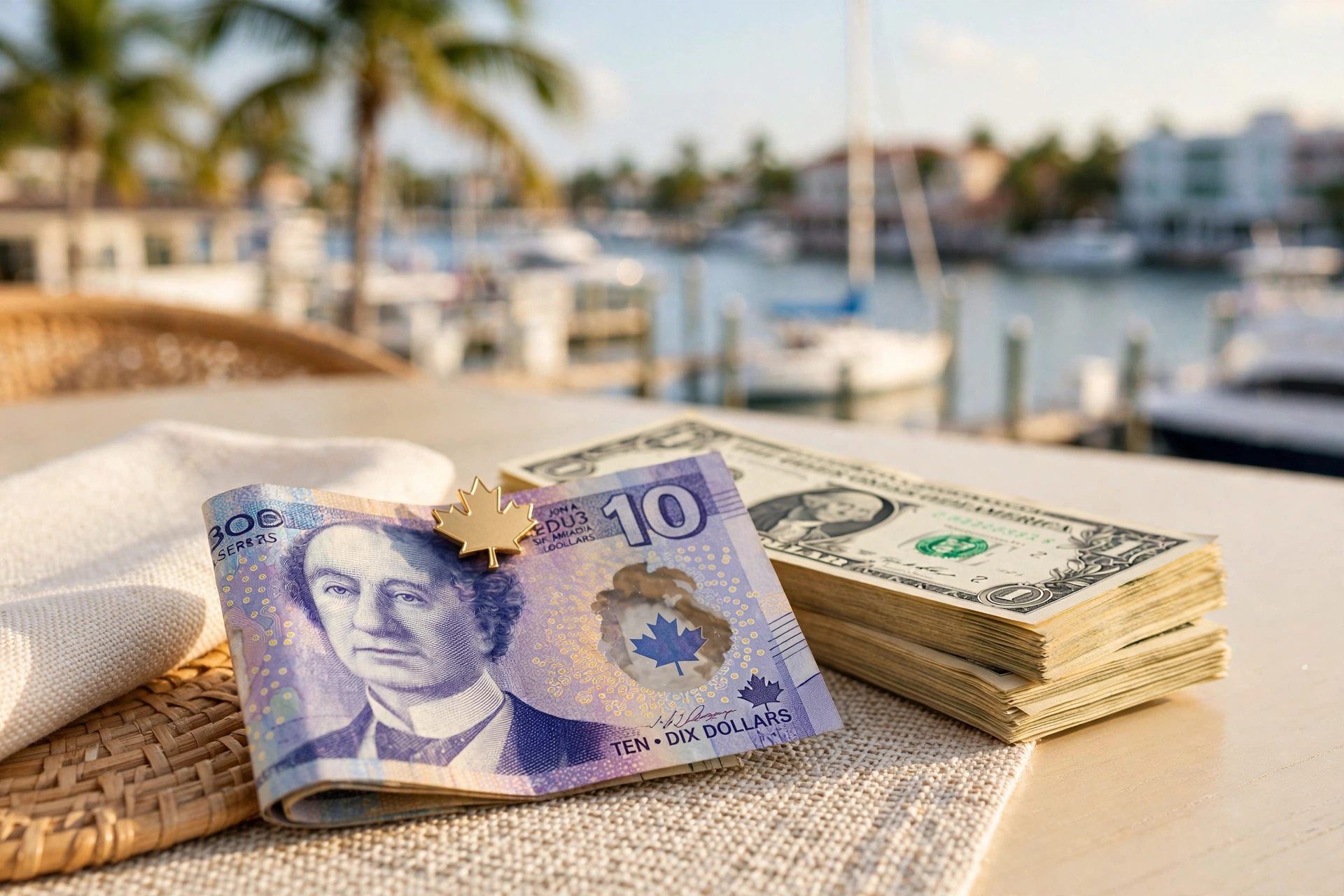
Short answer: Moving to Miami for the winter in 2026 means doing every calculation twice — once in US dollars, once in a weak loonie. On October 9, 2026, the Canadian dollar hit an 18-month low at 1.4275 per US dollar, so C$1 buys about 70 US cents. A 4-month winter season that costs $14,000 USD now costs you ~C$19,980 — about C$1,780 more than at a 1.30 rate. The literal question behind this guide — “CAD to USD in 2026: what the exchange rate means for a Canadian winter in Miami” — has a bottom line: the rate is an 11% tax on everything you spend in Florida this winter, and your budget has to be built in loonies, not dollars.
Updated: October 10, 2026.
¿Prefieres leer en español? Lee esta guía en español
Moving to Miami: what the 2026 exchange rate does to your winter budget
The number on your banking app isn’t the number you actually get. The mid-market rate (1.4275 on October 9, per Reuters) is the wholesale price — what banks pay each other. When you convert as a consumer, the bank or card network quietly adds its margin and calls it the “tourist rate” or a foreign-transaction fee. On a full snowbird season, that margin is real money.
| Your 4-month winter season (USD) | At 1.30 CAD/USD | At 1.4275 CAD/USD (Oct 2026) | The weak-loonie surcharge |
|---|---|---|---|
| $10,000 (budget season) | C$13,000 | C$14,275 | +C$1,275 |
| $12,000 (typical furnished 1BR) | C$15,600 | C$17,130 | +C$1,530 |
| $14,000 (comfortable season) | C$18,200 | C$19,985 | +C$1,785 |
| $18,000 (premium winter) | C$23,400 | C$25,695 | +C$2,295 |
Rent is where the surcharge bites hardest. A furnished 1-bedroom winter rental in Miami Beach runs about $2,700/month in peak season — that’s C$3,854/month at today’s rate, versus C$3,510 at 1.30. Four months of that gap is C$1,376 — more than a month of groceries.
Why is the loonie this weak? The Bank of Canada held its rate at 2.25% in September while the US Federal Reserve raised to 3.75%–4.00% — the first hike in three years. Higher US yields pull capital south, and unresolved trade friction keeps weighing on Canada’s outlook. Nothing in that picture points to a fast loonie recovery this winter.
Cost of living Miami: the five money moves that protect your loonies
The cost of living in Miami is already high for winter visitors; the exchange rate stacks on top. Here’s how experienced snowbirds shave it back down:
- Open a US-dollar account before you leave Canada. Most major Canadian banks offer one. Convert in Canada, at your bank’s online rate (or a specialist transfer service), and pay Florida rent and bills from the USD account — never let a US landlord’s payment processor convert for you.
- Convert in tranches, not all at once. You can’t time the bottom, but you can refuse to buy everything on the worst day. Convert your rent money early when the loonie rallies, keep spending money flexible.
- Use a no-foreign-transaction-fee credit card. Standard Canadian cards add ~2.5% on every US swipe. On a C$20,000 season, that’s C$500 for nothing. A no-FX-fee card is the single easiest saving in this guide.
- Never convert at airport kiosks or hotel desks. Their spreads are the worst in the business — routinely 5–8% off the mid-market rate. A 3-minute app transfer beats a 30-second counter line every time.
- Book housing early, when the dollar math works in your favor. A winter rental secured early is routinely 15–20% cheaper than the same unit booked in December. That housing discount is bigger than any realistic FX swing — see our 3-month furnished snowbird playbook for the timing.
What most people don’t know
The 70-cent loonie is changing who comes to Florida. About 3.17 million Canadians visited Florida in 2025 — roughly 15% fewer than in 2024 (Visit Florida), and a December 2025 Snowbird Advisor survey found only 70% of established snowbirds still planned their US winter, down from 82% the year before. The weak dollar is one of the reasons. If you’re still coming, you’re competing for housing against a smaller but determined crowd — and booking early matters more than ever.
Fort Lauderdale is the loonie’s best friend. Furnished winter 1BRs there run ~$1,890/month versus ~$2,700 in Miami Beach — 20–30% less in USD, which compounds the FX saving: the same budget in Canadian dollars stretches a full extra month. Read the full comparison in our Canadian snowbird winter guide.
Your security deposit is a currency position too. Landlords hold deposits in USD, so a one-month deposit of $2,700 ties up C$3,854 until you get it back — and Florida law lets landlords return it within 15–60 days of move-out (see how security deposits in Miami actually work). Budget the deposit in loonies, not dollars.
A USD-denominated winter is a hedge, not just a cost. If you own Florida property, the same weak loonie that hurts your spending is quietly inflating your property’s value in Canadian-dollar terms. Season renters don’t get that — but seasonal buyers do. Worth a thought if you come every year.
Frequently asked questions
Should I wait for a better CAD/USD rate before booking my Miami rental? No — don’t time your housing on the exchange rate. Early-booking discounts on winter rentals (15–20%) dwarf any realistic FX move: dropping from $3,200 to $2,700/month saves you $2,000 USD over four months, while a generous rate swing from 1.42 to 1.38 on a $14,000 season saves about C$580. Lock the housing first; manage the currency second.
What’s the cheapest way to convert CAD to USD for a winter season? Open a USD account at your Canadian bank before leaving, move money with a specialist transfer service (a fraction of a bank counter’s markup), and run daily spending through a no-foreign-transaction-fee credit card. Pay US landlords in USD from your USD account.
Does the weak loonie change the IRS day-count rules? Not at all — days are days, and the snowbird tax trap doesn’t care about exchange rates. But currency and taxes are the two winter-season levers: get both right and the season costs thousands less.
Is Miami still worth it at 70 cents on the dollar? Honestly: it costs roughly 10% more in Canadian-dollar terms than at a 1.30 rate. For most snowbirds, the move still pencils out — because the alternative is a Canadian winter, and because early booking, Fort Lauderdale over Miami Beach, and smart currency handling together offset most of the FX hit. The ones who get burned are the ones who convert everything at the airport in January.
Exchange rates move daily — the figures above reflect conditions as of October 9–10, 2026. Build your budget with a cushion above today’s rate.
Yara Coker — SETTLE, relocation services in Miami.
Want help with your move to Miami?
Moving to Miami for the winter as a Canadian? SETTLE builds your winter budget in Canadian dollars — not just the rent, but deposits, utilities, insurance and the exchange costs most snowbirds miss — then coordinates the housing side: lease terms, furnished options, and move-in timeline. Tell us your dates and your budget:
Versión en español: Vivir en Miami este invierno: lo que tu dólar canadiense de 70 centavos realmente compra
